Constitutional morality is the discipline that keeps Indian democracy honest. It demands obedience to the spirit of the Constitution, not merely its text.

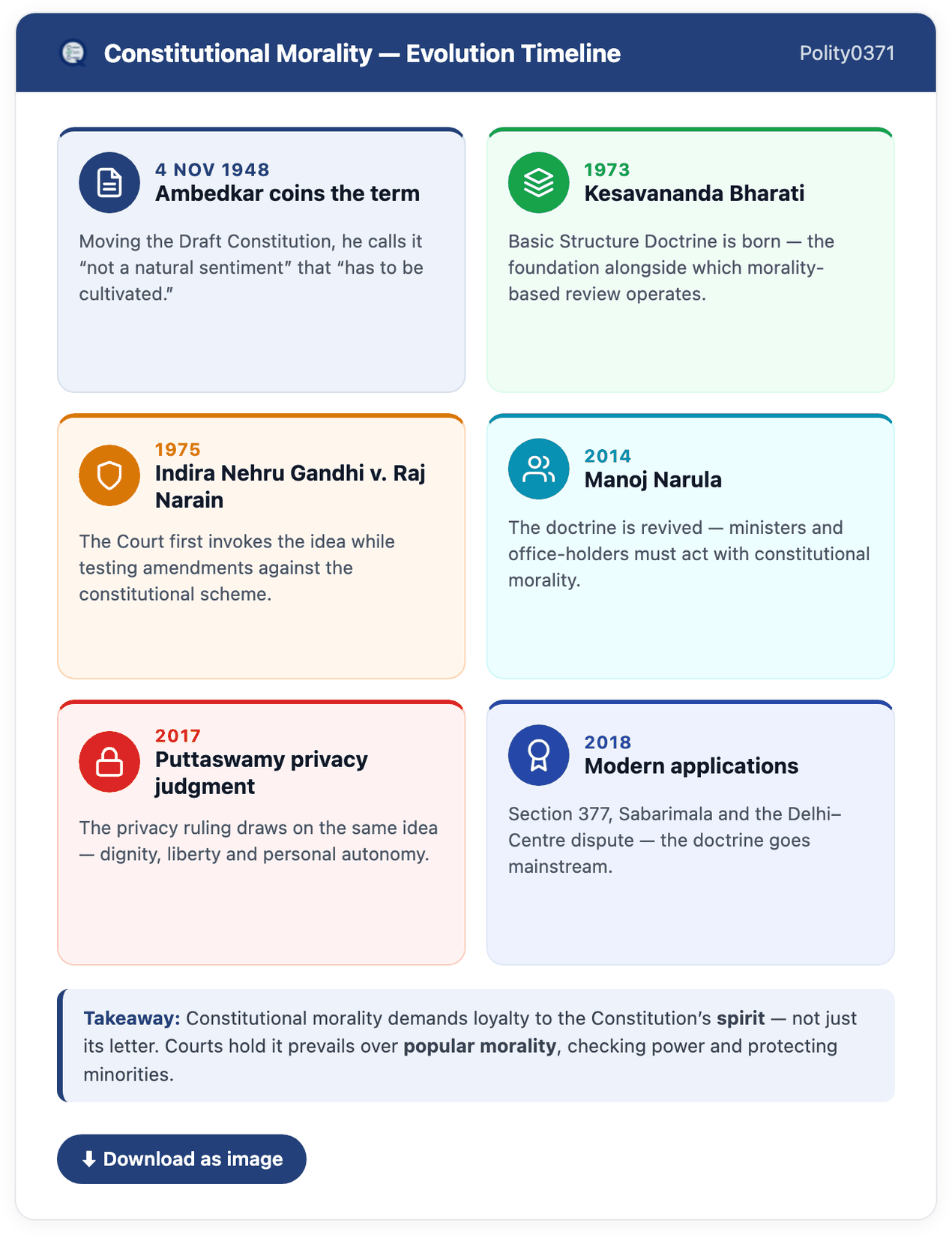
 Constitutional Morality — Evolution Timeline
4 NOV 1948
Ambedkar coins the term
Moving the Draft Constitution, he calls it “not a natural sentiment” that “has to be cultivated.”
1973
Kesavananda Bharati
Basic Structure Doctrine is born — the foundation alongside which morality-based review operates.
1975
Indira Nehru Gandhi v. Raj Narain
The Court first invokes the idea while testing amendments against the constitutional scheme.
2014
Manoj Narula
The doctrine is revived — ministers and office-holders must act with constitutional morality.
2017
Puttaswamy privacy judgment
The privacy ruling draws on the same idea — dignity, liberty and personal autonomy.
2018
Modern applications
Section 377, Sabarimala and the Delhi–Centre dispute — the doctrine goes mainstream.
Takeaway: Constitutional morality demands loyalty to the Constitution’s spirit — not just its letter. Courts hold it prevails over popular morality, checking power and protecting minorities.
📑 Contents
- 1What Constitutional Morality Is
- 2The Ambedkar Origin
- 3Letter vs Spirit
- 4Why It Matters in a Democracy
- 5The Doctrine in Supreme Court Judgments
- 6Constitutional Morality vs Popular Morality
- 7Reasoned Deliberation
- 8Institutional Restraint
- 9The Term’s Ambiguity
- 10Tension with Majoritarian Morality
- 11Role in Judicial Review
- 12Recent Usage
- 13UPSC PYQ Status
Must Know
Constitutional Morality and Its Origin
What Constitutional Morality Is
- Meaning Constitutional morality means loyalty to the core values of the Constitution.
- Bindings It binds institutions and citizens to the document’s foundational principles.
- How It goes beyond obeying the text to embracing its underlying values of liberty, equality, fraternity and justice.
- Why This keeps the Constitution a living framework rather than a mere rulebook.
The Ambedkar Origin
- Origin Dr B.R. Ambedkar coined the term in the Constituent Assembly.
- Date He spoke of it on 4 November 1948 while moving the Draft Constitution.
- Context He urged Indians to abandon a grammar of anarchy and follow constitutional methods.
- So The term has a founding-moment authority, rooted in how the Constitution was meant to be followed.
Letter vs Spirit
- Letter vs Spirit Obeying the letter alone is not enough.
- Demand Constitutional morality demands fidelity to the Constitution’s spirit.
- Values Liberty, equality and dignity are the spirit the letter is meant to serve.
- Why A literal but spiritless reading can let an institution defeat the Constitution’s own purpose.
Why It Matters in a Democracy
- Democracy Democracy needs more than elections and majority rule.
- Need It needs reasoned conduct from institutions and citizens.
- How Constitutional morality keeps majorities within limits and protects minorities.
- So Without it, a democracy can slide into mob rule or the tyranny of the majority.
Good to Know
The Doctrine in Practice
The Doctrine in Supreme Court Judgments
- Case Law The Supreme Court invoked the idea in Indira Nehru Gandhi v. Raj Narain (1975).
- Later Cases such as Manoj Narula (2014) built on the idea.
- Use The Court uses it to test state action against constitutional values.
- So It has moved from a rhetorical phrase to a tool in constitutional adjudication.
Constitutional Morality vs Popular Morality
- Framing Popular morality reflects the moral views of the majority.
- Constitutional Constitutional morality reflects the Constitution’s fixed values.
- Conflict Courts uphold the latter even when the majority disagrees.
- Why This protects rights from being voted away by momentary public opinion.
Reasoned Deliberation
- Deliberation The doctrine demands reasoned, deliberate decision-making.
- Requirement Institutions must justify their choices with care and give reasons.
- How Unreasoned or hasty decisions offend the standard.
- So Reasons matter as much as outcomes in constitutional governance.
Institutional Restraint
- Restraint Every organ must respect its constitutional limits.
- Self-limit The legislature, executive and judiciary each need self-restraint.
- How Each must avoid overstepping into another’s domain.
- So This balance keeps the separation of powers intact.
Test Yourself
Great to Know
Critique and Context
The Term’s Ambiguity
- Critique The Constitution never defines constitutional morality.
- Vague Critics call the term vague and open-ended.
- Risk Judges may fill it with their own personal values.
- Concern Its unsettled meaning raises doubts about judicial neutrality.
- Why An undefined term gives judges wide discretion, which both enables review and invites criticism.
Tension with Majoritarian Morality
- Tension The doctrine can override the will of majorities.
- Use Courts use it to strike down popular laws.
- Debate This fuels a real debate about judicial power over elected legislatures.
- So It pits individual rights against democratic majoritarianism.
- Why Balancing an entrenched constitution against an elected majority is a core constitutional dilemma.
Role in Judicial Review
- Judicial Review Constitutional morality strengthens judicial review of legislation.
- How Courts test laws against the Constitution’s values.
- So It acts as a yardstick beyond mere legality.
- Why This lets courts strike down laws that are formally valid but values-inconsistent.
- In practice The Court applies it to test whether a law serves the Constitution’s deeper values, not just its text.
Recent Usage
- Recent Cases The Court invoked it in the Section 377 judgment (2018).
- Sabarimala It also featured in the Sabarimala judgment (2018).
- Privacy The privacy judgment built on dignity and liberty.
- So The idea now anchors major rights jurisprudence.
- Why Using the idea in major rights judgments makes it a recurring anchor for expanding liberty and dignity.
Previous Year Questions
Exam Point of View
UPSC PYQ Status
- PYQ No direct UPSC PYQ yet; tested conceptually via GS-II.
- Expect Expect questions linking the idea to judicial review and fundamental rights.
- Approach Frame answers around Ambedkar’s origin, the doctrine’s cases, and the majority-vs-constitution tension.
Leave a Reply