Women remain a small minority in India’s higher judiciary, six decades after the first woman judge took the bench. The Supreme Court has never had a woman Chief Justice — 2027 may finally change that.

 Women in the Higher Judiciary
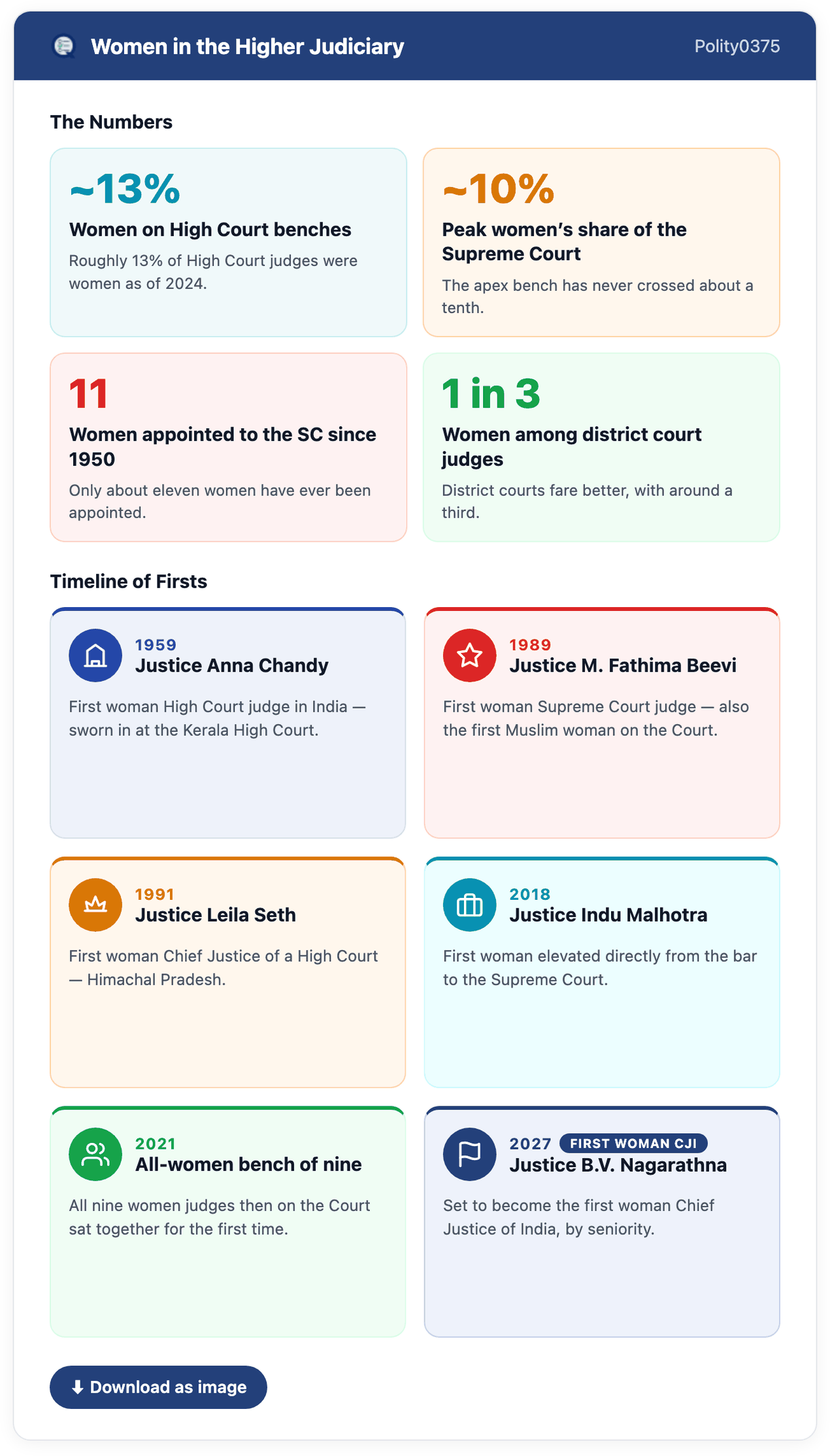
The Numbers
~13%
Women on High Court benches
Roughly 13% of High Court judges were women as of 2024.
~10%
Peak women’s share of the Supreme Court
The apex bench has never crossed about a tenth.
11
Women appointed to the SC since 1950
Only about eleven women have ever been appointed.
1 in 3
Women among district court judges
District courts fare better, with around a third.
Timeline of Firsts
1959
Justice Anna Chandy
First woman High Court judge in India — sworn in at the Kerala High Court.
1989
Justice M. Fathima Beevi
First woman Supreme Court judge — also the first Muslim woman on the Court.
1991
Justice Leila Seth
First woman Chief Justice of a High Court — Himachal Pradesh.
2018
Justice Indu Malhotra
First woman elevated directly from the bar to the Supreme Court.
2021
All-women bench of nine
All nine women judges then on the Court sat together for the first time.
2027
FIRST WOMAN CJI
Justice B.V. Nagarathna
Set to become the first woman Chief Justice of India, by seniority.
📑 Contents
- 1Few Women, Long History
- 2The Two Firsts
- 3Why Representation Matters
- 4The Collegium’s Role
- 51959 — Anna Chandy’s Kerala Milestone
- 61989 — Fathima Beevi Joins the Supreme Court
- 72021 — The Nine-Woman Bench
- 82027 — A Woman Chief Justice at Last?
- 9The Numbers, as of 2024
- 10The Demand for Reservation
- 11The Case For Quotas
- 12The Case Against
- 13Reform Ideas and Recent Steps
- 14So-What: Seniority makes history
- 15So-What: Appointments are accelerating
- 16So-What: Representation is still thin
- 17So-What: Institutions push for quotas
- 18UPSC PYQ — GS-II 2021, Q2
Must Know
Few Women, A Long History
Few Women, Long History
- Reality Women have never formed more than about a tenth of the Supreme Court’s bench since 1950.
- Appointments Only about eleven women have ever been appointed to the Supreme Court in over seven decades.
- High Courts The High Courts are only slightly better off, with women a small minority.
- Why The scarcity is systemic, not isolated, because the pipeline from district courts and the bar has long been tilted against women.
The Two Firsts
- Firsts Justice Anna Chandy became India’s first woman High Court judge in 1959, on the Kerala High Court.
- Apex Justice Fathima Beevi joined the Supreme Court in 1989 as its first woman judge.
- Significance Both opened doors that had stayed shut for decades.
- Result Their appointments proved that merit and the bench were not a male preserve.
Why Representation Matters
- Diversity A diverse bench enjoys greater public trust and legitimacy.
- Experience Women judges bring lived experience to gender-justice cases such as custody and workplace rights.
- Constitutional Diversity, equity and inclusiveness are constitutional goals, not concessions.
- So When the bench mirrors society, its rulings are more credible and its reasoning more complete.
The Collegium’s Role
- Collegium A collegium of senior judges controls appointments to the higher judiciary.
- Criticism The system has been criticised as closed and self-perpetuating.
- Outcome Critics say it has kept the bench overwhelmingly male because the same narrow pool recommends itself.
- NJAC A 2015 attempt to replace the collegium with the NJAC was struck down by the Supreme Court.
- Full form NJAC is the National Judicial Appointments Commission.
Good to Know
Milestones and the Numbers
1959 — Anna Chandy’s Kerala Milestone
- 1959 Justice Anna Chandy took oath as a Kerala High Court judge in 1959.
- First She was the first woman High Court judge in India.
- Commonwealth She was also among the first women judges in the British Commonwealth.
- Why Her appointment ended the assumption that judging was a role reserved for men.
1989 — Fathima Beevi Joins the Supreme Court
- 1989 Justice M. Fathima Beevi became the first woman Supreme Court judge in 1989.
- Tenure She retired in 1992 after a relatively brief tenure.
- First Muslim She was also the first Muslim woman to sit on the apex court.
- Significance Her presence showed the top court could and should include women.
2021 — The Nine-Woman Bench
- 2021 In March 2021, all nine women judges then on the Court sat together.
- Historic The all-women bench of nine was a first in Supreme Court history.
- Hearing It heard a matter concerning the rights of women.
- Why Even as a one-off, the bench was a visible symbol of how far representation could go.
2027 — A Woman Chief Justice at Last?
- 2027 Justice B.V. Nagarathna is the senior-most woman judge on the Court today.
- Convention By convention, the senior-most judge becomes Chief Justice.
- Prospect She is set to become the first woman Chief Justice of India, expected in 2027.
- So Because elevation follows seniority, her ascent would break the highest glass ceiling in the judiciary.
The Numbers, as of 2024
- Data Women made up roughly 13 per cent of High Court judges as of 2024.
- So These figures matter because the bench’s makeup shapes whether gender-justice cases are heard with adequate lived perspective.
- Supreme Court The Supreme Court has never crossed about a tenth of its bench.
- Districts District courts fare better, with women around a third of judges.
- Context In 2021, the then Chief Justice said 11 per cent was reached ‘with great difficulty.’
Test Yourself
Great to Know
The Quota Debate and Reform
The Demand for Reservation
- Quota Push In 2023, a former bar body president asked the Chief Justice for a 33 per cent quota for women.
- Debate Critics of the quota point out that elevation already follows seniority, so a reservation would alter who ranks where.
- Echo The demand echoed the Women’s Reservation Bill for legislatures.
- Logic Some now want the same quota logic applied to judges.
- Why Reservation is framed as the fastest lever to correct a gap that voluntary progress has left almost untouched.
The Case For Quotas
- For Quotas would correct decades of slow, voluntary progress.
- Outcome Supporters cite jurisdictions that used temporary reservations and later lifted them once the pipeline normalised.
- Jurisprudence A gender-balanced bench would strengthen gender-justice case law.
- Precedent The State already reserves seats for women in panchayats and legislatures.
- Why Advocates argue a temporary quota can jump-start a proportion that merit alone has failed to move.
The Case Against
- Against Critics fear quotas would compromise merit and invite litigation.
- Risk A mandated quota could be seen to taint every woman judge’s appointment, which itself can discourage the very candidates it aims to help.
- Alternative Better, they say, to widen the candidate pool at the source.
- Path More women must rise through district courts and the bar.
- So Opponents prefer fixing the pipeline over mandating outcomes.
Reform Ideas and Recent Steps
- Reform Transparency in collegium deliberations could check bias.
- Pool Appointing more women directly from the bar widens the pool.
- 2018 Justice Indu Malhotra, in 2018, was the first woman directly elevated from the bar.
- Follow-up A second woman has since followed that route.
- Why Direct elevation breaks the bottleneck that waits only for sitting and former judges.
Current Affairs
The Road Ahead
So-What: Seniority makes history
- CJI 2027 The senior-most Supreme Court judge becomes Chief Justice by convention, so Justice Nagarathna’s elevation is all but assured.
- First She would be the first woman to head India’s judiciary since 1950.
- Source Convention of seniority; judicial appointment reporting.
So-What: Appointments are accelerating
- High Courts Since 2014, 170 women judges have joined the High Courts, including 96 in the last five years.
- Why This acceleration suggests recent transparency and pipeline efforts are starting to work.
- Source Union Law Ministry appointment data.
So-What: Representation is still thin
- Low shares Women form about a seventh of High Court judges.
- Extremes Eight High Courts have only one woman judge each, and the Supreme Court has one woman among its 33 working judges today.
- Why These extreme gaps show representation remains an exception rather than the norm.
So-What: Institutions push for quotas
- SCBA The Supreme Court Bar Association has flagged women’s low representation in the higher judiciary.
- Full form SCBA is the Supreme Court Bar Association.
- Quota A former bar president earlier sought a one-third quota for women judges.
- Why Institutional voices stepping in shows the demand is no longer confined to the personal.
Previous Year Questions
Exam Point of View
UPSC PYQ — GS-II 2021, Q2
- PYQ “Discuss the desirability of greater representation to women in the higher judiciary to ensure diversity, equity and inclusiveness.” UPSC CSM 2021, GS Paper II, Question 2 (10 marks, 150 words). See it in the 2021 GS-II paper-index.
- Approach Open with the data and the firsts. Then weigh the collegium debate and the quota demand. Close with reforms that widen the candidate pool.
Leave a Reply