The Rigveda praises a river greater than any other, one that no longer flows today. Scholars still debate exactly which vanished river the ancient hymns were describing.


 MCQ Questions
The Saraswati River
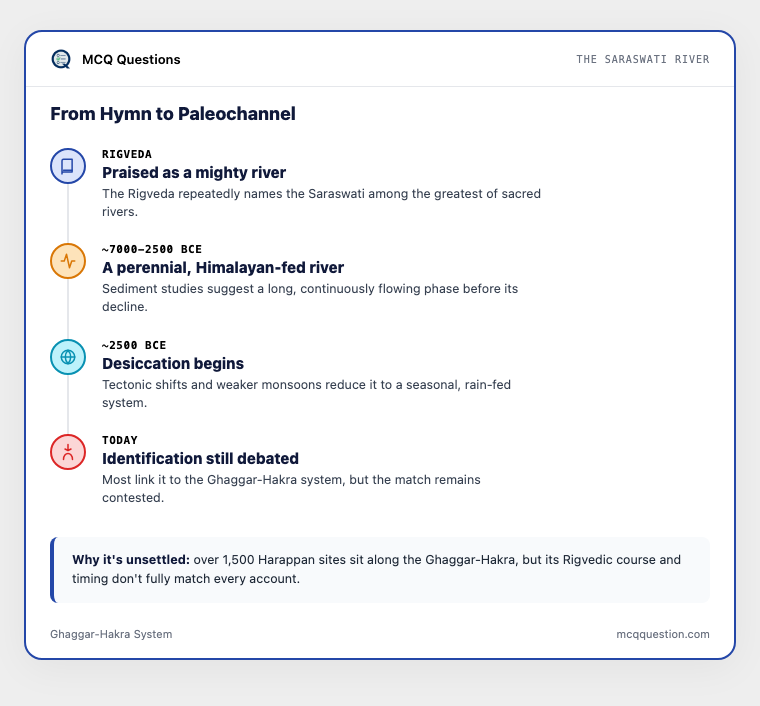
From Hymn to Paleochannel
Rigveda
Praised as a mighty river
The Rigveda repeatedly names the Saraswati among the greatest of sacred rivers.
~7000-2500 BCE
A perennial, Himalayan-fed river
Sediment studies suggest a long, continuously flowing phase before its decline.
~2500 BCE
Desiccation begins
Tectonic shifts and weaker monsoons reduce it to a seasonal, rain-fed system.
Today
Identification still debated
Most link it to the Ghaggar-Hakra system, but the match remains contested.
Why it’s unsettled: over 1,500 Harappan sites sit along the Ghaggar-Hakra, but its Rigvedic course and timing don’t fully match every account.
⬇ Download as image
Must Know
- The Rigveda repeatedly praises the Saraswati as a mighty, sacred river.
- No river by that name flows in this region today.
- Most Indian archaeologists identify it with the now largely dry Ghaggar-Hakra river system.
- This system runs through Haryana, Rajasthan, and on toward the Rann of Kutch.
Good to Know
- Satellite imagery has revealed a broad paleochannel beneath the Ghaggar-Hakra basin.
- This paleochannel shows the buried course of a once-mighty river.
- Over 1,500 Harappan and pre-Harappan sites sit along this ancient river system.
- These include major sites like Kalibangan and Banawali.
- Sediment studies suggest the river’s Himalayan-fed, perennial phase ran from roughly 7000 to 2500 BCE.
- Around 2500 BCE, tectonic shifts and weaker monsoons likely reduced it to a seasonal, rain-fed river.
Test Yourself

Great to Know
- The Ghaggar-Hakra identification remains debated among scholars, not settled fact.
- Some researchers argue the Ghaggar-Hakra system had already dried up before the Harappan civilization even ended.
- Others note the river’s Rigvedic course doesn’t fully match the Ghaggar-Hakra’s actual path.
- A separate theory instead links the Saraswati to the Helmand river in Afghanistan.
- This mix of textual, geological, and archaeological evidence is still actively debated today.
Leave a Reply