Birbal Sahni laid the foundation stone of his life’s biggest project, then died weeks later without ever seeing it finished. His wife, Savitri Sahni, spent the next twenty years making sure it survived him. That institute still bears his name in Lucknow today.
 MCQ Questions
SCITECH0058
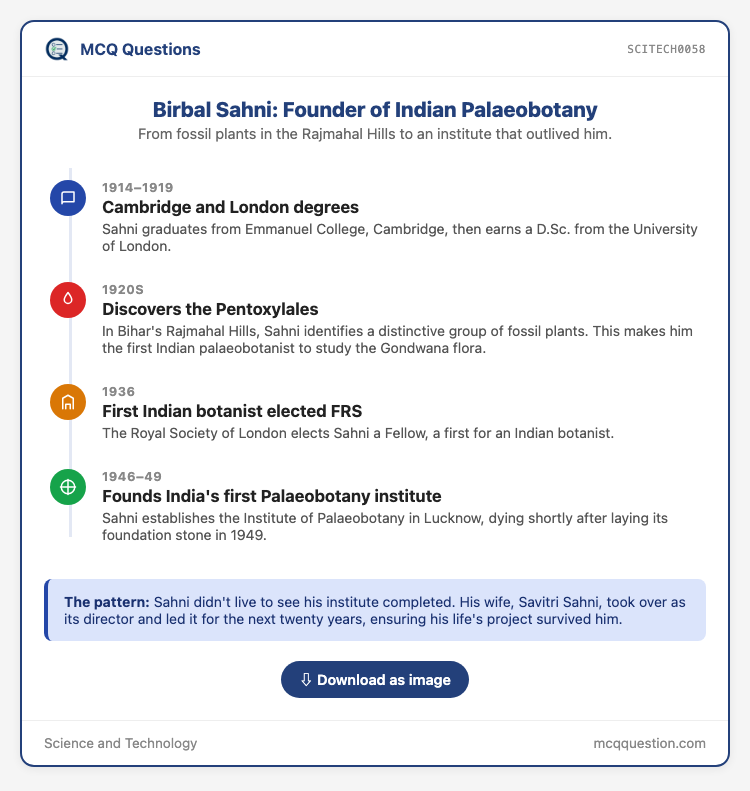
Birbal Sahni: Founder of Indian Palaeobotany
From fossil plants in the Rajmahal Hills to an institute that outlived him.
1914–1919
Cambridge and London degrees
Sahni graduates from Emmanuel College, Cambridge, then earns a D.Sc. from the University of London.
1920s
Discovers the Pentoxylales
In Bihar‘s Rajmahal Hills, Sahni identifies a distinctive group of fossil plants. This makes him the first Indian palaeobotanist to study the Gondwana flora.
1936
First Indian botanist elected FRS
The Royal Society of London elects Sahni a Fellow, a first for an Indian botanist.
1946–49
Founds India’s first Palaeobotany institute
Sahni establishes the Institute of Palaeobotany in Lucknow, dying shortly after laying its foundation stone in 1949.
The pattern: Sahni didn’t live to see his institute completed. His wife, Savitri Sahni, took over as its director and led it for the next twenty years, ensuring his life’s project survived him.
Science and Technologymcqquestion.com
Must Know
- Birbal Sahni (14 November 1891 – 10 April 1949) is regarded as the founder of palaeobotany research in India. He was born in Bhera, now in Pakistan’s Punjab province.
- Sahni graduated from Emmanuel College, Cambridge, in 1914. He later earned a D.Sc. from the University of London in 1919, and a Cambridge Sc.D. in 1929.
- Sahni was the first Indian palaeobotanist to study plant fossils from India’s Gondwana region. In Bihar’s Rajmahal Hills, he identified the Pentoxylales, a distinctive group of fossil plants.
- He described several fossil plant species, including Williamsonia sewardi and Homoxylon rajmahalense.
- In 1936, the Royal Society of London elected Sahni a Fellow. This was the first such honour given to an Indian botanist.
- In 1946, Sahni established the Institute of Palaeobotany in Lucknow, India’s first dedicated palaeobotany institute. He died in 1949, shortly after laying its foundation stone; it was renamed the Birbal Sahni Institute of Palaeobotany that October.
Good to Know
- Sahni served as President of the National Academy of Sciences, India, and as Honorary President of the International Botanical Congress in Stockholm.
- Sahni married Savitri Suri in 1920. She proved a major source of support for his scientific work throughout their marriage.
- After Sahni’s death in 1949, Savitri Sahni became the Institute’s Director. She led it for the next twenty years, until 1969, fulfilling her husband’s founding vision.
- The Institute later became known as the Birbal Sahni Institute of Palaeosciences, and remains a leading centre for the study of India’s fossil plant record.
Test Yourself

Great to Know
- Sahni’s Pentoxylales discovery mattered for a bigger reason. Gondwana-era plant fossils help scientists reconstruct how the ancient southern supercontinent’s flora evolved and later split apart. This connects Indian geology directly to a much larger global story.
- Savitri Sahni’s twenty years running the Institute is an underrecognised part of this story. A scientific legacy institution surviving its founder’s early death often depends entirely on who’s willing and able to carry it forward. It’s not just about the founder’s own original vision.
- Sahni’s career reflects a broader pattern among early-20th-century Indian scientists. They studied abroad at British institutions, then returned to build entirely new research infrastructure in India from scratch. This wasn’t simply importing a foreign field wholesale.
- In July 2026, the Institute’s own researchers used a new AMS radiocarbon-dating method on a Banyan tree in Munger, Bihar. They identified it as roughly 700 years old, the world’s oldest accurately dated Banyan. See GK0001 — India’s National Symbols for the full story, since the Banyan is also India’s national tree.
Beyond the answer
Browse all science-and-technology topics →
📚 Keep reading
SciTech0089 — Bose InstituteIndGeo0114 — Indian Botanic Garden, KolkataModHist0094 — Caste Consciousness Movements, 19th CenturyGK0002 — India's Notable FirstsModHist0115 — Jyotirao Phule: Education and Anti-Caste Reform❓ Practice this topic
What does India's National Viral Hepatitis Control Programme aim to achieve by 2030?According to WHO, how does viral hepatitis's global death toll compare to HIV/AIDS?What can now cure most Hepatitis C infections, even without a vaccine?Since when has a Hepatitis B vaccine existed?🎲 Take a Science And Technology Quiz
Leave a Reply