A robot smaller than a cell can now be steered by light alone, straight into a breast cancer tumour. This is not one lab’s isolated trick. It is the latest step in a 25-year Indian research effort to build machines that treat disease at the nanoscale.

Timeline
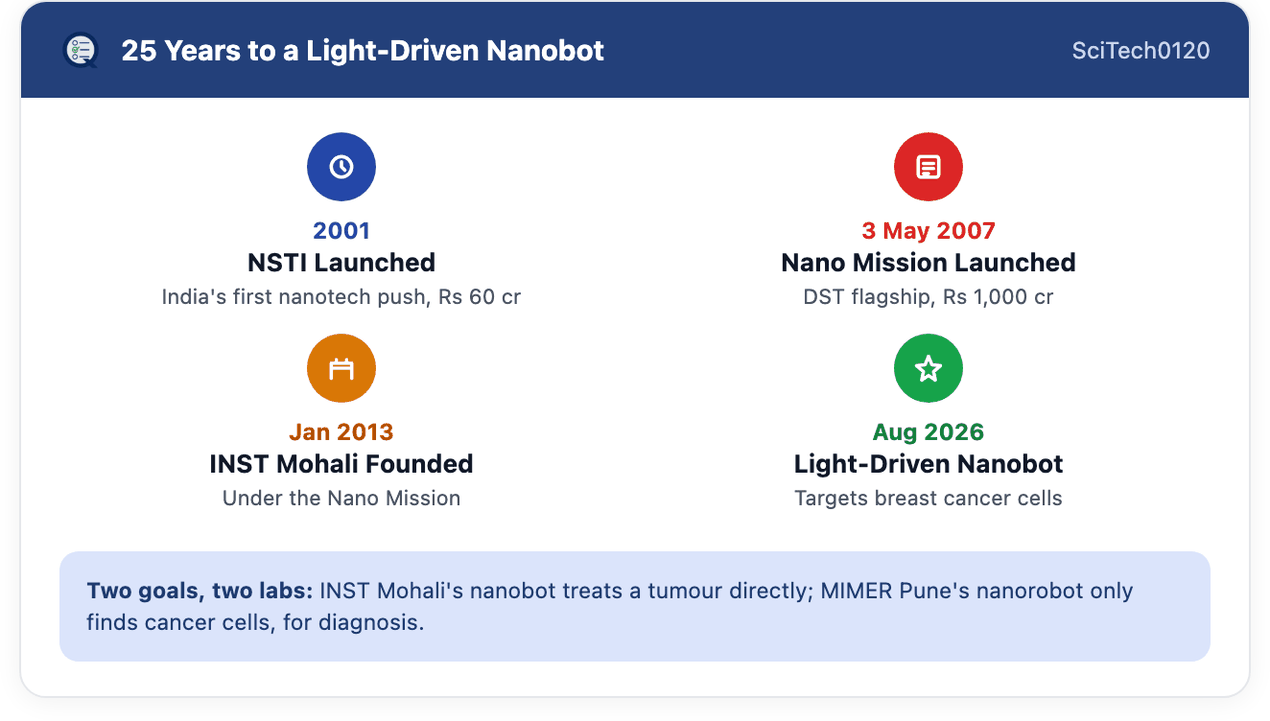
- 2001: India’s first dedicated nanotechnology funding push, the Nanoscience and Technology Initiative, begins with a Rs 60 crore budget.
- 3 May 2007: The DST launches the Nano Mission, India’s flagship nanoscience programme, with an initial Rs 1,000 crore budget.
- January 2013: The Institute of Nano Science and Technology (INST), Mohali, is established under the Nano Mission’s umbrella.
- Early August 2026: INST Mohali scientists publish a light-driven nanobot for targeted breast cancer therapy, in the journal ACS Applied Materials & Interfaces.
Must Know
- Nanorobots are stimulus-responsive nanoscale devices. External cues, like light or magnetic fields, guide them to a precise target inside the body.
- India’s Nano Mission, launched by the DST in 2007, funds this kind of research. It grew out of an even earlier initiative from 2001.
- The Institute of Nano Science and Technology (INST), Mohali, is a leading centre for this work. It is an autonomous DST institute, set up under the Nano Mission in 2013.
- In August 2026, INST Mohali scientists, led by Dr Jiban Jyoti Panda with Dr Santosh K. Gupta of the Bhabha Atomic Research Centre (BARC), Mumbai, published a nanobot for targeted breast cancer therapy.
- This nanobot combines nanorobotics with phototherapy. It converts near-infrared (NIR) light into heat, and moves directionally in response to that light.
Good to Know
- The nanobot’s surface carries folic acid. Breast cancer cells often over-express folate receptors, so this lets the nanobot selectively find and bind to them.
- This design solves two known problems. Passive-accumulation nanomedicines struggle to penetrate deep into tumour tissue, and earlier light-powered nanorobots used UV or visible light, which can damage healthy tissue.
- Near-infrared light avoids that damage. It still gives precise control, with minimal harm to the rest of the body.
- India’s nanorobotics research is not limited to therapy alone. At the Maharashtra Institute of Medical Education and Research (MIMER), Pune, scientists built magnetic nanorobots for a different job. These capture circulating cancer cells directly from a patient’s blood sample, for diagnosis.
- MIMER’s nanorobots are propelled by water in the blood itself, avoiding toxic chemicals. An external magnetic field guides and separates them once they capture a target cell.
Test Yourself

Great to Know
- This nanobot builds on India’s much broader nanomedicine effort. See SciTech0043 — Nanotechnology in Health: Nanomedicine, Diagnostics, and Drug Delivery in India for the wider landscape this specific research sits inside.
- Therapy and diagnosis are pulling India’s nanorobotics research in two directions at once. INST Mohali’s nanobot treats a tumour directly, while MIMER’s nanorobot only finds cancer cells, without treating anything. Both count as real progress, just toward different goals.
Current Affairs
- Early August 2026: The Ministry of Science and Technology shared details of a new light-driven, multifunctional nanobot developed by INST Mohali, for targeted breast cancer treatment. (Source: The Tribune)
- Early August 2026: The research team was led by Dr Jiban Jyoti Panda of INST Mohali, working with Dr Santosh K. Gupta of BARC, Mumbai. Their findings were published in ACS Applied Materials & Interfaces. (Source: The Tribune)
- Early August 2026: The nanobot’s folic acid coating lets it selectively target breast cancer cells. Its near-infrared light response also avoids the tissue damage risked by older UV-based designs. (Source: Indian Masterminds)
Beyond the answer
Browse all science-and-technology topics →
📚 Keep reading
SciTech0043 — Nanotechnology in Health: Nanomedicine, Diagnostics, and Drug Delivery in IndiaGenSci0027 — ICMR (Indian Council of Medical Research)GK0003 — India Geography FactsGenSci0032 — Non-Communicable Diseases (NCDs) in India: Cancer, Diabetes, ObesitySciTech0128 — Aqueous Battery Electrolyte Research❓ Practice this topic
What does India's National Viral Hepatitis Control Programme aim to achieve by 2030?According to WHO, how does viral hepatitis's global death toll compare to HIV/AIDS?What can now cure most Hepatitis C infections, even without a vaccine?Since when has a Hepatitis B vaccine existed?🎲 Take a Science And Technology Quiz
Leave a Reply