A blockchain is a shared digital ledger. Every participant on the network holds a copy. New records get added in blocks, each one cryptographically linked to the one before it. This makes the ledger transparent to permitted users, and extremely hard to tamper with.

 mcqquestion.com
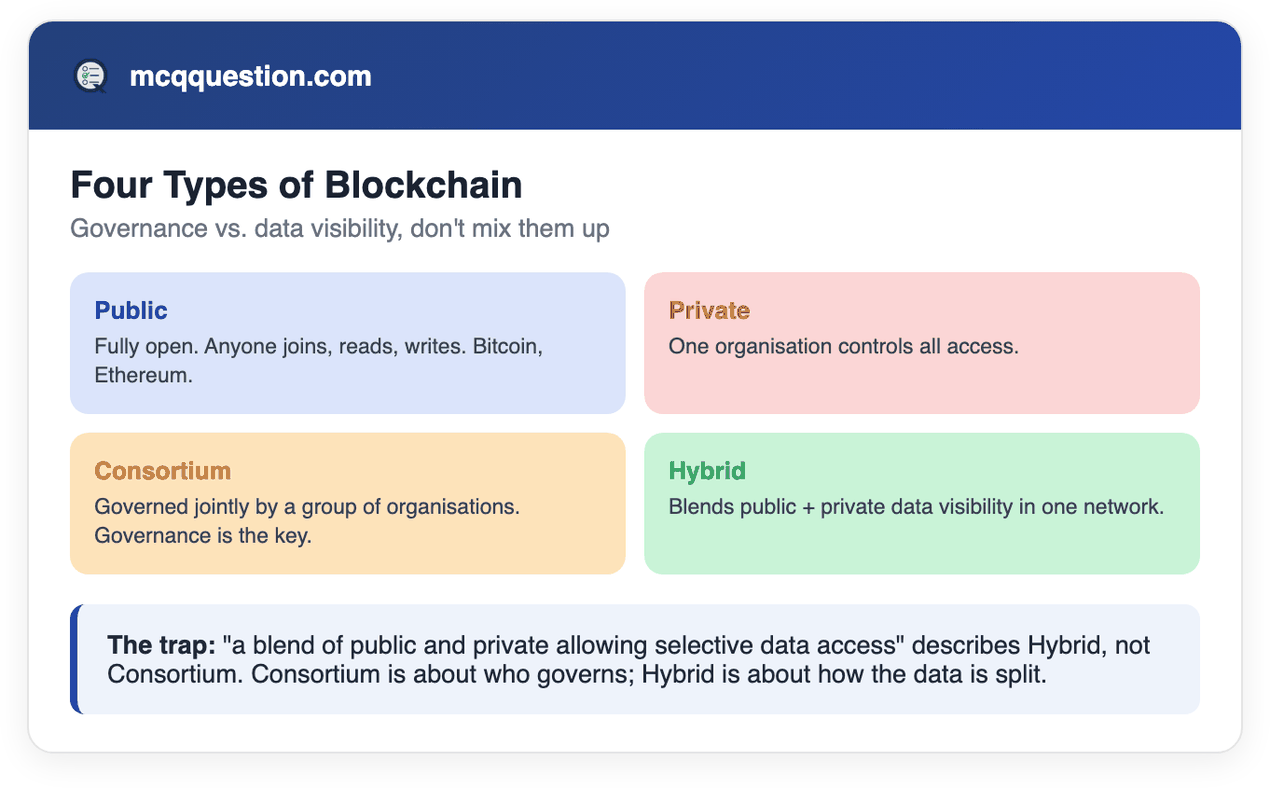
Four Types of Blockchain
Governance vs. data visibility, don’t mix them up
Public
Fully open. Anyone joins, reads, writes. Bitcoin, Ethereum.
Private
One organisation controls all access.
Consortium
Governed jointly by a group of organisations. Governance is the key.
Hybrid
Blends public + private data visibility in one network.
The trap: “a blend of public and private allowing selective data access” describes Hybrid, not Consortium. Consortium is about who governs; Hybrid is about how the data is split.
⬇ Download as image
🏛️ Must Know
Core Features of Blockchain
- Records stored on Records stored on a blockchain can be made visible to relevant stakeholders, with a very low risk of quiet alteration.
- Full copies of Full copies of the entire database sit on multiple computers across the network. These copies sync with each other within seconds.
- Cryptographic hashing links Cryptographic hashing links each block to the one before it. Changing an old record would mean redoing that block’s hash and every block after it, across most of the network, at once. Exam-level phrasing often calls this “impossible,” though the more precise term is computationally infeasible.
- This combination, wide This combination, wide visibility plus tamper-resistance, is what makes blockchain useful for records that many parties need to trust at once.
🏘️ Good to Know
Four Types, Often Confused
- Public blockchain Public blockchain: fully open. Anyone can join, read, write, and validate. Bitcoin and Ethereum are the best-known examples.
- Private blockchain Private blockchain: a single organisation controls access. Only approved participants can join.
- Consortium blockchain Consortium blockchain: semi-decentralised, jointly governed by a pre-selected group of organisations, not just one. Multi-party governance is its defining trait, used in banking groups and supply-chain alliances.
- Hybrid blockchain Hybrid blockchain: a genuine blend of public and private architecture in one network. Some data stays open and transparent, other data stays private and permissioned, under a controlling authority that decides what’s exposed.
- A frequent exam A frequent exam trap swaps these last two definitions. “A blend of public and private blockchains allowing selective data access” describes a hybrid blockchain, not a consortium blockchain. Consortium is about who governs it; hybrid is about how the data is split.
Test Yourself


📰 Current Affairs
Current Affairs
- MeitY launched the MeitY launched the National Blockchain Framework in September 2024, with a ₹64.76 crore budget. It gives a unified architecture for blockchain use across government. By 21 October 2025, over 34 crore documents had been verified through platforms built on it. (Source: Shankar IAS)
- Andhra Pradesh was Andhra Pradesh was the first Indian state to pilot blockchain, starting with transport registrations. It has since announced blockchain- and QR-code-based land surveys, targeted for completion by 2027. This will come alongside blockchain-embedded Pattadar Passbooks.
- Telangana launched its Telangana launched its “Bhu Bharathi” land-records portal, building on earlier blockchain-based land-registry pilot work done with C-DAC.
- The RBI’s e-Rupee The RBI’s e-Rupee is a retail Central Bank Digital Currency, launched in December 2022. It uses distributed-ledger components, but stays under sovereign central-bank control rather than being a fully decentralised blockchain. By early 2026, it had reached around 7 million retail users across 19 banks.
- Judiciary Chain The framework also covers justice delivery: its Judiciary Chain had verified 665 judicial documents by October 2025, and the Inter-Operable Criminal Justice System (ICJS) had over 39,000 documents verified on-chain in the same period. MeitY ran a Blockchain India Challenge in February 2026 to widen adoption further.
Leave a Reply