One Sufi saint invited a Sultan to invade his own city. This article covers the Suhrawardi order, the Sufi tradition that chose the state as a partner, not something to keep at arm’s length.


Timeline
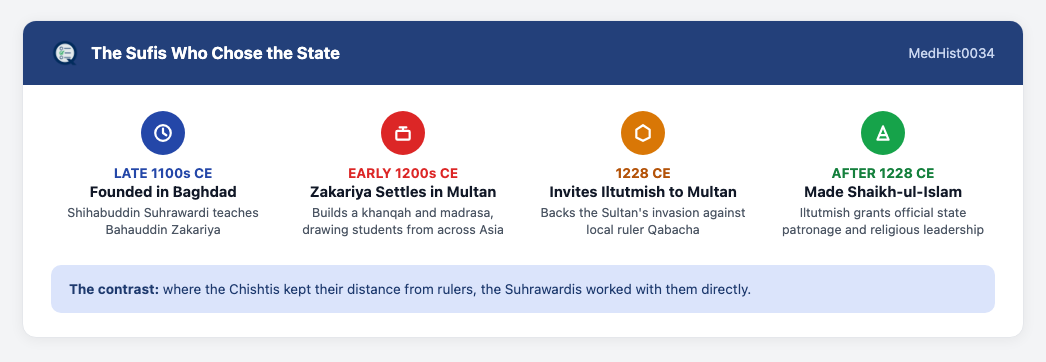
- Late 1100s CE: Shihabuddin Suhrawardi founds the order in Baghdad. Bahauddin Zakariya studies under him there.
- Early 1200s CE: Zakariya settles in Multan. He builds a khanqah and madrasa that attracts students from across Asia.
- 1228 CE: Zakariya invites Sultan Iltutmish to invade Multan and remove its ruler, Qabacha.
- After 1228 CE: Following the annexation, Iltutmish appoints Zakariya Shaikh-ul-Islam, granting the order official state patronage.
A Saint Who Chose the StateNeed to Know
- The Suhrawardi order was founded by Shihabuddin Suhrawardi in Baghdad. Bahauddin Zakariya studied under him and brought the order to India.
- Zakariya established the order’s Indian base at Multan, building a khanqah and madrasa that became a major centre of learning.
- In 1228 CE, Zakariya invited Sultan Iltutmish to invade Multan and topple its ruler, Qabacha.
- After the annexation, Iltutmish appointed Zakariya Shaikh-ul-Islam, the formal leader of the Muslim community, granting the order official state patronage.
- The Suhrawardi order is defined by its political alignment with the state, unlike the Chishti order’s deliberate distance from rulers.
- Some Suhrawardi saints went further than religious patronage. They held actual ministerial posts within the Sultanate’s administration.
Practice and DoctrineGood to Know
- Doctrinally, the Suhrawardis aligned closely with mainstream Sunni jurisprudence, particularly the Shafi’i school of law. That closeness helped legitimise organised Sufism within traditional Islamic scholarship.
- Their dhikr, the ritual remembrance of God, centres on repeating the declaration “there is no god but Allah.” Later practice built this into a structured method using seven divine names, tied to seven “subtle spirits” within the seeker.
- Bahauddin Zakariya opposed the Qalandars, a more austere and wandering strand of Sufism. That opposition reflects the Suhrawardi order’s more institutional, settled character.
- For Sufism’s broader development in medieval India, including the Chishti order, see MedHist0012 — Sikhism and Sufism in Medieval India.
Test Yourself

Two Theories of Religious AuthorityGreat to Know
- Inviting a Sultan to invade your own city is a striking act for a religious figure. It shows Zakariya treated political alignment as a legitimate tool, not a compromise of his spiritual standing.
- The Suhrawardi-Chishti contrast reveals two different theories of religious authority. One saw engagement with power as an opportunity to shape governance. The other saw distance from power as the only way to preserve spiritual integrity.
- Multan’s strategic position, on key trade and invasion routes into India, made it a natural fit for a state-aligned Sufi order. A saint with real local influence there was valuable to any ruler seeking to control the region.
- The title Shaikh-ul-Islam formalised something unusual: religious authority explicitly backed by, and answerable to, the state. That arrangement shaped how later rulers in Punjab and Multan related to Sufi institutions.
Beyond the answer
Browse all medieval-indian-history topics →
📚 Keep reading
MedHist0012 — Sikhism and Sufism in Medieval IndiaMedHist0036 — The Naqshbandi Order of SufismMedHist0035 — The Qadiriyya Order of SufismPolity0280 — Article 26 of the ConstitutionMedHist0003 — The Slave (Mamluk) Dynasty of Delhi❓ Practice this topic
During which two Mughal emperors' reigns did Tavernier make his six voyages to India, between 1630 and 1668?The 115-carat rough diamond Tavernier acquired in 1666 was later cut down and sold to Louis XIV as which famous diamond?In which year did Tavernier publish “Les Six Voyages,” recording diamond prices and mining techniques from his travels?Jean-Baptiste Tavernier's book gave the first detailed European technical description of which diamond mines?🎲 Take a Medieval Indian History Quiz
Leave a Reply