Who picks the next Dalai Lama? In 2025, the current one gave his answer. China gave a different one. This dispute sits on top of a much older tradition: Tibetan Buddhism’s four schools, and its unusual system of reincarnating teachers.
 MCQ Questions
Tibetan Buddhism
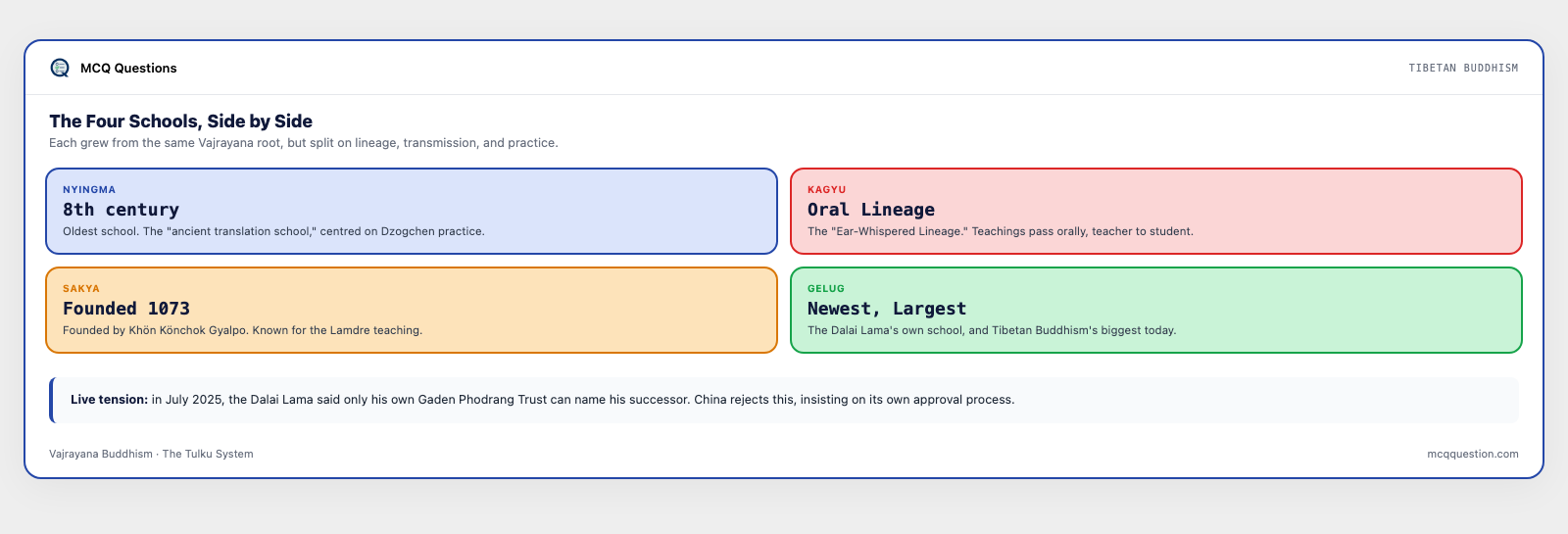
The Four Schools, Side by Side
Each grew from the same Vajrayana root, but split on lineage, transmission, and practice.
Nyingma
8th century
Oldest school. The “ancient translation school,” centred on Dzogchen practice.
Kagyu
Oral Lineage
The “Ear-Whispered Lineage.” Teachings pass orally, teacher to student.
Sakya
Founded 1073
Founded by Khön Könchok Gyalpo. Known for the Lamdre teaching.
Gelug
Newest, Largest
The Dalai Lama’s own school, and Tibetan Buddhism’s biggest today.
Live tension: in July 2025, the Dalai Lama said only his own Gaden Phodrang Trust can name his successor. China rejects this, insisting on its own approval process.
⬇ Download as image
Must Know
- Tibetan Buddhism is a form of Vajrayana Buddhism.
- It blends Mahayana ideas, like the bodhisattva path, with tantric practices.
- Those tantric practices include mantra recitation and deity visualization.
- Tibetan Buddhism has four main schools: Nyingma, Kagyu, Sakya, and Gelug.
- Nyingma is the oldest school, founded in the 8th century.
- It is called the “ancient translation school,” and it centres on Dzogchen practice.
- Kagyu passes its teachings orally, earning it the name the “Ear-Whispered Lineage.”
- Sakya was founded in 1073 by Khön Könchok Gyalpo, known for its Lamdre teaching.
- Gelug is the newest and largest of the four schools.
- The Dalai Lama belongs to the Gelug school.
Good to Know
- Tibetan Buddhism has a unique system for succession: the tulku, or reincarnating lama.
- This formal system of recognising reincarnations traces back to the 13th century.
- The Dalai Lama lineage is the most famous tulku lineage.
- The current, 14th Dalai Lama is Tenzin Gyatso, born in 1935.
- He was identified as the 13th Dalai Lama’s reincarnation at just age 2.
- On 17 March 1959, he fled Tibet on foot and horseback, over the Himalayas.
- He reached India on 31 March 1959, escaping a Chinese crackdown in Tibet.
- In 1960, he established a Tibetan government-in-exile at Dharamshala, in Himachal Pradesh.
- In 2011, he gave up his own political power, ending 369 years of tradition.
- That power passed to the Central Tibetan Administration, a democratically elected body.
- The Central Tibetan Administration is still based in Dharamshala today.
Test Yourself

Great to Know
- The tulku system was never designed with geopolitics in mind, but it invites exactly that.
- Whoever recognises the “true” reincarnation gains real religious and political authority.
- The Karmapa Lama dispute shows this same pattern playing out, separately from the Dalai Lama’s own succession.
- Both cases show how a religious tradition can become a live diplomatic flashpoint, once a powerful state has a stake in the outcome.
Current Affairs
- On 2 July 2025, the 14th Dalai Lama stated that the Gaden Phodrang Trust alone has authority to recognise his reincarnation. (Source: Office of the Dalai Lama)
- China’s government rejected this. It insists any successor must be approved using the “golden urn” method, a Qing-era selection process it legally mandated in 2007. (Source: TIME)
- As of mid-2026, this succession question remains unresolved, and is an active point of India-China-Tibet tension. (Source: The Diplomat)
Beyond the answer
Browse all international-relations topics →
📚 Keep reading
AncHist0027 — Buddhism: Historical Timeline and Present-Day StatusAncHist0011 — Buddhism: Schools and Sacred TextsArtnCulture0039 — The Buddhist Councils and the Spread of BuddhismAncHist0066 — Vikramshila UniversityAncHist0022 — The Palas, Senas and Buddhist Learning Centres❓ Practice this topic
D0416 — Which event, eight years after Panchsheel, is often cited as the irony of the India-China framework of peaceful coexistence?D0415 — The principles of Panchsheel gained wider resonance at which 1955 gathering of newly independent Asian and African states?D0414 — The Five Principles of Panchsheel were primarily associated with which two leaders of India and China?D0413 — Which of the following is one of the Five Principles of Panchsheel?🎲 Take a International Relations Quiz
Leave a Reply