For the first time since Independence, one Indian state now has a single civil law for every religion. Uttarakhand got there first. This article covers the Uniform Civil Code, and how it’s spreading to other states.

Timeline
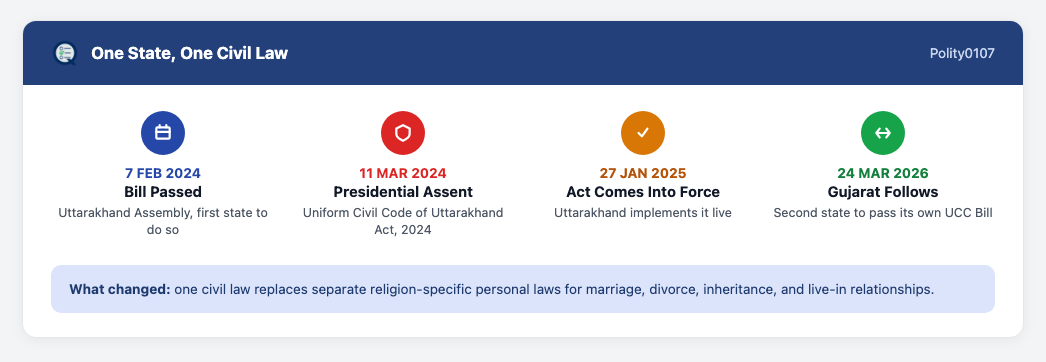
- 7 February 2024: The Uttarakhand Legislative Assembly passes the Uniform Civil Code Bill, the first state in independent India to do so.
- 11 March 2024: The President gives assent to the Uniform Civil Code of Uttarakhand Act, 2024.
- 27 January 2025: The Act comes into force, and Uttarakhand becomes the first state to actually implement a UCC.
- 24 March 2026: The Gujarat Assembly passes its own Uniform Civil Code Bill, becoming the second state to do so.
Must Know
- Uttarakhand’s Uniform Civil Code Act, 2024 came into force on 27 January 2025, making it the first state to implement a UCC.
- The Code replaces separate religion-specific personal laws — the Hindu Marriage Act, Muslim Personal Law (Shariat), Indian Christian Marriage Act, and the Special Marriage Act — for residents of Uttarakhand.
- It makes registering a live-in relationship mandatory. Failing to register can carry a jail term of up to six months.
- On 24 March 2026, Gujarat‘s Assembly passed its own UCC Bill after a seven-hour debate, becoming the second state to legislate one.
Good to Know
- The live-in relationship registration rule applies to couples both starting and ending a live-in relationship, not just starting one.
- A Public Interest Litigation was filed in the Nainital High Court, challenging the UCC Act’s constitutional validity.
- Petitioners specifically argue the mandatory live-in registration requirement is unconstitutional, violating the right to privacy.
- In 2026, the Uttarakhand government issued the UCC (Amendment) Ordinance, 2026, making procedural and administrative changes to the original Code.
Test Yourself

Great to Know
- Article 44 of the Constitution’s Directive Principles calls for a Uniform Civil Code, but leaves the timing and method to the state. Uttarakhand is the first to actually legislate one at the state level.
- Since personal law usually falls under the Concurrent List, a state-level UCC can operate alongside a still-absent national one — a workaround other states can copy independently.
- Gujarat following Uttarakhand within about a year suggests this could become a state-by-state trend, rather than a single national law passed all at once.
- The live-in registration provision tests a real tension: state interest in tracking relationships, against an individual’s right to keep personal relationships private.
Leave a Reply