In 2020, a rule letting Ayurveda graduates perform surgery split India’s medical community. Doctors called it “mixopathy.” This article covers AYUSH, the modern allopathy debate, and India’s push toward integrative medicine.

Timeline
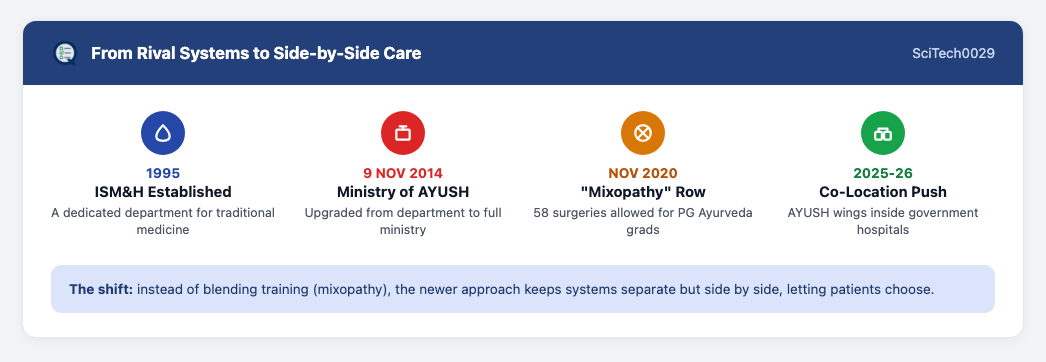
- 1995: The Department of Indian Systems of Medicine and Homoeopathy (ISM&H) is established.
- 9 November 2014: The department is upgraded into the full Ministry of AYUSH.
- November 2020: A CCIM amendment lets postgraduate Ayurveda students perform 58 surgical procedures. The IMA opposes it, calling it “mixopathy.”
- 2025-26: Policy shifts toward “integrative medicine,” co-locating AYUSH wings inside government hospitals.
AYUSH Basics and the Mixopathy Debate Need to Know
- The Ministry of AYUSH was created on 9 November 2014, upgraded from a department that dates back to 1995.
- AYUSH stands for Ayurveda, Yoga & Naturopathy, Unani, Siddha, and Homoeopathy.
- In November 2020, a Central Council of Indian Medicine (CCIM) amendment let postgraduate Ayurveda students perform 58 surgical procedures. The Indian Medical Association (IMA) opposed it, calling it “mixopathy.”
- As of 2026, government policy has shifted toward “integrative medicine” — treating AYUSH as a partner to allopathy, via AYUSH wings co-located in government hospitals.
Co-location, Ayush Visas, and Curriculum Integration Good to Know
- Co-location means setting up AYUSH wings inside District Hospitals and Community Health Centres. This gives patients a choice between allopathy and traditional systems, at the same facility.
- About 12,500 AYUSH dispensaries are being upgraded into Ayushman Arogya Mandirs for holistic primary care.
- As of December 2025, AYUSH services were co-located at 13,249 health facilities nationwide. This included 6,302 Primary Health Centres, 3,191 Community Health Centres, and 475 District Hospitals. Over 25,000 AYUSH doctors and 5,600 paramedics support this network, under National Health Mission funding.
- The government has allocated ₹1,872.71 crore to upgrade these dispensaries into Ayushman Arogya Mandirs. So far, ₹1,802.15 crore has been used.
- Foreign nationals can apply for a dedicated Ayush Visa (M-3), introduced in July 2023, to receive AYUSH treatment in India. A companion Ayush Attendant Visa (M-4) covers their caregivers.
- Since 2022, Ayurveda’s undergraduate curriculum can include up to 40% modern-medicine content, under National Commission for Indian System of Medicine rules — part of the same integration push as co-location.
- The Ayush Grid runs 24 digital platforms, including the Ayush Research Portal. It holds over 43,000 curated research publications. A hospital-management system is now live in over 5,300 AYUSH facilities.
- The All India Institute of Ayurveda (AIIA) runs integrative medical services in cancer therapy, dentistry, emergency medicine, orthopaedics, and nutrition. It also has satellite clinics at Safdarjung Hospital and AIIMS Jhajjar. See ArtnCulture0061 — Sushruta, the ancient surgeon AIIA honours each year on Sushruta Jayanti.
- The IMA’s core objection to “mixopathy”: AYUSH practitioners prescribing allopathic drugs like antibiotics and steroids without full allopathic training, risking misuse and antibiotic resistance.
Current Affairs
- On 14 August 2026, the National Commission for Homoeopathy (NCH) clarified its cross-practice rules. Under Regulation 36(y) of its 2022 Code of Ethics, a Homoeopathic practitioner cannot practise any other system of medicine. (Source: PIB)
- A proviso to Regulation 36(y) carves out an exception. It allows practice under a National Health Programme, or any Central or State scheme, if the practitioner has the prescribed training. (Source: PIB)
- The NCH also cited Regulation 14(7) of its B.H.M.S. degree rules. It recognises Homoeopathic graduates’ role in Government health facilities and National Health Programmes. (Source: PIB)
- On 7 August 2026, the Bureau of Indian Standards (BIS) signed an MoU with CCRAS. It’s BIS’s 100th MoU overall, and its first with an AYUSH body. (Source: Global Governance News)
- The MoU aims to set globally benchmarked Ayurveda quality standards. BIS’s Ayurveda Sectional Committee already covers 128 Indian Standards, with 243 AYUSH-domain standards developed over the last three years. (Source: Global Governance News)
- The same day, Parliament also got fresh detail on the Ayush Suraksha portal’s reach. Its 97 Peripheral Pharmacovigilance Centres have run 4,165 awareness programmes, reaching 3,71,477 participants. (Source: PIB)
- On Kerala’s Ayurveda-tourism push, the government detailed a dedicated Ayush Visa category, introduced 27 July 2023. It has also run two Medical Value Travel summits, at Mumbai in 2024 and Chennai in 2025. (Source: PIB)
- Kerala hosts several dedicated AYUSH research institutes. These include the National Ayurveda Research Institute for Panchakarma, and the Regional Ayurveda Research Institute, Thiruvananthapuram. (Source: PIB)
- On Ladakh’s medicinal plants, the government has released ₹705.11 lakh over five years, for AYUSH projects there. A Centre of Excellence for Seabuckthorn also runs at Nimoo, Leh, built with DRDO’s high-altitude research institute. (Source: PIB)
- Separately, Union AYUSH Minister Prataprao Jadhav chaired the 2nd Governing Body Meeting of the National Institute of Sowa-Rigpa. He unveiled a plan to boost the system through scientific research and institutional growth. (Source: Global Governance News)
- On 6 August 2026, Ayush Minister Prataprao Jadhav chaired CCRAS’s 27th Governing Body Meeting. (Source: PIB)
- He inaugurated new Research Lab and Animal House wings at CCRAS-RARI Pune, and a Guest House at CCRAS-RARI Ranikhet. (Source: PIB)
- He also held the Bhoomi Poojan, for a new 50-bedded hospital at CCRAS-RARI Nagpur. (Source: PIB)
- The meeting unveiled CCRAS-PARAMPARA, a project to document and validate Local Health Traditions. (Source: PIB)
- It also launched the CCRAS National Research Recognitions portal, covering three award schemes: PRAKASA, NAVONMESA, and PRABODH 3MT. (Source: PIB)
- CCRAS also launched Ayur-dict, its first Android app, an aggregator of Ayurveda dictionaries. (Source: PIB)
- On 4 August 2026, Parliament reviewed Ayush regulatory reforms. (Source: PIB)
- NCISM and NCH, set up under 2020 Acts, now regulate Indian-medicine and Homoeopathy education. (Source: PIB)
- Faculty training under the new curriculum has covered 3,145 undergraduate and 602 postgraduate teachers, plus 450 medical officers. (Source: PIB)
- Under the National Ayush Mission, the Centre released about ₹6,407 crore to States and UTs. (Source: PIB)
- The funds covered Ayush infrastructure, over 2014-15 to 2025-26. (Source: PIB)
- The 10th Ayurveda Day was held on 23 September 2025, at AIIA Goa. (Source: PIB)
- Its theme was “Ayurveda for People and Planet,” with Goa’s Governor as Chief Guest. (Source: PIB)
- 31 July 2026: A Parliament reply cited the NSSO’s 79th Round survey (2022-23) on Ayush usage nationally.
- It found 94.8% awareness of Ayush systems in rural India, and 96% in urban India. Around 46.3% of rural residents, and 52.9% of urban residents, used Ayush treatment or prevention within the past year.
- 31 July 2026: Separately, the Ministry signed an MoU with IndiaAI (MeitY), to drive AI-driven innovation across the Ayush sector.
- It will onboard the AIKosh platform, sharing eligible datasets, AI models, and toolkits with researchers. The MoU also gives subsidised access to GPU-based and high-performance computing infrastructure.
- 31 July 2026: The Ministry also detailed deeper Ayurveda-modern medicine integration, through an Ayush Vertical under the Directorate General of Health Services.
- It has published Standard Treatment Guidelines for 6 musculoskeletal disorders, and 5 metabolic disorders. Integrated Ayush Departments now run at Safdarjung and Lady Hardinge hospitals in New Delhi, and over 450 Ayush colleges run Tobacco Cessation Centres.
- 31 July 2026: On insurance, IRDAI now requires insurers to cover Ayush treatments at par with other systems of medicine.
- The Ministry also signed an MoU with the General Insurance Council, to empanel all government Ayush hospitals for policyholders.
- 31 July 2026: Separately, an Ayush-ICMR partnership funds Advanced Centres for Integrative Health Research, at 4 AIIMS campuses — Delhi, Jodhpur, Nagpur, and Rishikesh. (Source: PIB)
- On 28 July 2026, Parliament reviewed India’s global leadership in Yoga and traditional medicine. (Source: PIB)
- The UN adopted 21 June as International Day of Yoga in 2014, with member-state support. (Source: PIB)
- WHO and the Ayush Ministry jointly developed a Technical Report on Yoga training standards. (Source: PIB)
- MDNIY signed Yoga-cooperation MoUs with Mongolia’s Yoga Federation in 2025, and a French cultural body (ARRCC) in 2026. (Source: PIB)
- Separately, Ayush Research Councils cover clinical trials, drug standardisation, and medicinal-plant research. (Source: PIB)
- Ayush product exports grew from $869.81 million in FY2020-21, to $1,251.25 million in FY2025-26. (Source: PIB)
- That’s a compound annual growth rate of 7.54 percent, across medicinal plants, extracts, and Ayush pharma. (Source: PIB)
- On 24 July 2026, Parliament reviewed several Ayush digital and investment initiatives. (Source: PIB)
- The Ayush Nivesh Saarthi Portal, launched 29 May 2025, is an investment-facilitation platform for the sector. (Source: PIB)
- The Budget 2026-27 announced new Regional AYUSH Medical Hubs, under DPIIT’s nodal department. (Source: PIB)
- That Summit adopted the Delhi Declaration, with SMART commitments for the WHO’s 2025-2034 Traditional Medicine Strategy. (Source: PIB)
- The AOGUSY scheme, running since 2021-22, has a ₹122 crore budget over five years. (Source: PIB)
- It has funded upgrades at 18 Ayush pharmacies and 7 state Drug Testing Laboratories, worth ₹40.13 crore. (Source: PIB)
- In FY2025-26 alone, 3 more State DTLs received AOGUSY funding for further upgrades. (Source: PIB)
- AI chatbots are now rolling out across Ayush Grid platforms, including MAISP, the Yoga Portal, and Ayush Nivesh Saarthi. (Source: PIB)
- Under the Ayurgyan scheme, 42 new-and-ongoing research projects ran in FY2025-26. (Source: PIB)
- The five Ayush Research Councils together conducted 693 research studies, and published 653 research papers, that year. (Source: PIB)
- On 23 July 2026, NRDC and NCISM signed an MoU on Ayurveda innovation. (Source: PIB)
- It covers IP management, technology transfer, and commercialisation in Indian systems of medicine. (Source: PIB)
- NRDC’s CMD Cmde. Amit Rastogi, and NCISM Chairperson Dr. Maneesha Kothekar, signed the pact. (Source: PIB)
- On 22 July 2026, Union Minister Prataprao Jadhav inaugurated Prakriti Café at Ayush Bhawan. It is a workplace initiative, serving healthy food inspired by Ayush Ahaar principles. (Source: PIB)
- The café’s menu features items like beetroot-oats cutlet, millet dhokla, and makhana kheer. It also offers herbal drinks like tulsi-ginger tea, alongside coconut water. (Source: PIB)
- The same day, Jadhav wrote to Defence Minister Rajnath Singh. He proposed Ayush OPDs and treatment services across Military and Field Hospitals. (Source: PIB)
- Jadhav noted only a limited number of defence institutions currently have dedicated Ayush facilities. He offered the Ministry’s support, including a possible MoU, to expand this access. (Source: PIB)
- On 21 July 2026, in a cluster of Rajya Sabha written replies, the Ayush Ministry detailed its digital and international push. The Ayush Quality Mark, launched at the Second Global Traditional Medicine Summit in December 2025, aims to align AYUSH products with international quality standards. (Source: PIB)
- India co-hosted that Summit with the WHO, in New Delhi, from 17-19 December 2025. Officials also held 16 bilateral meetings there, on traditional-medicine cooperation. (Source: PIB)
- 10 July 2026: Union Minister of State for Ayush Prataprao Jadhav welcomed Delhi’s Ridge conservation plan. He wrote to Chief Minister Rekha Gupta, calling it a step towards sustainable urban development. The plan covers over 70 lakh trees, 70-plus water bodies, and nearly 6,000 hectares of notified forest land. (Source: PIB)
- Jadhav recommended at least 20% of the plantation be medicinal plants, or two dedicated Medicinal Forests. Suggested species include Ashwagandha, Giloy, Tulsi, Brahmi, Shatavari, Amla, and Neem. (Source: PIB)
Test Yourself

Regulation, Rural Gaps, and the Integration Question Great to Know
- The mixopathy debate isn’t just professional turf. It reflects a real rural healthcare gap: many rural areas lack MBBS doctors. Some states, like Uttarakhand, let Ayurvedic doctors prescribe allopathic medicine to fill that gap.
- Co-location and integrative medicine are the government’s answer to the “blend the training” fight over mixopathy. Instead of merging curricula, the systems stay separate but sit side by side, letting patients — not practitioners — choose.
- The debate over surgical rights for PG Ayurveda graduates tests a bigger question. How much of modern medical practice can traditional-system training legitimately claim, without formally converging the two curricula?
- This tension — integration versus separation — recurs across India’s traditional-versus-modern institutional debates, not just in medicine.
- AYUSH drugs are regulated under the Drugs & Cosmetics Act, 1940. A dedicated body, the Pharmacopoeia Commission for Indian Medicine & Homoeopathy (PCIM&H), sets their quality standards. As of 2026, 118 private and 34 state-run labs test AYUSH drug samples.
- The Ayush Suraksha portal, launched in May 2025, tracks misleading AYUSH drug advertisements online. Separately, India’s Consumer Protection Authority now requires e-commerce platforms to demand a valid prescription, before selling certain restricted AYUSH drugs.
- The National Medicinal Plants Board has backed 57 research projects and 15 conservation projects, over the last five years. This supports India’s medicinal-plant supply chain, from cultivation through to market.
Beyond the answer
Browse all science-and-technology topics →
📚 Keep reading
GenSci0027 — ICMR (Indian Council of Medical Research)UPSC CSP 2025 — General Studies Paper I (Full Question Paper)IndEco0112 — Textile Industry in IndiaIndGeo0087 — Indian RailwaysIndGeo0074 — India's National Highway Network❓ Practice this topic
What does India's National Viral Hepatitis Control Programme aim to achieve by 2030?According to WHO, how does viral hepatitis's global death toll compare to HIV/AIDS?What can now cure most Hepatitis C infections, even without a vaccine?Since when has a Hepatitis B vaccine existed?🎲 Take a Science And Technology Quiz
Leave a Reply