A minor solar god in the Rig Veda ended up on Gupta gold coins as the empire’s chosen faith. This article traces how Vishnu worship grew from that small start into a pan-Indian tradition.
A scope note: this article covers Vaishnavism as a historical and textual development — how the tradition formed, spread, and organised itself over time. It does not cover its theology as a matter of religious truth, or any modern social or political dimension.


Timeline
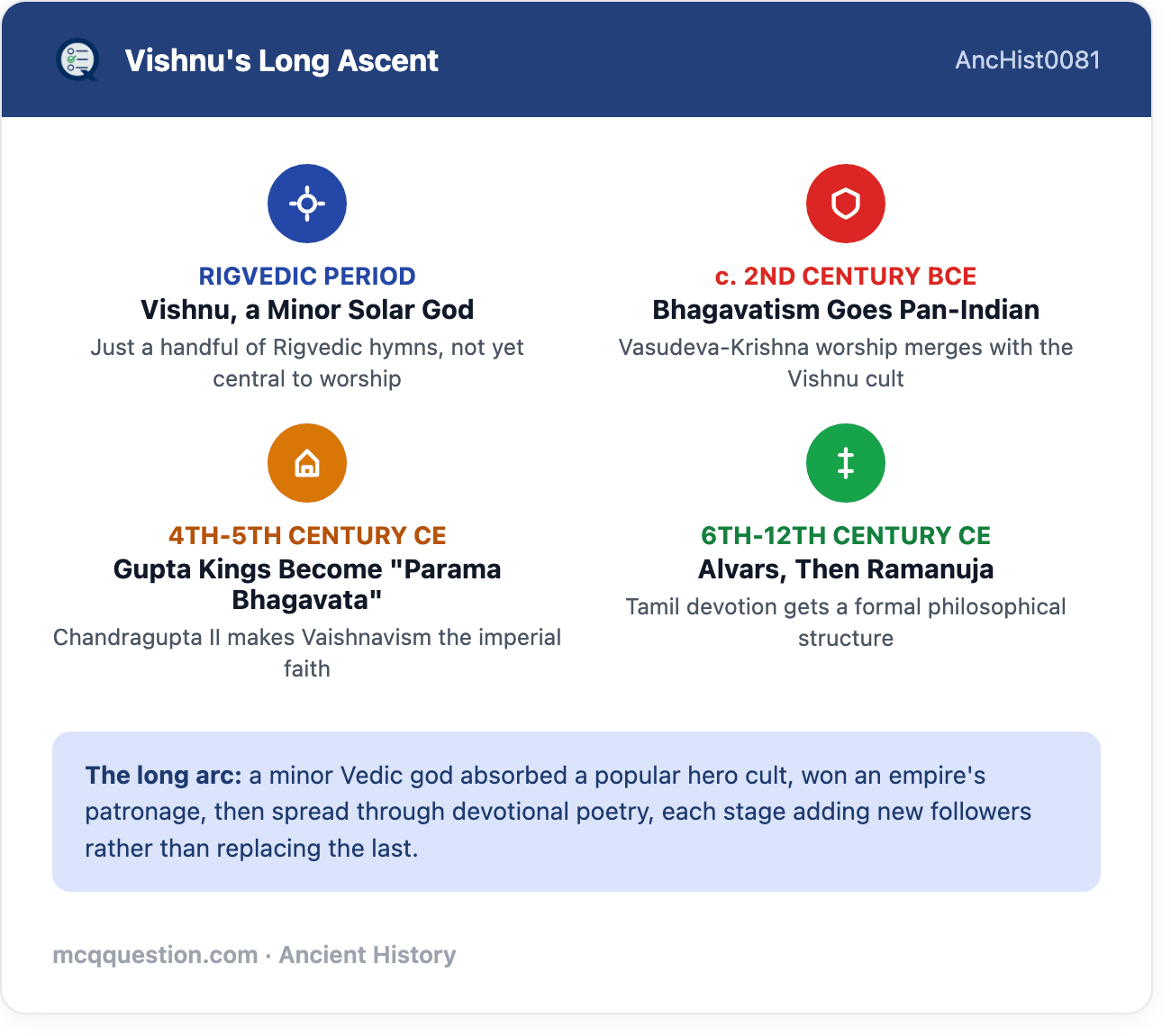
- Rigvedic period: Vishnu appears in the Rig Veda as a minor solar god, known for his three cosmic strides. He was not yet a major object of worship.
- c. 2nd century BCE: The Bhagavata tradition, centred on the Vrishni hero Vasudeva-Krishna at Mathura, merges with Brahmanical Vishnu worship. It becomes a pan-Indian faith.
- 4th-5th century CE: Gupta emperor Chandragupta II takes the title Parama Bhagavata, “foremost devotee of Vishnu.” Later Gupta kings follow his example.
- 6th-9th century CE: The Alvars, Tamil poet-saints, compose devotional hymns to Vishnu across South India. Their poetry feeds directly into the later Bhakti movement.
- 11th-13th century CE: Ramanuja and Madhva give that devotion formal philosophical and institutional structure.
From Minor God to Pan-Indian Faith Need to Know
- In the Rig Veda, Vishnu is a minor solar deity. Only a handful of its roughly 1,000 hymns are dedicated to him. He’s famous for taking three strides to cover earth, sky, and heaven. His rise to a major, widely-worshipped deity happened later, not within the Rig Veda’s own timeframe.
- For the wider Rigvedic pantheon Vishnu belonged to before his later rise, see AncHist0051 — Gods of the Vedic Age: The Rigvedic Pantheon.
- The Bhagavata tradition (Bhagavatism) began as devotion to Vasudeva-Krishna, a Vrishni clan hero worshipped around Mathura.
- By around the 2nd century BCE, this Vasudeva-Krishna cult merged with Vedic Vishnu worship. It became a single, pan-Indian Vaishnava tradition.
- Gupta emperor Chandragupta II adopted the title Parama Bhagavata, meaning “foremost among Vishnu’s devotees.” His coins and inscriptions record it.
- The Alvars were Tamil poet-saints who composed devotional hymns to Vishnu between the 6th and 9th centuries CE, paralleling the Shaivite Nayanars.
Texts, Avatars, and Imperial Patronage Good to Know
- The Pancharatra movement traces its ideas to around the late 3rd century BCE, centred on Narayana and Vishnu’s various forms and avatars. That date marks the movement’s conceptual origin. Its actual texts weren’t systematised until centuries later, and it eventually merged into the Bhagavata tradition.
- The Dashavatara, or ten incarnations of Vishnu, gave the faith a flexible framework. Local and regional deities could be absorbed as new avatars, rather than pushed out.
- Key Vaishnava texts include the Bhagavad Gita, the Pancharatra Agama texts, and the Bhagavata Purana, which systematised Krishna devotion.
- Not every Gupta official followed the emperor’s Vaishnava faith. Many still donated to Buddhist monasteries and Shaiva temples, showing continued religious plurality even under a Vaishnava court.
Test Yourself


Devotion Gets a Philosophy Great to Know
- Vaishnavism’s growth shows a pattern of absorption, not replacement. A minor Vedic god, a popular hero cult, and countless local deities all found a place inside one expanding tradition, through the avatar doctrine.
- After the Alvars’ devotional wave, two thinkers gave Vaishnavism lasting institutional structure. Ramanuja (traditionally c. 11th-12th century CE) organised temple worship and gave devotion to Vishnu a systematic philosophical framework, later known as Vishishtadvaita. Madhva (traditionally c. 13th century CE) founded a separate school, Dvaita, and established the Krishna Mutt at Udupi, which is still active today.
- Both schools mattered historically because they turned an emotional, poetic devotional movement into organised, lasting institutions, temple lineages, and teaching traditions, not just because of their philosophical content.
- Imperial patronage mattered, but it was not the whole story. Chandragupta II’s title spread Vaishnavism at court, yet the faith had already gone pan-Indian centuries earlier through popular devotion at Mathura.
- The Alvars’ devotional poetry, like the Nayanars’ for Shaivism, shows that Bhakti-style personal worship predates its “movement” by many centuries. Formal Bhakti built on foundations already laid.
- Vaishnavism and Shaivism grew through similar stages: an old Vedic root, a popular devotional surge, and a wave of regional poet-saints. Studying one tradition’s arc helps explain the other’s.
Beyond the answer
Browse all ancient-indian-history topics →
📚 Keep reading
UPSC CSP 2019 — General Studies Paper I (Full Question Paper)Polity0322 — National Commission for Minorities (NCM)AncHist0086 — Trade and Towns of the Gupta AgeAncHist0021 — Post-Gupta Regional Dynasties of North IndiaModHist0094 — Caste Consciousness Movements, 19th Century❓ Practice this topic
James Burgess founded a journal in 1872, and later served as Director General of the Archaeological Survey of India from 1886 to which year?Alexander Rea first excavated Amaravati in 1888–89. In which year did he go on to become the first Superintendent of the Archaeological Survey of Southern India?Robert Sewell's 1900 book “A Forgotten Empire” is a history of which South Indian empire, drawn from two Portuguese travellers' accounts?A.H. Longhurst's excavations from 1926 to 1931 uncovered a great stupa and several smaller structures at which site?🎲 Take a Ancient Indian History Quiz
Leave a Reply