One Parsi merchant made his fortune trading opium with China. He went on to become the first Indian ever knighted by Queen Victoria. This article traces how a small refugee community built some of India’s largest business houses.

Timeline
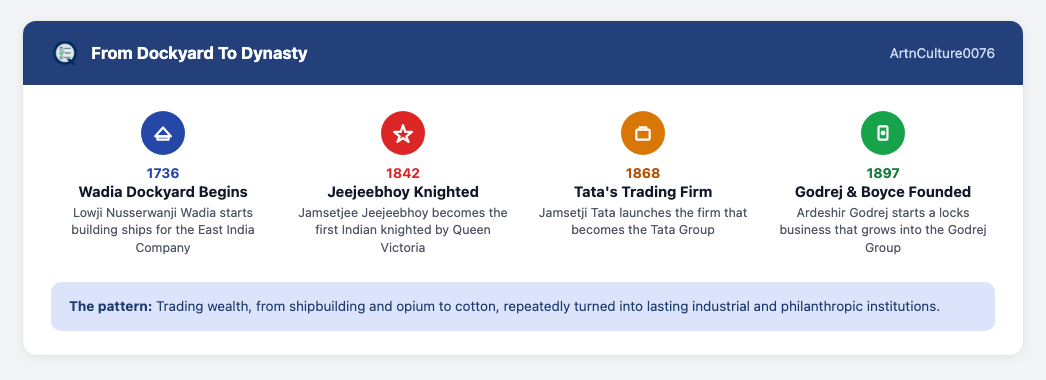
- In 1736, the East India Company brought Lowji Nusserwanji Wadia to Bombay to build its dockyard. His family’s shipyard later built the “Bombay Frigates,” used by the British Admiralty at the Battle of Trafalgar.
- In 1842, Jamsetjee Jeejeebhoy, who built his fortune in the opium and cotton trade with China, became the first Indian knighted by Queen Victoria.
- In 1868, Jamsetji Tata launched a trading firm. It grew, through the Empress Mills in the 1870s, into what became the Tata Group.
- In 1897, Ardeshir Godrej founded Godrej & Boyce to manufacture locks, the start of today’s Godrej Group.
Must Know
- The Wadia family built ships for the East India Company from Bombay, starting in 1736. This is distinct from the Parsis’ religious and migration history, covered in ArtnCulture0044.
- Jamsetjee Jeejeebhoy made his early fortune trading opium and cotton with China, in partnership with the firm that became Jardine Matheson.
- Jamsetji Tata‘s 1868 trading firm grew into the Tata Group, one of India’s largest business houses today.
- The Godrej Group, founded in 1897 as a locks manufacturer, is another major Parsi-founded industrial house.
- Parsi business families were known for large-scale philanthropy, funding schools, hospitals, and housing across Bombay.
Good to Know
- In 1854, Cowasji Nanabhai Davar set up India’s first mechanised cotton mill in Bombay, importing machinery from England.
- Jeejeebhoy donated a huge personal fortune to Bombay’s institutions. Much of it funded schools and charities for his own Parsi community.
- The Wadia family also funded “baugs,” self-contained residential colonies built to house Parsis who could not otherwise afford housing in Bombay.
Test Yourself

Great to Know
- Parsis remain a tiny community by population, yet built some of India’s largest business houses. Trading roles under colonial rule, not just numbers, explain that outsized influence.
- Moving from shipbuilding and opium trading, to cotton mills, and then to diversified industry, shows a repeated pattern. Parsi merchants kept redeploying trading capital into new industries as each earlier one matured.
- Large-scale philanthropy, alongside business success, was not incidental. It reflects a community norm that treated wealth as something to be reinvested in shared institutions, not just personal fortune.
Beyond the answer
Browse all art-and-culture topics →
📚 Keep reading
IndEco0141 — Ratan TataIndEco0149 — JRD TataIndEco0165 — Jamsetji TataIndEco0116 — Air India: History, Privatisation, and OperationsIndEco0157 — National Stock Exchange (NSE)❓ Practice this topic
D0421 — Which Director-General led the revival of the ASI under Lord Curzon in 1902?D0420 — Under which Ministry does the Archaeological Survey of India function?D0419 — Which Act governs the protection of monuments and archaeological sites of national importance in India?D0418 — Who is regarded as the founder and first Director-General of the Archaeological Survey of India?🎲 Take a Art And Culture Quiz
Leave a Reply