One fine wool is sheared from a live goat, harmlessly, every spring. A similar-looking wool requires killing an endangered antelope. This article explains the difference, and Pashmina’s own long history.

Timeline
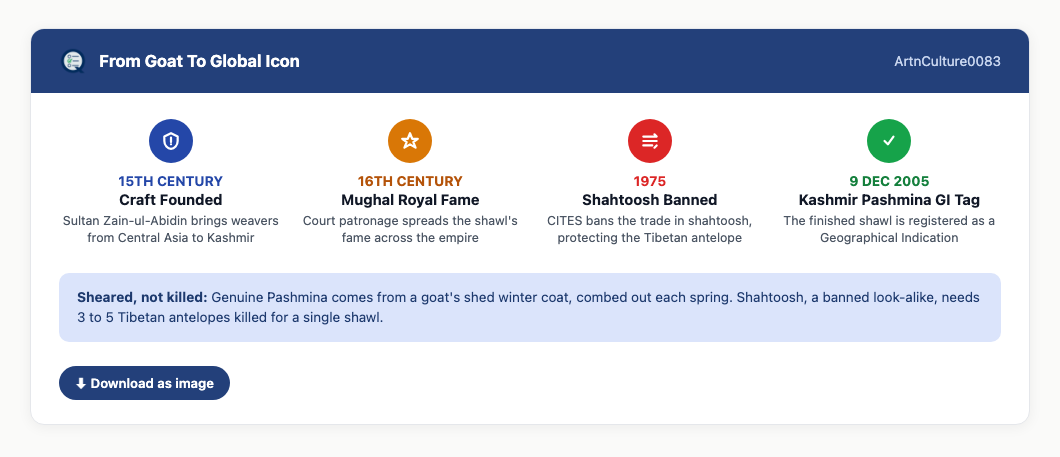
- In the 15th century, Sultan Zain-ul-Abidin of Kashmir brought weavers from Central Asia to the Valley. He is traditionally credited as the founder of its shawl-weaving craft.
- By the 16th century, Kashmir shawls had reached the Mughal court. Royal patronage under emperors like Akbar spread their fame across the empire.
- In 1975, the CITES treaty banned international trade in shahtoosh, a similar-looking wool that requires killing the Tibetan antelope.
- On 9 December 2005, Kashmir Pashmina was registered under India’s Geographical Indications of Goods Act.
Must Know
- Pashmina is a fine wool combed from the undercoat of the Changthangi goat. This goat is native to the Changthang plateau in Ladakh, at altitudes above 14,000 feet.
- Changpa nomadic herders raise these goats. Each goat sheds only about 170 grams of this fine undercoat each spring, so a single shawl needs wool from 3 to 4 goats.
- The raw wool is spun and woven into finished shawls in Kashmir. Kashmir Pashmina, the finished product, got its GI tag in 2005.
- Kashmiri artisans use two distinct techniques: Kani (the pattern is woven directly into the fabric on a loom) and Sozni (a fine needle embroiders a pattern onto an already-woven shawl).
Good to Know
- Shahtoosh comes from the Tibetan antelope, or chiru. Unlike a goat, the animal must be killed to obtain its wool. It takes 3 to 5 antelopes for one shawl.
- The chiru is protected under Schedule I of India’s Wildlife (Protection) Act, 1972, the law’s highest protection level. Shahtoosh is often smuggled disguised as genuine Pashmina, since the two wools look and feel similar.
- In October 2024, Ladakh Pashmina, the raw wool itself, received its own separate GI tag. This is distinct from Kashmir Pashmina’s 2005 tag, which covers the finished, woven shawl.
- Kashmir’s teardrop-shaped shawl motif, called boteh, became globally famous as the “paisley” pattern. Mills in Paisley, Scotland mass-produced imitation shawls carrying this motif through the 19th century.
Test Yourself

Great to Know
- Kashmir Pashmina and Ladakh Pashmina’s two separate GI tags reflect one supply chain, split across two regions. Ladakh supplies the raw fibre; Kashmir supplies the weaving and finishing craft.
- The sheared-versus-killed distinction is the real dividing line between Pashmina and shahtoosh. It is also why genuine Pashmina carries no conservation controversy, while shahtoosh remains illegal.
- GI protection exists partly to fight machine-made or synthetic imitations sold under the “pashmina” label. A legal designation like this only works if buyers and regulators can trace a product back to its real origin.
Beyond the answer
Browse all art-and-culture topics →
📚 Keep reading
IndEco0033 — Economics of Animal Rearing in IndiaModHist0036 — Article 370: Kashmir's Special Status and Its 2019 RemovalPolity0378 — Article 370 of the ConstitutionIntlRel0040 — India-Pakistan RelationsGK0074 — Jammu and Kashmir❓ Practice this topic
Which Sikh Guru compiled the Guru Granth Sahib, giving Sikhism its fixed central scripture?The Third Buddhist Council, held at Pataliputra under Emperor Ashoka, was presided over by which elder, who also compiled the Kathavatthu?Which self-taught Bengal School painter, sister of Abanindranath Tagore, developed her own folk-influenced style distinct from the movements formal academic training?British colonial authorities restricted or banned the public singing of certain nationalist songs during the freedom struggle. What does this show?🎲 Take a Art And Culture Quiz
Leave a Reply