Just before Jawaharlal Nehru‘s “Tryst with Destiny” speech, another sound filled the air over the Red Fort. This article covers the shehnai, and the musician who took it from wedding tents to the concert stage.

Timeline
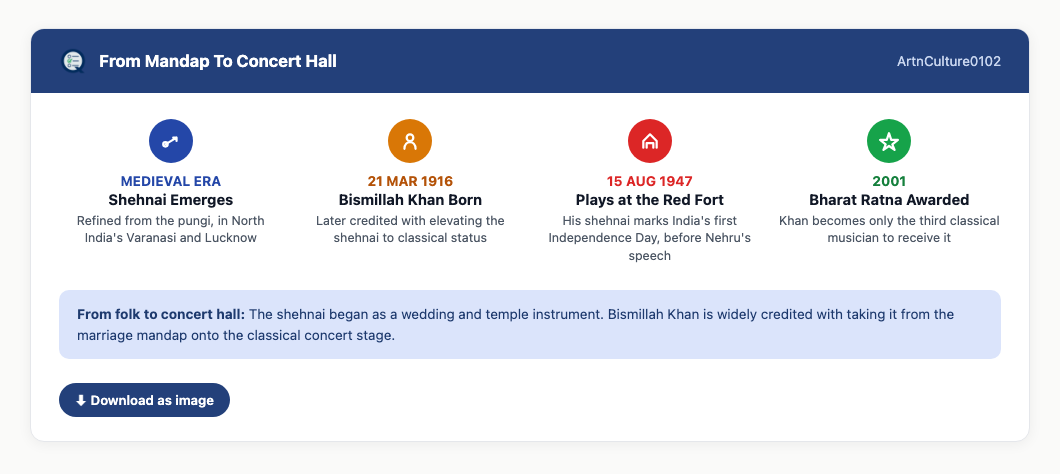
- The shehnai developed in North India, refined in centres like Varanasi and Lucknow. It descends from the pungi, a simpler folk instrument once used by snake charmers.
- On 21 March 1916, Ustad Bismillah Khan was born. He would later become the musician most credited with elevating the shehnai to classical status.
- On 15 August 1947, Bismillah Khan played the shehnai at the Red Fort, marking India’s first Independence Day. His performance came just before Jawaharlal Nehru’s “Tryst with Destiny” speech.
- In 2001, Khan received the Bharat Ratna, India’s highest civilian honour. He was only the third classical musician to receive it, after M.S. Subbulakshmi and Ravi Shankar.
Must Know
- The shehnai is a double-reed wind instrument, central to North Indian Hindustani classical and ceremonial music.
- It is classified as a mangal vadya, an “instrument of auspiciousness.” Traditionally, it is played at weddings, temple thresholds, and processions.
- Ustad Bismillah Khan (1916-2006) is the musician most associated with the shehnai, and with bringing it into classical concert halls.
- For a broader survey of India’s classical music traditions, see ArtnCulture0005 — Indian Music: Hindustani and Carnatic Traditions.
Good to Know
- The shehnai is related to the Persian surna. Its Southern Indian cousin, the nagaswaram, plays a similar auspicious, ceremonial role in Carnatic music.
- Bismillah Khan received the Bharat Ratna in 2001, alongside earlier honours including the Padma Vibhushan, Padma Bhushan, and Padma Shri. See GK0017 — Awards of India for India’s full civilian awards system.
- Khan died on 21 August 2006, at age 90.
- The shehnai’s penetrating, reedy tone is central to why it was traditionally believed to consecrate ceremonies and bring good fortune.
Test Yourself

Great to Know
- Bismillah Khan’s career reflects a broader pattern in Indian classical arts. Moving a tradition from a purely folk or ceremonial role into formal concert status has happened repeatedly, from Mohiniyattam‘s revival to the shehnai’s own rise.
- The shehnai and the nagaswaram both hold the same cultural role in different regions: an instrument specifically reserved for auspicious moments, not everyday performance. This North-South parallel is a useful pattern to recognise across India’s classical traditions.
- Playing at the Red Fort on the very first Independence Day gave the shehnai a lasting association with the nation itself, beyond its older role in weddings and temples.
- For the broader Hindustani classical tradition the shehnai was absorbed into, see ArtnCulture0103 — Hindustani Classical Music.
Beyond the answer
Browse all art-and-culture topics →
📚 Keep reading
ArtnCulture0132 — Bismillah Khan: The Shehnai's Classical VoiceArtnCulture0105 — SarodArtnCulture0139 — Ali Akbar Khan: A Sarod Dynasty's Central FigureHow Odia Got Classical Language StatusArtnCulture0131 — Ravi Shankar: Sitar Maestro to the World❓ Practice this topic
D0421 — Which Director-General led the revival of the ASI under Lord Curzon in 1902?D0420 — Under which Ministry does the Archaeological Survey of India function?D0419 — Which Act governs the protection of monuments and archaeological sites of national importance in India?D0418 — Who is regarded as the founder and first Director-General of the Archaeological Survey of India?🎲 Take a Art And Culture Quiz
Leave a Reply