As a child, Ravi Shankar toured Europe as a dancer, not a musician. At 18, he gave that career up entirely to spend years training under a strict classical guru. Decades later, a Beatle sought him out, and together they helped invent the modern benefit concert.
 MCQ Questions
ARTNCULTURE0131
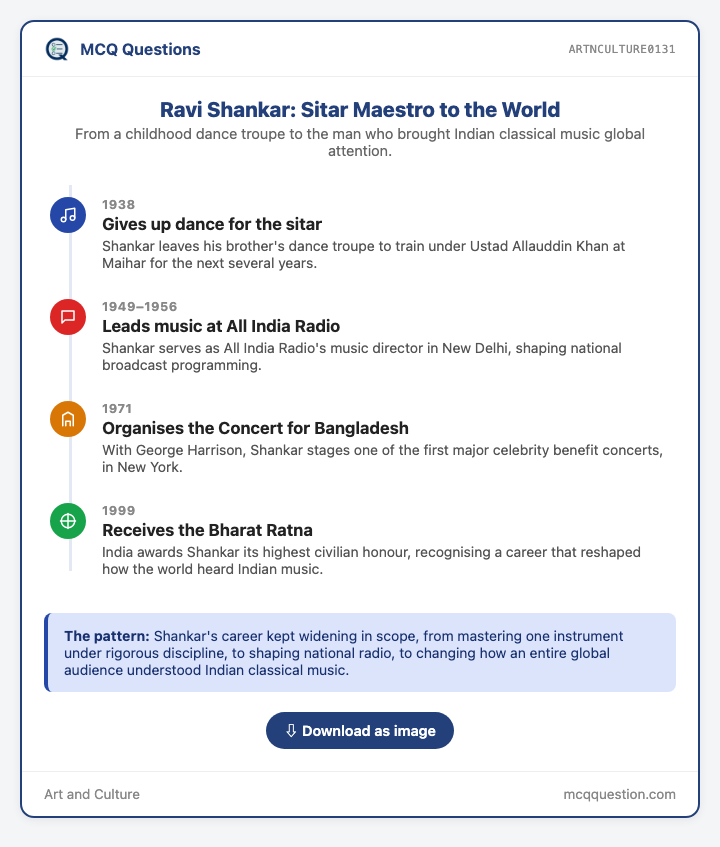
Ravi Shankar: Sitar Maestro to the World
From a childhood dance troupe to the man who brought Indian classical music global attention.
1938
Gives up dance for the sitar
Shankar leaves his brother’s dance troupe to train under Ustad Allauddin Khan at Maihar for the next several years.
1949–1956
Leads music at All India Radio
Shankar serves as All India Radio’s music director in New Delhi, shaping national broadcast programming.
1971
Organises the Concert for Bangladesh
With George Harrison, Shankar stages one of the first major celebrity benefit concerts, in New York.
1999
Receives the Bharat Ratna
India awards Shankar its highest civilian honour, recognising a career that reshaped how the world heard Indian music.
The pattern: Shankar’s career kept widening in scope, from mastering one instrument under rigorous discipline, to shaping national radio, to changing how an entire global audience understood Indian classical music.
Art and Culturemcqquestion.com
Must Know
- Ravi Shankar (7 April 1920 – 11 December 2012) was India’s best-known sitar player. He was born Ravindra Shankar Chowdhury, in Benares (now Varanasi), and died at age 92, having performed until the end of his life.
- At age 10, he joined his brother Uday Shankar’s dance troupe, touring Europe as a dancer, not yet as a musician.
- In 1938, Shankar gave up dancing to train under Ustad Allauddin Khan at Maihar. He studied sitar and Hindustani classical music intensively there for several years.
- He served as All India Radio’s music director in New Delhi, from February 1949 to January 1956.
- His performances with violinist Yehudi Menuhin brought Indian classical music sustained international attention from the 1960s onward. So did his association with George Harrison of the Beatles.
- Shankar received the Bharat Ratna, India’s highest civilian honour, in 1999. He had already received the Padma Bhushan in 1967 and the Padma Vibhushan in 1981.
Good to Know
- In 1971, Shankar and George Harrison organised the Concert for Bangladesh in New York. Bob Dylan, Eric Clapton, and Ringo Starr also performed, in one of the first major celebrity benefit concerts.
- Shankar won five Grammy Awards over his career, including a posthumous Lifetime Achievement Grammy in 2012. The live album from the Concert for Bangladesh won Album of the Year at the 1973 Grammys.
- His daughters, Anoushka Shankar and Norah Jones, are half-sisters through him. Anoushka became an acclaimed sitar player in her own right, while Norah Jones became a Grammy-winning singer in an entirely different genre.
- See ArtnCulture0100 — Sitar for the instrument Shankar spent his career championing worldwide.
Test Yourself

Great to Know
- Shankar is often called the “godfather of world music.” His work changed how Western audiences engaged with non-Western classical traditions, not just how they perceived Indian music specifically.
- The Concert for Bangladesh set a template that later benefit concerts, including Live Aid, would follow directly. A humanitarian crisis response became a reusable format for global pop culture.
- Giving up an established dance career at 18, to start over as a classical music student under a demanding guru, was a genuine reinvention. It wasn’t a natural next step from what he’d already trained for.
- His close ties to Yehudi Menuhin echo in a later generation of Indian-Western fusion musicians. See ArtnCulture0154 — L. Subramaniam, who also collaborated closely with Menuhin.
Beyond the answer
Browse all art-and-culture topics →
📚 Keep reading
ArtnCulture0100 — Sitar: The Instrument That Took Indian Classical Music to the WorldArtnCulture0102 — ShehnaiArtnCulture0103 — Hindustani Classical MusicArtnCulture0105 — SarodArtnCulture0139 — Ali Akbar Khan: A Sarod Dynasty's Central Figure❓ Practice this topic
D0421 — Which Director-General led the revival of the ASI under Lord Curzon in 1902?D0420 — Under which Ministry does the Archaeological Survey of India function?D0419 — Which Act governs the protection of monuments and archaeological sites of national importance in India?D0418 — Who is regarded as the founder and first Director-General of the Archaeological Survey of India?🎲 Take a Art And Culture Quiz
Leave a Reply