Legend credits Nirmal painting’s royal patronage to a single striking moment: a banana bud, suspended over the Nizam of Hyderabad’s seat, unfurled to shower him with golden petals. Impressed, the Nizam began patronising the artisans behind it. Whatever the legend’s exact truth, Nirmal painting really did move through three separate ruling houses on its way to a modern GI tag.
 MCQ Questions
ARTNCULTURE0123
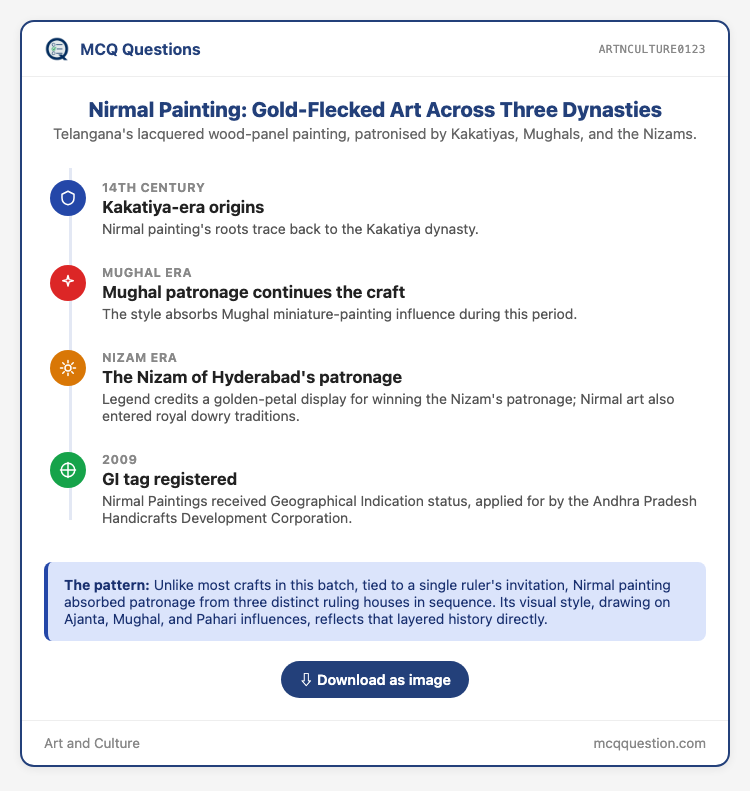
Nirmal Painting: Gold-Flecked Art Across Three Dynasties
Telangana’s lacquered wood-panel painting, patronised by Kakatiyas, Mughals, and the Nizams.
14th century
Kakatiya-era origins
Nirmal painting’s roots trace back to the Kakatiya dynasty.
Mughal era
Mughal patronage continues the craft
The style absorbs Mughal miniature-painting influence during this period.
Nizam era
The Nizam of Hyderabad’s patronage
Legend credits a golden-petal display for winning the Nizam’s patronage; Nirmal art also entered royal dowry traditions.
2009
GI tag registered
Nirmal Paintings received Geographical Indication status, applied for by the Andhra Pradesh Handicrafts Development Corporation.
The pattern: Unlike most crafts in this batch, tied to a single ruler’s invitation, Nirmal painting absorbed patronage from three distinct ruling houses in sequence. Its visual style, drawing on Ajanta, Mughal, and Pahari influences, reflects that layered history directly.
Art and Culturemcqquestion.com
Must Know
- Nirmal painting is a gold-flecked art form from Nirmal town in Telangana. Artists paint on lacquered wooden boards, using teak as the base wood.
- The craft’s roots trace to the 14th century, under Kakatiya dynasty patronage. It continued receiving support through the Mughal period and later the Nizams of Hyderabad.
- Nirmal art is made by the Naqash community. The technique involves lacquering the wood surface first, then painting the design, and finally applying a Duco paint coat in the chosen background colour.
- The style draws on multiple artistic influences. Ajanta cave art, Mughal miniature painting, and Pahari miniature painting all shaped Nirmal’s naturalistic look.
- Nirmal paintings received their Geographical Indication (GI) tag in 2009. The Andhra Pradesh Handicrafts Development Corporation applied for the registration.
Good to Know
- Nirmal paintings historically played a role in dowry traditions under the Nizams’ rule. This tied the craft directly into Hyderabad’s court and social customs, not just its decorative arts.
- The gold-flecked, glossy finish is the style’s most recognisable trait. It comes from applying gold-toned pigment detail over a rich lacquer base coat.
- Nirmal painting is distinct from Nirmal Toys, a separate wood-craft tradition also based in the same town. Both share the Nirmal name and general region but differ completely in form and technique.
Test Yourself

Great to Know
- Nirmal painting’s three-dynasty patronage history is unusual in this batch. Most crafts here (Bidriware, Channapatna, Meenakari) trace back to one ruler’s single invitation; Nirmal instead absorbed support across centuries and multiple ruling houses.
- This layered patronage history shows up directly in the art itself. A style influenced by Ajanta (ancient), Mughal (medieval imperial), and Pahari (regional hill-court) painting traditions couldn’t have formed under just one court’s taste.
- The banana-bud legend, whether literally true or not, captures something real about how craft patronage often worked historically: a single memorable display of skill, not a planned state policy, could secure a craft’s survival for generations.
This craft is one of many now sold directly to buyers through India’s digital marketplace for handloom and handicrafts. See ArtnCulture0134 — Indiahandmade for how the platform works.
Beyond the answer
Browse all art-and-culture topics →
📚 Keep reading
ArtnCulture0002 — Regional Schools of Indian Painting: Bundi, Pahari and Tanjore: A Complete GuideEconomy0033 — Global Gold Trade and ReservesArtnCulture0120 — Zardozi: Gold-Thread Embroidery of the Mughal CourtsArtnCulture0003 — Mughal Painting: Characteristic Features and Manuscripts: A Complete GuideModHist0004 — The Decline of the Mughal Empire: Causes Behind the Collapse❓ Practice this topic
D0421 — Which Director-General led the revival of the ASI under Lord Curzon in 1902?D0420 — Under which Ministry does the Archaeological Survey of India function?D0419 — Which Act governs the protection of monuments and archaeological sites of national importance in India?D0418 — Who is regarded as the founder and first Director-General of the Archaeological Survey of India?🎲 Take a Art And Culture Quiz
Leave a Reply