At age eleven, Bhimsen Joshi ran away from home to find a music teacher. He spent three years searching across North India before his father finally tracked him down. That search eventually led him to Sawai Gandharva, and to a voice that would become one of the most recognisable in Indian classical music.

Timeline
- 4 February 1922: Born in Ron, Gadag district, Karnataka.
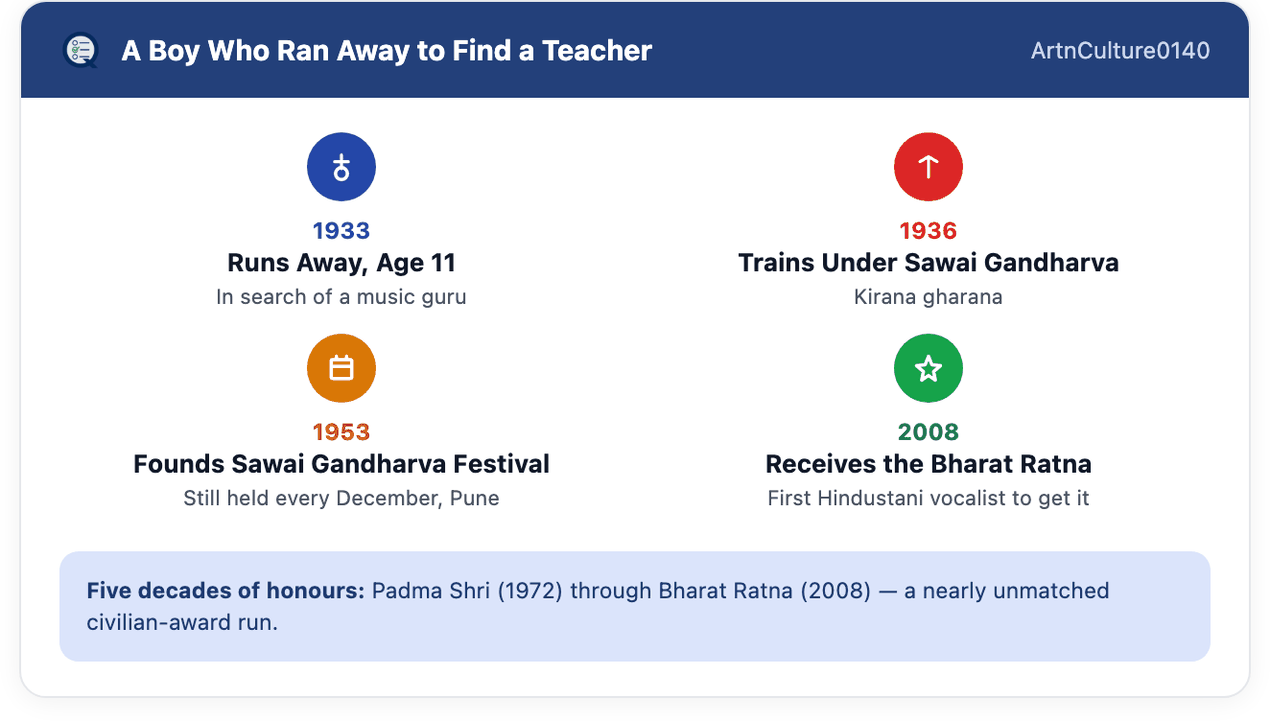
- 1933: Runs away from home at age 11, seeking a music guru.
- 1936: Begins formal training under Sawai Gandharva.
- 1953: Founds the Sawai Gandharva Music Festival, in Pune, to honour his guru.
- 1985: Wins the National Film Award for Best Male Playback Singer, and receives the Padma Bhushan.
- 2008: Receives the Bharat Ratna, India’s highest civilian honour.
- 24 January 2011: Dies in Pune, aged 88.
Must Know
- Bhimsen Joshi was a legendary Hindustani classical vocalist of the Kirana gharana. He was known for his powerful voice and exceptional breath control.
- He trained under guru Sawai Gandharva starting in 1936. This came after he ran away from home at age 11, in search of a teacher.
- In 1953, he founded the Sawai Gandharva Music Festival in Pune, still held every December. It was renamed the Sawai Gandharva Bhimsen Festival after his own death in 2011.
- He received the Bharat Ratna in 2008, becoming the first Hindustani classical vocalist to receive India’s highest civilian honour.
- Over a six-decade career, he specialised in khayal. He became known for popular ragas including Shuddha Kalyan, Miyan Ki Todi, and Darbari.
Good to Know
- He received a remarkable sequence of honours across five decades. These included the Padma Shri (1972), Padma Bhushan (1985), and Padma Vibhushan (1999). Later came the Maharashtra Bhushan (2002), Karnataka Ratna (2005), and finally the Bharat Ratna (2008).
- His senior fellow student under Sawai Gandharva was vocalist Gangubai Hangal, whom he respectfully called “akka” (elder sister).
- In 1984, he became the first Hindustani vocalist to receive a Platinum Disc for record sales.
- He also sang playback for films. In 1985, he won the National Film Award for Best Male Playback Singer, for the song “Thumak Thumak Pag” in Ankahee.
- He took part in the 1988 unity song Mile Sur Mera Tumhara. Between 1964 and 1982, he also toured internationally, including Afghanistan, Italy, France, Canada, and the United States.
Test Yourself

Great to Know
- His Kirana gharana style sits within India’s broader Hindustani classical tradition. See ArtnCulture0103 — Hindustani Classical Music and ArtnCulture0005 — Indian Music: Hindustani and Carnatic Traditions.
- A boy who ran away from home just to find a teacher went on to define an entire style of Indian classical singing. That kind of restlessness, the refusal to settle for whatever training was locally available, often separates a talented performer from a defining one.
Beyond the answer
Browse all art-and-culture topics →
📚 Keep reading
GK0009 — Bharat RatnaArtnCulture0103 — Hindustani Classical MusicArtnCulture0005 — Indian Music: Hindustani and Carnatic TraditionsArtnCulture0102 — ShehnaiArtnCulture0105 — Sarod❓ Practice this topic
D0421 — Which Director-General led the revival of the ASI under Lord Curzon in 1902?D0420 — Under which Ministry does the Archaeological Survey of India function?D0419 — Which Act governs the protection of monuments and archaeological sites of national importance in India?D0418 — Who is regarded as the founder and first Director-General of the Archaeological Survey of India?🎲 Take a Art And Culture Quiz
Leave a Reply