He died in 2011. His country’s highest civilian honour took eight more years to catch up.

Timeline
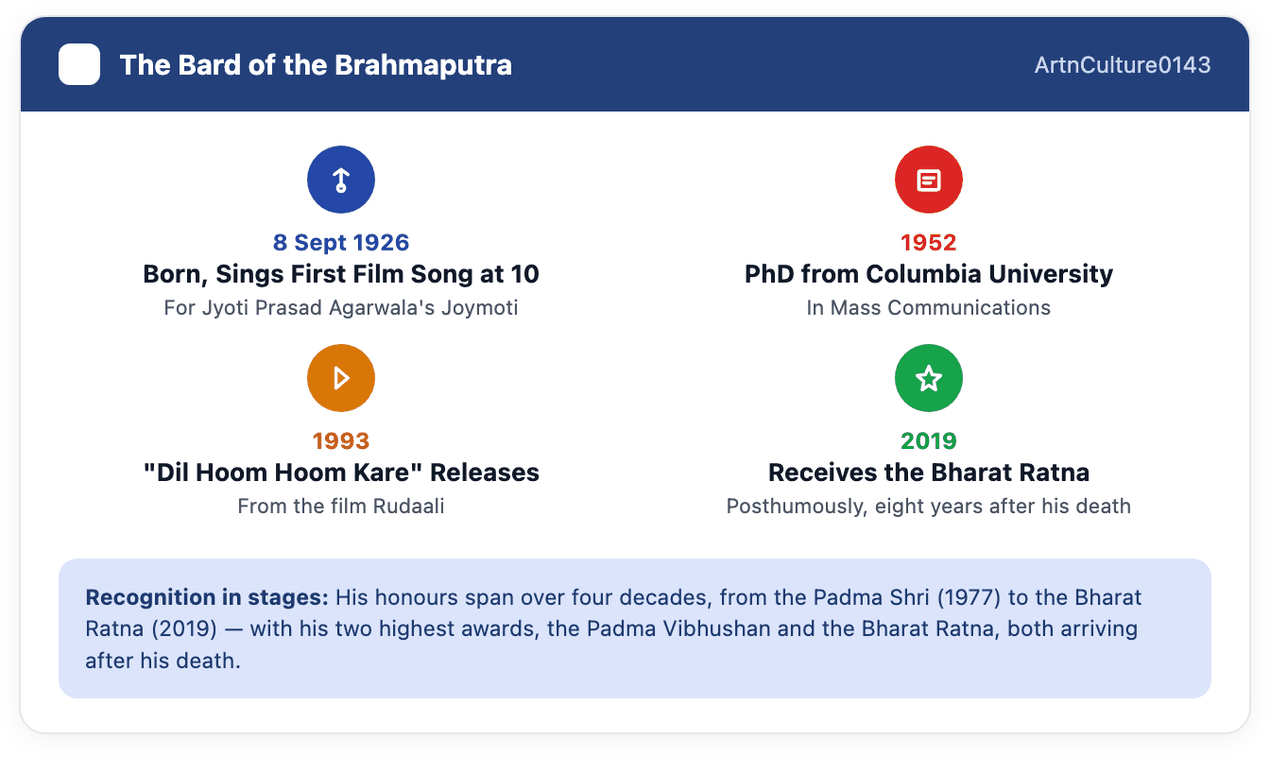
- 8 September 1926: Born in Sadiya, Assam. Sings his first film song at age 10, for Jyoti Prasad Agarwala’s Joymoti.
- 1952: Earns a PhD in Mass Communications, from Columbia University.
- 1993: His Hindi song “Dil Hoom Hoom Kare,” from the film Rudaali, is released.
- 5 November 2011: Dies in Mumbai, at age 85.
- 2019: Receives the Bharat Ratna, India’s highest civilian honour, posthumously.
Must Know
- Bhupen Hazarika (1926-2011) was an Assamese singer, composer, lyricist, and filmmaker.
- He is known as the “Bard of the Brahmaputra,” for his songs on Assamese culture and the river.
- He sang his first film song at age 10, for Jyoti Prasad Agarwala’s Assamese film Joymoti.
- He earned a PhD in Mass Communications from Columbia University, in 1952.
- His Hindi song “Dil Hoom Hoom Kare,” from the 1993 film Rudaali, made him a household name nationally.
- He was posthumously awarded the Bharat Ratna, India’s highest civilian honour, in 2019.
Good to Know
- He studied at Cotton College, Guwahati, and Banaras Hindu University, before his Columbia PhD.
- “Dil Hoom Hoom Kare” adapted his own earlier Assamese song, “Buku Hom Hom Kore.” Gulzar wrote its Hindi lyrics.
- He served as an independent MLA from Nauboicha, in the Assam Legislative Assembly, from 1967 to 1972.
- In 2004, he unsuccessfully contested the Lok Sabha election from Guwahati, on a BJP ticket.
- He won the National Film Award for Best Music Direction in 1975. He later won the Dadasaheb Phalke Award, India’s highest cinema honour, in 1992.
- See ArtnCulture0101 — Sattriya: The Monastery Dance of Assam, for another major art form from his home state.
Test Yourself

Great to Know
- His awards span over four decades. Padma Shri came in 1977, and Padma Bhushan in 2001.
- Both the Padma Vibhushan (2012) and the Bharat Ratna (2019) arrived after his death.
- Beyond music, he worked as a journalist, poet, and university teacher, briefly at Guwahati University.
- His career spanned Assamese, Hindi, and Bengali cinema, reflecting a broader vision of cultural integration across India.
Beyond the answer
Browse all art-and-culture topics →
📚 Keep reading
GK0009 — Bharat RatnaArtnCulture0037 — Patriotic Songs and Poetry of the Freedom StruggleGK0017 — Awards of IndiaPolity0072 — Dr. Zakir HusainArtnCulture0028 — Mani Ratnam and the Commercial-Arthouse Crossover❓ Practice this topic
In the Samudra Manthan story, what does Vishnu take the form of to distribute Amrita only among the gods?Who is the architect of the Ram Temple constructed at Ayodhya?The Dilwara Jain Temples are located at which hill site in Rajasthan?Which of India's three national arts academies was established first?🎲 Take a Art And Culture Quiz
Leave a Reply