India fights drugs on two fronts at once: cutting off supply at the border, and reducing demand at home. One coordinating agency sits at the centre of the first front.
 MCQ Questions
Narcotics Control Bureau
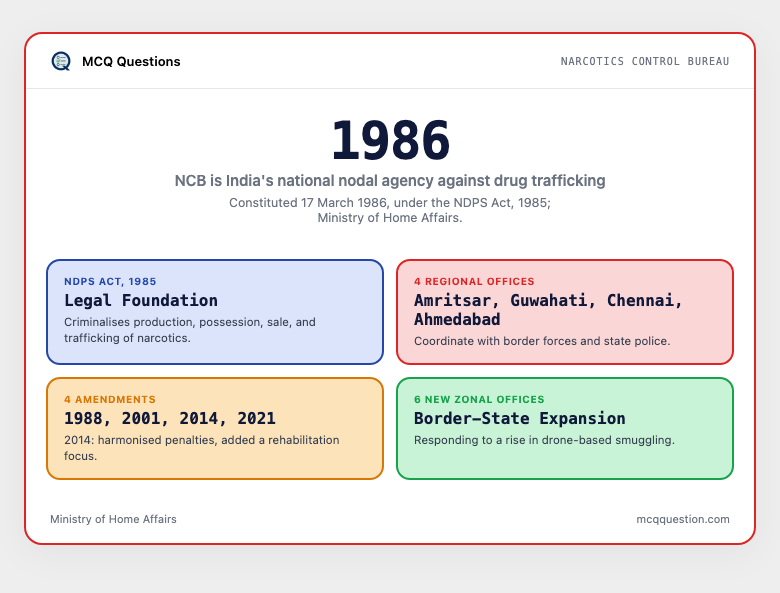
1986
NCB is India’s national nodal agency against drug trafficking
Constituted 17 March 1986, under the NDPS Act, 1985; Ministry of Home Affairs.
NDPS Act, 1985
Legal Foundation
Criminalises production, possession, sale, and trafficking of narcotics.
4 Regional Offices
Amritsar, Guwahati, Chennai, Ahmedabad
Coordinate with border forces and state police.
4 Amendments
1988, 2001, 2014, 2021
2014: harmonised penalties, added a rehabilitation focus.
6 New Zonal Offices
Border-State Expansion
Responding to a rise in drone-based smuggling.
Must Know
- The Narcotics Control Bureau (NCB) is India’s national nodal agency against drug abuse and the illicit trafficking of narcotic drugs and psychotropic substances, one of several bodies covered in Polity0015 — India’s Security and Intelligence Agencies.
- NCB was constituted on 17 March 1986, under the Narcotic Drugs and Psychotropic Substances (NDPS) Act, 1985.
- NCB is headquartered in New Delhi, under the administrative control of the Ministry of Home Affairs.
- NCB coordinates enforcement action by State Governments and other authorities. This spans the NDPS Act, the Customs Act, the Drugs and Cosmetics Act, and other relevant laws.
- The NDPS Act, 1985, is the foundational law here. It criminalises the production, possession, sale, purchase, transport, storage, and consumption of narcotic drugs and psychotropic substances, outside legitimate medical and scientific use.
Good to Know
- NCB is headed by a Director General, typically an IPS officer. Zonal units, each headed by a Zonal Director, operate in major cities across India.
- Four regional offices, each headed by a Deputy Director General, are based at Amritsar, Guwahati, Chennai, and Ahmedabad. They improve coordination with border-guarding forces and state police.
- The NDPS Act has been amended four times: in 1988, 2001, 2014, and 2021. The 2014 amendment harmonised penalties with the gravity of the offence, and gave more weight to rehabilitation.
- The National Policy on Narcotic Drugs and Psychotropic Substances, 2012, was issued by the Ministry of Finance. It draws on Article 47 of the Constitution’s Directive Principles of State Policy.
Test Yourself

Great to Know
- India’s counter-narcotics architecture splits supply-side enforcement from demand-side reduction. NCB, DRI, Customs, and state police handle enforcement, while the Ministry of Social Justice and Empowerment leads treatment, rehabilitation, and reintegration.
- Demand-side work runs through the National Action Plan for Drug Demand Reduction (NAPDDR), delivered via government hospitals and an NGO network.
- NCB works closely with the Directorate of Revenue Intelligence, Customs, the Central Bureau of Investigation, and state police. Drug trafficking networks routinely cross agency and jurisdictional lines.
- NCB’s role as “nodal coordinator” does not mean it leads every bust itself. Many large seizures, including narcotics cases, are actually carried out by DRI or Customs field formations.
Current Affairs
- 31 July 2026: The Union Government told the Rajya Sabha there is presently no proposal to establish integrated drug de-addiction and vocational training centres in the Jammu region.
- MoS Social Justice and Empowerment B L Verma was replying to an unstarred question from BJP MP Sat Sharma, who had sought stronger rehabilitation infrastructure for J&K’s youth.
- The Minister said J&K currently has 1 Integrated Rehabilitation Centre for Addicts (IRCA), 6 District De-Addiction Centres (DDACs), 2 Community-based Peer-led Intervention centres, 3 Outreach and Drop-In Centres, and 21 Addiction Treatment Facilities, under the National Action Plan for Drug Demand Reduction.
- On drug trafficking, the government cited its four-tier NCORD mechanism: since 2018, J&K has held 17 state-level and 836 district-level NCORD committee meetings.
- 29 July 2026: MoS Home Affairs Nityanand Rai told the Rajya Sabha that Manipur’s Moreh-Tamu border remains a major cross-border trafficking transit point from Myanmar.
- Between 2021-2025, agencies seized 4,626 kg of Amphetamine Type Stimulants and 2,652 kg of heroin nationwide.
- A four-tier Narco-Coordination Centre (NCORD) mechanism coordinates Central and State drug-enforcement agencies, down to monthly district-level meetings.
- The reply cited the Vision Document on Drug Control (2026-2029), released 26 June 2026, as the government’s current strategy framework.
- 22 July 2026: DRI busted a clandestine Mephedrone manufacturing facility, at a residential premises in Ankleshwar, Gujarat.
- Officers seized 1.349 kg of Mephedrone, plus precursor chemicals including 2-Bromo-4-Methylpropiophenone and Hydrobromic Acid.
- Rs 21 lakh in cash was recovered, believed to be drug-trafficking proceeds; three people were arrested.
- Under the same “Operation Vajra,” CBN separately thwarted a 12 crore-tablet Tramadol trafficking attempt, between 10-20 July 2026. The consignment weighed around 30 metric tonnes. (Source: PIB)
- The shipment was declared bound for Guinea-Bissau, but investigators suspect its real destination was Libya. CBN recovered it from a Delhi warehouse, before it entered illegal supply chains. (Source: PIB)
- Three people were arrested, including a company director in Bengaluru and two conspirators traced to Kochi. DRI’s Bengaluru and Kochi units supported the operation. (Source: PIB)
- India’s northeastern and Himalayan border states have recently seen a surge in drone-based drug smuggling. This has driven NCB’s expansion of new zonal offices, in Dimapur (Nagaland), Aizawl (Mizoram), Gangtok (Sikkim), Shillong (Meghalaya), Shimla (Himachal Pradesh), and Port Blair (Andaman and Nicobar Islands).
- On 1 August 2026, the Directorate of Revenue Intelligence busted a clandestine Alprazolam and Diazepam manufacturing unit in Satara district, Maharashtra. It seized about 1 kg of finished Alprazolam, over 15 kg of Alprazolam in intermediary form, and about 3.75 kg of Diazepam, along with roughly 400 litres of raw materials and reaction mixtures.
- DRI officers followed up with a swift operation in Pune, arresting the intended buyer of the consignment. This shows how psychotropic-substance enforcement often falls to DRI and Customs, not NCB alone, under India’s shared counter-narcotics architecture.
- Both Alprazolam and Diazepam are NDPS Act-regulated psychotropic benzodiazepines. They have legitimate medical uses, for anxiety, panic disorder, insomnia, and seizures, but carry high abuse and dependence potential.
- Between 1-10 July 2026, the Central Bureau of Narcotics (CBN) dismantled a high-tech Mephedrone (MD) manufacturing lab in Pune, Maharashtra, under “Operation Vajra.” Two masterminds were arrested, from Ujjain (Madhya Pradesh) and Jodhpur (Rajasthan). (Source: PIB)
- The bust built on an earlier CBN Neemuch case, from February 2026. That case had seized 8.17 kg of Mephedrone, and led investigators to a linked lab at Thavlay, Mhow. In the current calendar year, CBN has registered 142 cases and made 193 arrests, including busting four clandestine labs. (Source: PIB)
- 23 July 2026: MoS Home Affairs Nityanand Rai told the Rajya Sabha that drone-assisted drug trafficking has seen an “exponential rise,” with Punjab “the most affected border state.”
- In 2025 alone, 305 drone-related drug-trafficking incidents were reported nationwide, 298 of them along the Punjab border, seizing about 460 kg of narcotics, including 448 kg of heroin, 9 kg of methamphetamine, and 3 kg of opium.
- Traffickers increasingly use encrypted platforms like WhatsApp, Telegram, Snapchat, and Zangi to coordinate procurement and distribution, alongside GPS-enabled consignments. The government is deploying anti-drone systems, CCTV, night-vision devices, and upgraded border fencing in response. (Source: Millennium Post)
- 1 August 2026: Under Operation Vajra, CBN’s Madhya Pradesh Unit dismantled an inter-state counterfeit drug network in Bihar, targeting Gaya and Masaurhi (Patna).
- Eight illegal godowns storing counterfeit medicines and narcotics, plus one illicit manufacturing facility, were dismantled. Seized counterfeit medicines included Clavam-625, PAN-40, Betadine Ointment, and Azithral.
- A clandestine unit at a farmhouse near Masaurhi was found manufacturing Buprenorphine and other narcotics, using machinery, chemicals, and flavouring agents seized under the NDPS Act, 1985.
- The syndicate operated from rented premises without tenancy agreements, paid in cash to avoid digital records, and used mobile numbers registered with forged ID documents.
- 4 August 2026: The government said its “zero tolerance” policy against drug traffickers led to 29 traffickers being convicted across 12 cases nationwide, under the NDPS Act.
- The cases spanned Ahmedabad, Bhopal, Chandigarh, Kochi, Dehradun, Delhi, Indore, Kolkata, Jharkhand, and Lucknow, involving seizures of charas, ganja, opium, and heroin.
- 26 June 2026: Union Home Minister Amit Shah chaired the 10th apex-level NCORD meeting, at Vigyan Bhawan, New Delhi. He released the Vision Document on Drug Control (2026-2029) at the meeting.
- The meeting brought together 44 Central Ministries and Departments. It also drew 108 representatives from State Governments and Drug Law Enforcement Agencies, in hybrid mode.
- The roadmap runs on 4 pillars: Enforcement, Intelligence and Operations; Precursors and Synthetic Drug Control; Demand and Harm Reduction; and Capacity Building, Coordination and Monitoring.
- Shah summed up the strategy in 3 words: Detect, Disrupt, and Destroy. It targets cartels at every stage, from foreign sourcing to state-to-user distribution.
- Shah also launched the Online Drugs Disposal Fortnight Campaign, targeting the destruction of over ₹6,000 crore in narcotics, weighing 2,09,500 kg. He released the NCB Annual Report 2025, and e-inaugurated new NCB zonal offices in Jammu and Guwahati.
- Shah cited a decade-on-decade comparison. Drug seizures rose from ₹40,000 crore (2004-2014) to ₹1,84,000 crore (2014-2026). Destruction rose from ₹8,000 crore to ₹89,896 crore over the same two periods.
Beyond the answer
Browse all indian-polity-and-constitution topics →
📚 Keep reading
Polity0153 — India's National Anti-Narcotics Coordination Mechanism (NCORD)Polity0176 — MANAS: National Narcotics HelplinePolity0150 — Directorate of Revenue Intelligence (DRI)GenSci0027 — ICMR (Indian Council of Medical Research)Polity0152 — The NDPS Act, 1985: Narcotic Drugs and Psychotropic Substances❓ Practice this topic
What does Article 75(1A) of the Constitution, inserted by the 91st Amendment, specifically cap?How does a sitting Vice-President of India resign from office?Which landmark Supreme Court case first established the Basic Structure doctrine?Under international law, what is the precise legal test that defines an act as 'piracy'?🎲 Take a Indian Polity And Constitution Quiz
Leave a Reply