Flooding a field can waste more than half the water used. This article covers drip and micro-irrigation, and the government scheme built to spread them.

Timeline
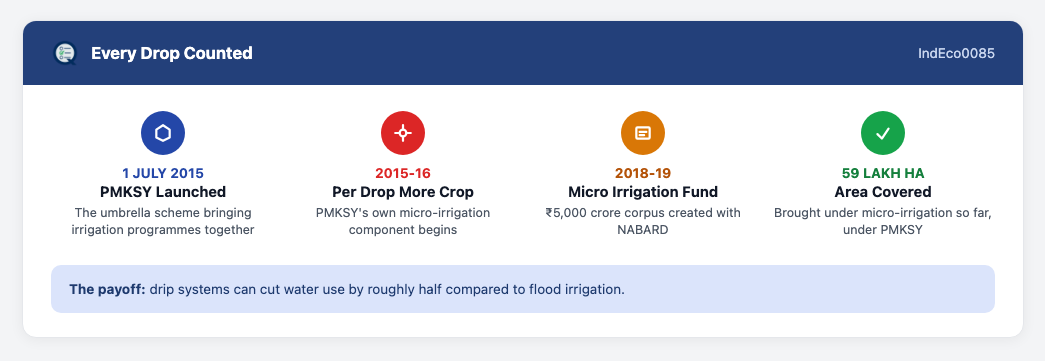
- 1 July 2015: The Pradhan Mantri Krishi Sinchayee Yojana (PMKSY) launched, bringing India’s irrigation programmes under one umbrella scheme.
- 2015-16: PMKSY’s Per Drop More Crop (PDMC) component began. It focuses specifically on drip and sprinkler micro-irrigation.
- 2018-19: The government created a Micro Irrigation Fund, with a ₹5,000 crore corpus, housed at NABARD. It became operational the following year, 2019-20.
- 2022-23: Per Drop More Crop (PDMC) moves out of PMKSY. It now runs under the Rashtriya Krishi Vikas Yojana (RKVY) instead.
- 2023-24: India had brought about 83 lakh hectares under micro-irrigation, cumulatively since 2015-16.
Must Know
🏛️ Must Know
What Micro-Irrigation Covers
- Two Methods Micro-irrigation covers drip and sprinkler methods. Both deliver water directly and precisely, instead of flooding an entire field.
- Efficiency Drip irrigation can achieve water-use efficiency above 80-90%. Traditional flood irrigation typically manages only around 40-60%.
- Real Advantages Drip irrigation genuinely reduces weed growth, since less water sits on the soil surface between rows. It also reduces soil erosion, since it delivers water at a slow, controlled rate with no surface runoff.
- Not a Salinity Fix Drip irrigation does not directly reduce soil salinity. If not managed carefully, it can even cause salt buildup at the edge of the wetted zone.
The Scheme Behind It
- Per Drop More Crop The Per Drop More Crop component gives farmers financial assistance for installing micro-irrigation systems.
- Subsidy Rates Small and marginal farmers get 55% financial assistance under the scheme; other farmers get 45%.
- Micro Irrigation Fund The Micro Irrigation Fund, held at NABARD, gives states low-cost loans to expand micro-irrigation coverage beyond what direct subsidies alone can reach.
Good to Know
📘 Good to Know
Impact and Uptake
- Yield Gains Drip irrigation studies show yield gains of roughly 25-50%, alongside water savings of 30-60%, compared to conventional flood irrigation.
- Uneven Adoption Adoption of micro-irrigation has been geographically uneven. A small handful of states have historically accounted for the bulk of India’s total progress under the scheme.
- NABARD Financing NABARD has sanctioned micro-irrigation projects worth several thousand crore rupees, funding state-level expansion beyond individual farmer subsidies.
📝 Previous Year Questions
UPSC CSP 2016 — Real Advantages of Drip Irrigation
- UPSC 2016 Drip irrigation reduces weed growth and soil erosion, so statements 1 and 3 are correct. It does not directly reduce soil salinity, so statement 2 is false. See UPSC CSP 2016 GS Paper I, Q83. View this question.
Test Yourself

Great to Know
🌟 Great to Know
Two Problems, One Fix
- Two Problems at Once Micro-irrigation addresses two problems at once: water scarcity and crop productivity. Precision delivery both conserves a scarce resource and improves how effectively plants can use it.
- Two-Track Funding Layering a dedicated Micro Irrigation Fund on top of direct subsidies shows a two-track funding strategy. Individual farmer incentives work alongside larger state-level infrastructure financing.
- The Scheme’s Logic The scheme’s name, “Per Drop More Crop,” captures its core logic directly. The goal isn’t using less water for its own sake, but producing more output per unit of water used.
- Why Adoption Varies Uneven state-level adoption suggests the barrier isn’t just cost. Local water stress, crop choice, and farmer awareness all likely shape how quickly a state takes up micro-irrigation.
Current Affairs
📰 Current Affairs
PMKSY’s Current Structure (2026)
- Three Components On 21 July 2026, a Lok Sabha reply detailed PMKSY’s current structure. It now runs on three components: AIBP and Har Khet Ko Pani (HKKP), under the Department of Water Resources, Ministry of Jal Shakti; and the Watershed Development Component (WDC), under the Department of Land Resources. (Source: PIB)
- No Private Provision PMKSY has no specific provision for private-sector investment. State governments run its projects through competitive tendering, and don’t maintain centralised data on how many farmers or field workers are trained. (Source: PIB)
- Micro-Irrigation Moved Out Drip and sprinkler micro-irrigation, the subject of this article, moved out of PMKSY in 2022-23. It now runs separately, under the Rashtriya Krishi Vikas Yojana (RKVY). (Source: PIB)
Leave a Reply