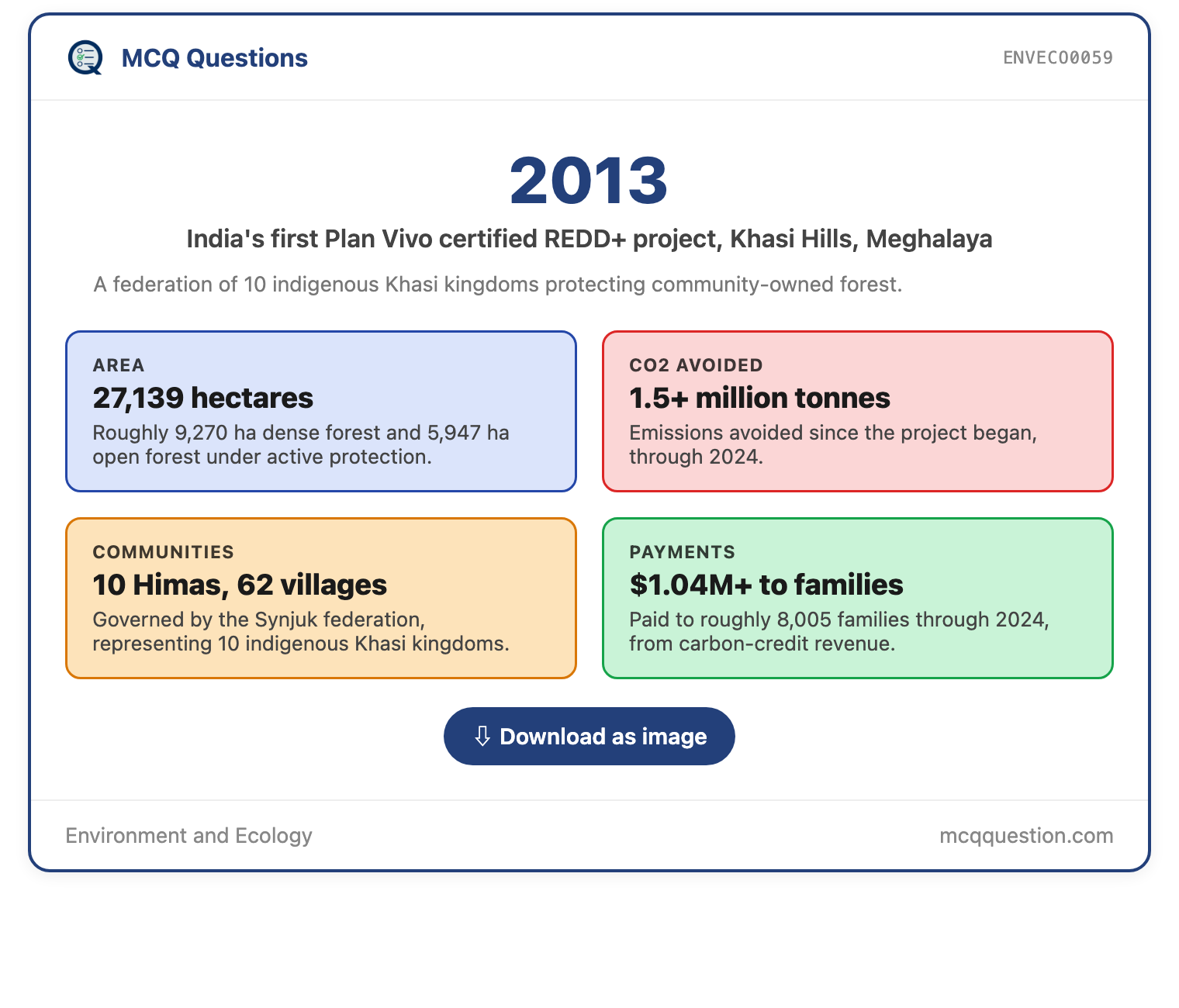
Ten Khasi kingdoms, one federation, and a forest that pays its own keepers. In 2013, a community project in Meghalaya became India’s first Plan Vivo certified REDD+ project, turning conservation into direct income for local families.

 MCQ Questions
1. What the Project Is
- First of Its Kind The Khasi Hills Community REDD+ Project is India’s first Plan Vivo certified REDD+ project. Its federation registered in 2011, and Plan Vivo certified it in 2013.
- Location It operates in East Khasi Hills District, Meghalaya, along the Umiam River watershed.
- Two Methods It uses REDD+ to protect existing dense forests and sacred groves. It uses Assisted Natural Regeneration (ANR) to restore degraded open forests separately.
2. Who Runs It
- The Synjuk The project is governed by the Ka Synjuk Ki Hima Arliang Wah Umiam Mawphlang Welfare Society. It’s a federation of 10 indigenous Khasi himas (traditional kingdoms) and their 62 villages.
- Legal Entity The federation registered in Meghalaya in August 2011, giving these traditional governments one unified legal body to run the project.
The Numbers Behind It
- Scale The project covers 27,139 hectares. That includes roughly 9,270 hectares of dense forest and 5,947 hectares of open forest.
- Climate Impact It has avoided over 1.5 million tonnes of CO2 emissions since it began.
- Community Payouts Through 2024, it had paid roughly $1.04 million to about 8,005 participating families. A further $414,951 went into forest conservation and management.
Global Forest-Carbon Financing Mechanisms
- BioCarbon Fund The BioCarbon Fund Initiative for Sustainable Forest Landscapes is a multilateral fund managed by the World Bank. It supports REDD+ programmes and sustainable land use in developing countries.
- Forest Carbon Partnership Facility The Forest Carbon Partnership Facility is a global partnership of governments, businesses, civil society, and indigenous peoples. It gives countries financial and technical assistance for their REDD+ efforts, not funding for individual scientific research.
- Same Family Both mechanisms are hosted by the World Bank. Projects like Khasi Hills sit within this same broader ecosystem of international forest-carbon finance.
Test Yourself

Why This Model Matters
- Traditional Governance The project works through existing Khasi traditional institutions, the himas, rather than creating new bureaucracy from scratch. Conservation policy runs through governance structures communities already trust.
- Paying for Protection Carbon-credit revenue gives forest-owning communities a direct financial reason to protect their forest, rather than clear it for other uses. This flips the usual incentive problem in community forestry.
- A Template As India’s first Plan Vivo REDD+ project, Khasi Hills became a reference case. Later Indian REDD+ efforts, including projects in the Garo Hills, have drawn on its community-federation model.
Why the Other Options Are Wrong
- Uttarakhand REDD+ A real initiative, but not the first Plan Vivo certified one in India.
- ICFRE-ICIMOD Transboundary Project Covers the North-Eastern Himalayas region broadly, but again, not the first certified project.
- Sikkim Mamley Kamrang A genuine community project, but certified after Khasi Hills, not before it.
- The Real Answer Khasi Hills alone holds the distinction of being first, certified by Plan Vivo in 2013.
Previous Year Question
Asked as: “Which one of the following is the first Plan Vivo certified Reducing Emissions from Deforestation and Forest Degradation (REDD+) project in India?” (UPSC CSP 2026, GS Paper I).
Previous Year Question
Asked as: “‘BioCarbon Fund Initiative for Sustainable Forest Landscapes’ is managed by the” (UPSC CSP 2015, GS Paper I). Answer: the World Bank. View this question.
Previous Year Question
Asked as: “With reference to ‘Forest Carbon Partnership Facility’, which of the following statements is/are correct?” (UPSC CSP 2015, GS Paper I). Answer: 1 and 3 only — it is a global partnership of governments, businesses, civil society and indigenous peoples, and it assists countries in their REDD+ efforts with financial and technical assistance. It does not fund individual scientific research. View this question.
Beyond the answer
Browse all environment-and-ecology topics →
📚 Keep reading
UPSC CSP 2026 — General Studies Paper I (Full Question Paper)UPSC CSP 2015 — General Studies Paper I (Full Question Paper)ModHist0134 — Tirot Sing: The Khasi Hills' Guerrilla WarEnvEco0140 — UN-REDD+ Programme BenefitsBamboo Under the Forest Act and the Forest Rights Act❓ Practice this topic
D0306 — Consider the following statements: 1. NCAP is a statutory programme backed by a dedicated law. 2. City action plans under NCAP are tracked on the PRANA portal. 3. The Graded Response Action Plan stages emergency measures for Delhi-NCR by AQI level. How many of the statements are correct?D0305 — Which statement best describes a 'non-attainment city' under NCAP?D0304 — What was the original target set by NCAP for reducing PM2.5 and PM10 concentrations by 2024?D0303 — Which ministry anchors the National Clean Air Programme?🎲 Take a Environment And Ecology Quiz
Leave a Reply