The warming climate is pushing global sea levels higher every year.
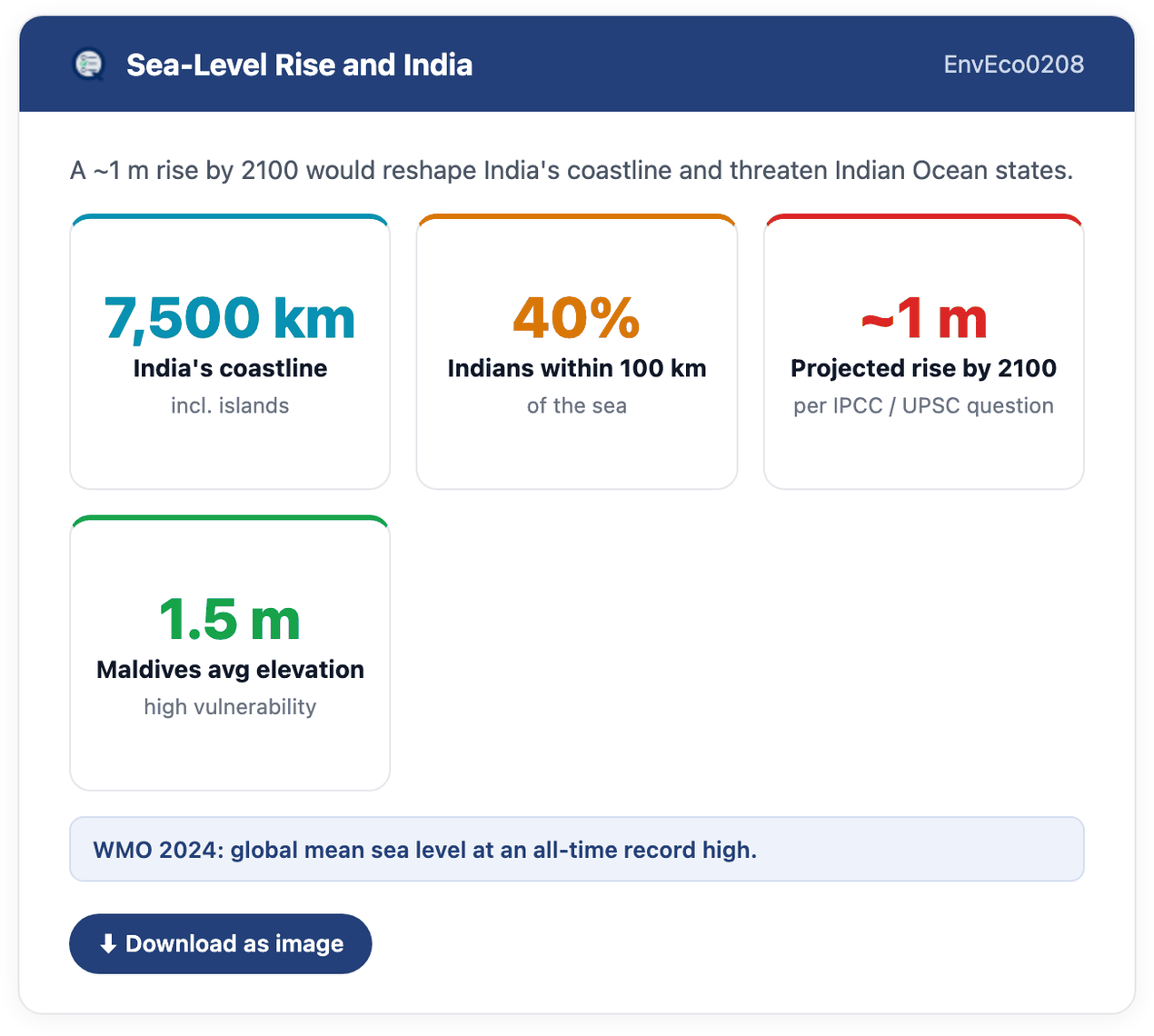
A rise of about one metre by 2100 would redraw India’s long coastline.


Must Know
Sea-Level Rise: The Basics
What sea-level rise is
- DefinitionSea-level rise is the long-term increase in the height of the ocean surface.
- ExpansionWarming seawater expands, and that expansion alone pushes sea levels up.
- Ice MeltMelting glaciers and ice sheets add huge volumes of new water to the sea.
- AR6Global mean sea level rose about 0.2 metres between 1901 and 2018.
- PaceThe rate of rise is accelerating as the planet keeps warming.
What the IPCC projects for 2100
- QuestionThe UPSC question cites a global rise of about one metre by 2100.
- AR6 RangeIPCC AR6 projects 0.63 to 1.01 metres under the high-emissions scenario.
- VariationActual rise will vary by region, warming and local land movement.
- Indian OceanParts of the Indian Ocean may see a rise above the global mean.
Why India’s long coastline is exposed
- LengthIndia’s coastline, including islands, is roughly 7,500 kilometres long.
- PeopleAbout 40 per cent of Indians live within 100 km of the sea.
- CitiesMumbai, Chennai and Kolkata are among the coastal megacities.
- DeltasRiver deltas such as the Sundarbans sit barely above sea level.
The four direct impacts on India
- InundationRising seas flood low-lying land during high tides and storms.
- ErosionHigher waters let waves eat away beaches, cliffs and delta shores.
- SalinitySeawater pushes inland into rivers, wells and farm soil.
- DisplacementCoastal people lose homes, farmland and livelihoods to the sea.
Good to Know
Impact on India and the Indian Ocean
How a one-metre rise hits Indian coasts
- ErosionA national satellite assessment found a third of the coastline vulnerable to erosion.
- MumbaiMumbai’s low-lying districts already flood during high tides.
- FarmingSaltwater ruins paddy fields and coconut groves near the shore.
- FisheriesEstuaries and fish nurseries face rising salinity.
- Drinking WaterSalt intrusion threatens drinking-water wells in coastal towns.
The Sundarbans and island territories
- SundarbansThe Sundarbans is a low delta shared by India and Bangladesh.
- LossRising seas and sinking land shrink its mangrove islands.
- AndamanThe Andaman and Nicobar islands lose beaches to erosion.
- LakshadweepLakshadweep’s coral atolls rise only a few metres above the sea.
Impacts on other Indian Ocean countries
- MaldivesThe Maldives has an average elevation of about 1.5 metres.
- BangladeshBangladesh’s vast delta is among the most exposed on Earth.
- IslandsSmall island states face threats to land, water and survival.
- Sri LankaSri Lanka’s low coasts face erosion, floods and saline water.
- Wider RegionCoastal Africa and Southeast Asia share the same rising risks.
Why the Indian Ocean is warming fast
- WarmingThe Indian Ocean is warming faster than the global average.
- HeatwavesMarine heatwaves have become more frequent in its waters.
- CyclonesWarmer seas fuel stronger cyclones and higher storm surges.
- Local RiseWarmth, currents and subsidence lift regional sea level further.
Test Yourself
quiz not found]Great to Know
Response and the Way Forward
Adaptation measures for India
- MangrovesMangrove restoration shields coasts and absorbs storm energy.
- CRZCoastal Regulation Zone rules control construction near the shore.
- Early WarningINCOIS issues forecasts for waves, surges and coastal flooding.
- DefencesSea walls and nature-based defences protect key cities and ports.
Global response and cooperation
- ParisThe Paris Agreement of 2015 frames global climate action.
- Loss and DamageCOP28 operationalised the loss and damage fund in 2023.
- IPCCThe IPCC synthesises the science behind these decisions.
- FinanceAdaptation finance must reach the smallest island nations.
Hard choices and the way forward
- Trade-offHard walls can protect cities but can damage beaches and ecology.
- RetreatSome communities may need a planned retreat from the shoreline.
- EmissionsCutting emissions slows the rise that adaptation cannot stop.
- Way ForwardCoastal planning must pair protection with honest risk maps.
Current Affairs
📰 Current Affairs
Recent reports show the rise accelerating and Indian coasts eroding.
WMO: sea level hit a record in 2024
- ReportThe WMO State of the Global Climate 2024 report came out in March 2025.
- RecordGlobal mean sea level in 2024 was the highest ever recorded.
- PaceThe recent decadal rate of rise is more than double the 1993 to 2002 rate.
- SourceAxios on the WMO report (19 March 2025)
A third of India’s coastline is vulnerable to erosion
- MappingSatellite monitoring covered the whole Indian coast from 1990 to 2018.
- ShareAbout 33.6 per cent of the coast was found vulnerable to erosion.
- BalanceAbout 26.9 per cent was accreting and 39.6 per cent stable.
- SourcePIB — Coastal Erosion (4 December 2023)
UN chief issues a global SOS on rising seas
- TongaIn August 2024 the UN Secretary-General addressed Pacific leaders in Tonga.
- SOSHe declared sea-level rise an emergency and issued a global SOS call.
- CallHe urged faster emission cuts and more adaptation finance.
- SourceUN Secretary-General statement (27 August 2024)
PYQ
Previous Year Questions
UPSC CSM 2023 GS Paper III, Q18
- Mains 2023UPSC CSM 2023 GS Paper III, Q18 — View this question
- AskThe question links a one-metre global rise with Indian Ocean impacts.
- PlanState the projection, then treat India and regional neighbours separately.
- TipName erosion, inundation, salinity and the Sundarbans for full marks.
Leave a Reply