Development funding doesn’t only flow from government budgets. Foreign contributions and hyper-local planning both shape how projects actually reach people.


Must Know
FCRA, Foreign Funding of NGOs and Micro-Level Planning
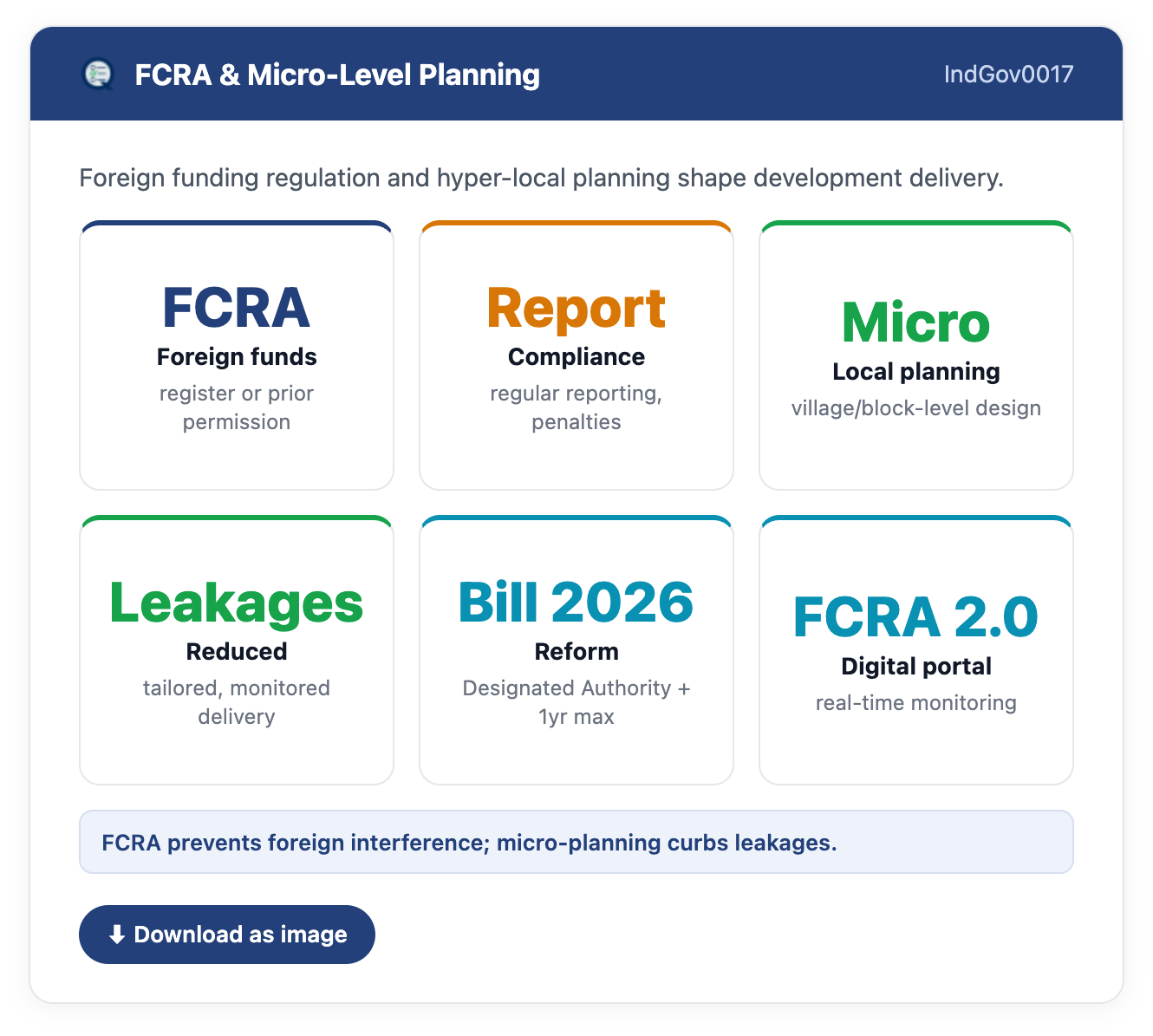
The FCRA Framework: Registration and Compliance
- LawThe Foreign Contribution (Regulation) Act regulates how NGOs and individuals receive foreign funding, to prevent foreign interference through unaccountable funding channels.
- RegistrationOrganisations must register, or get prior permission, to accept foreign funds. Violations can lead to registration cancellation.
- ComplianceFCRA requires regular reporting on how foreign funds are received and used, with penalties, including cancellation, for violations.
Micro-Level Planning
- DefinitionMicro-planning designs interventions at the village or local-block level, rather than applying a single uniform plan nationwide.
- GoalIt reduces leakages by tailoring interventions to local needs, which a one-size-fits-all national scheme cannot capture.
Good to Know
Debates and Requirements
Stricter Enforcement, and the Case For It
- TrendFCRA rules have tightened in recent years, with several NGOs losing registration, sparking debate about shrinking civil-society space.
- The Case ForSupporters say stricter enforcement prevents foreign interference in domestic affairs, treating unaccountable foreign funding as a genuine national-security concern, not just red tape.
Effective Micro-Planning
- NeedEffective micro-planning requires strong local data collection, since a plan built on inaccurate ground data fails regardless of good intentions.
- ParticipationIt needs genuine community participation in identifying priorities, not officials assuming what a village needs from the district office.
Test Yourself
Loading practice…
Great to Know
Balancing Regulation and Development
A Delicate Balance, and What Makes Micro-Planning Work
- The BalanceFCRA reflects an ongoing balance between enabling legitimate funding and preventing misuse. NGOs are a legitimate channel for philanthropy, research and development work, but unaccountable foreign funds can be misused to influence domestic affairs.
- The Trade-offStrict rules curb abuse but can also shrink the space for genuine civil-society work. Registration and reporting seek to keep funding flows visible and accountable, building public trust that foreign funds serve stated, lawful purposes.
- What Makes Micro-Planning WorkMicro-planning succeeds through genuine local participation, not top-down data dressed up as local input. Effective implementation also needs accountability mechanisms matched to the scale of the intervention, the same principle FCRA applies at the national level.
Current Affairs
📰 Current Affairs
FCRA Amendment Bill, 2026, and the FCRA 2.0 Portal
- The BillThe FCRA Amendment Bill, 2026, introduced in the Lok Sabha on 25 March 2026, creates a Designated Authority to supervise, manage and dispose of a lapsed organisation’s foreign-contribution assets. It has since been referred to a Joint Parliamentary Committee. (Source: PRS Legislative Research)
- Old vs NewThe 2010 Act set five-year renewable registration with a prior-permission route for one-time recipients; the 2020 amendment added Aadhaar for key functionaries, cut the administrative-expense cap to 15%, and mandated a designated SBI account. The 2026 Bill adds the asset-vesting mechanism on top of these: assets are restored if registration is renewed, but vest permanently if not, and places of worship must keep their religious character.
- Penalties EasedMaximum imprisonment is rationalised from five years to one, and state agencies now need central approval to investigate. Renewing NGOs must show they utilised at least Rs 10 lakh in foreign contributions over the prior two years.
- The PortalOn 30 June 2026, Union Home Minister Amit Shah launched the FCRA 2.0 Portal and e-OCI Card in New Delhi, enabling real-time monitoring of foreign contributions and cutting paperwork. As of 15 July 2026, 14,449 FCRA certificates were active; 37,455 organisations have been removed since 2011. (Source: News on AIR (Prasar Bharati))
PYQ
Exam Point of View
The Trap: Which Amendment Did What
- The PatternFCRA questions test whether you know which specific amendment introduced which specific rule, not just that FCRA was “tightened over time.”
- TrapAadhaar for key functionaries, the 15% administrative-expense cap, and the mandatory designated SBI account all came from the 2020 amendment, not the original 2010 Act. The 2026 Bill’s own new addition is the Designated Authority for lapsed organisations’ assets, and the reduction of maximum imprisonment from five years to one.
- Also TestedFCRA itself dates to 1976, enacted during the Emergency; the 2010 Act was a consolidation, not the law’s origin. A question naming “1976” versus “2010” versus “2020” versus “2026” as FCRA’s starting point is testing exactly this timeline.
- TakeawayBuild a simple year-to-change table before the exam: 1976 (law created), 2010 (consolidated), 2020 (Aadhaar, 15% cap, SBI account), 2026 (Designated Authority, penalty cut). Match any cited rule to its actual year rather than assuming the newest or oldest amendment did everything.
Beyond the answer
Browse all indian-polity-and-constitution topics →
📚 Keep reading
IndEco0013 — Planning Commission and Five Year PlansIndGov0002 — Development Processes, NGOs and BureaucracyIndEco0050 — India's Five Year PlansPolity0030 — Pressure Groups, NGOs and Key MinistriesPolity0122 — NITI Aayog: Founding, Structure, and Mandate❓ Practice this topic
Preamble Quiz: 5 Questions with ExplanationsPolity0391 — Article 47 of the ConstitutionPolity0390 — Article 46 of the ConstitutionPolity0389 — Article 30 of the Constitution🎲 Take a Indian Polity And Constitution Quiz
Leave a Reply