India has approved exactly one transgenic crop for commercial farming. This article covers how that decision gets made, and why most other GM crops never clear the bar.

Timeline.
From GEAC’s Founding to GM Mustard.
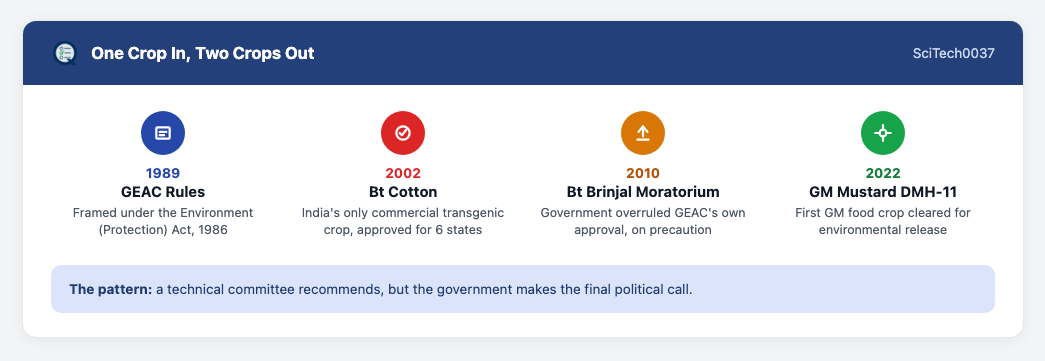
- 1989. India framed its GM-regulation rules under the Environment (Protection) Act, 1986. These rules created the committee that still approves GM crops today.
- 2002. The GEAC approved Bt cotton for commercial cultivation across six states. It remains India’s only approved commercial transgenic crop.
- 2010. The government placed an indefinite moratorium on Bt brinjal. This overruled the GEAC’s own prior approval, citing the precautionary principle. Pushpa Bhargava, the Supreme Court’s own nominee on the GEAC, was a leading voice pressing for that outcome.
- 2022. The GEAC recommended environmental release of GM mustard hybrid DMH-11. It was India’s first GM food crop cleared this way.
Must Know.
How Domestic GM Crops Get Cleared.
- GEAC. The Genetic Engineering Appraisal Committee (GEAC) is India’s statutory regulator for GM crops and organisms. It functions under the Ministry of Environment, Forest and Climate Change.
- Mandatory Clearance. GEAC clearance is mandatory before any GM crop’s environmental release. It appraises safety from an environmental angle, based on its 1989 Rules.
- Bt Cotton. Approved in 2002, Bt cotton remains India’s only commercially cultivated transgenic crop. It carries a bacterial gene giving it built-in insect resistance.
- GM Mustard DMH-11. Developed at Delhi University, it got GEAC’s environmental-release recommendation in 2022. It was India’s first GM food crop to clear this stage.
- Not Automatically Final. A GEAC recommendation is not automatically final. The government can still block release on policy grounds, as it did with Bt brinjal in 2010.
Good to Know.
Committee Structure and Cross-Pollination Concerns.
- GEAC Structure. GEAC has 24 members and meets monthly. Its members are drawn from bodies like ICAR and ICMR, alongside other ministries.
- Cross-Pollination Risk. Brinjal is a cross-pollinated crop. That made contamination of non-GM varieties a central concern behind the 2010 moratorium decision.
- Conditional Approval. The GM mustard approval came with conditions attached. Further coordinated field trials with ICAR were required within two years of the approval.
GM Food Imports.
Cultivation Rules Are Not Import Rules.
- A Different Question. GEAC’s rules govern GM crop cultivation and environmental release within India. Importing GM food is governed separately, mainly by the Food Safety and Standards Authority of India (FSSAI).
- Import Approval Needed. Indian law prohibits importing GM food without approval from the competent authority. GEAC evaluates and authorises GM food, feed, and living modified organism imports based on scientific risk assessment.
- FSSAI’s Threshold. FSSAI has set a 1% threshold for GMO content in imported food crops, and requires a “non-GM-origin-cum-GM-free certificate” for certain imported crops.
- A Common Exam Pairing. UPSC has tested this import-approval rule alongside unrelated trade facts, like whether India imports apples from a specific country, to see if candidates can separate the two issues.
Previous Year Question.
Asked as: “Consider the following statements. Statement-I: India does not import apples from the United States of America. Statement-II: In India, the law prohibits the import of Genetically Modified food without the approval of the competent authority.” This was asked in UPSC CSP 2024, GS Paper I. India in fact does import apples from the US, so Statement-I is wrong, while Statement-II on GM food imports is correct. View this question.
Previous Year Question.
Asked as: “With reference to the Genetically Modified mustard (GM mustard) developed in India, consider the following statements: 1. GM mustard has the genes of a soil bacterium that give the plant the property of pest-resistance to a wide variety of pests. 2. GM mustard has the genes that allow the plant cross-pollination and hybridization. 3. GM mustard has been developed jointly by the IARI and Punjab Agricultural University.” This was asked in UPSC CSP 2018, GS Paper I, Q63. GM mustard’s soil-bacterium genes (barnase/barstar) enable hybridization, not pest resistance, and it was developed by Delhi University, not IARI or Punjab Agricultural University, so only statement 2 is correct. View this question.

Test Yourself.
Great to Know.
Expert Bodies vs. Political Decisions.
- Two Layers. The Bt brinjal moratorium shows how India’s GM regulation has two layers. A technical committee assesses safety, but political and public-acceptance concerns can still override its recommendation.
- A 20-Year Gap. Twenty years separate Bt cotton’s 2002 approval from GM mustard’s 2022 clearance. That gap reflects how much more contested a food crop is than a non-food fibre crop.
- Food vs. Fibre. Bt cotton avoided some of Bt brinjal’s controversy partly because cotton isn’t eaten. Food-safety objections carry far less weight for a crop nobody consumes directly.
- A Broader Pattern. GEAC’s structure, a technical body whose recommendation the government can still overrule, mirrors a broader pattern in Indian regulation. Expert bodies inform decisions; elected government retains the final say.
Leave a Reply