By the late 1800s, hunting had reduced India’s Asiatic lions to about a dozen animals, all in one forest. In 1900, the Nawab of Junagadh banned hunting there. Every wild Asiatic lion alive today descends from that one protected population, in what is now Gir National Park.


 MCQ Questions
IndGeo0101
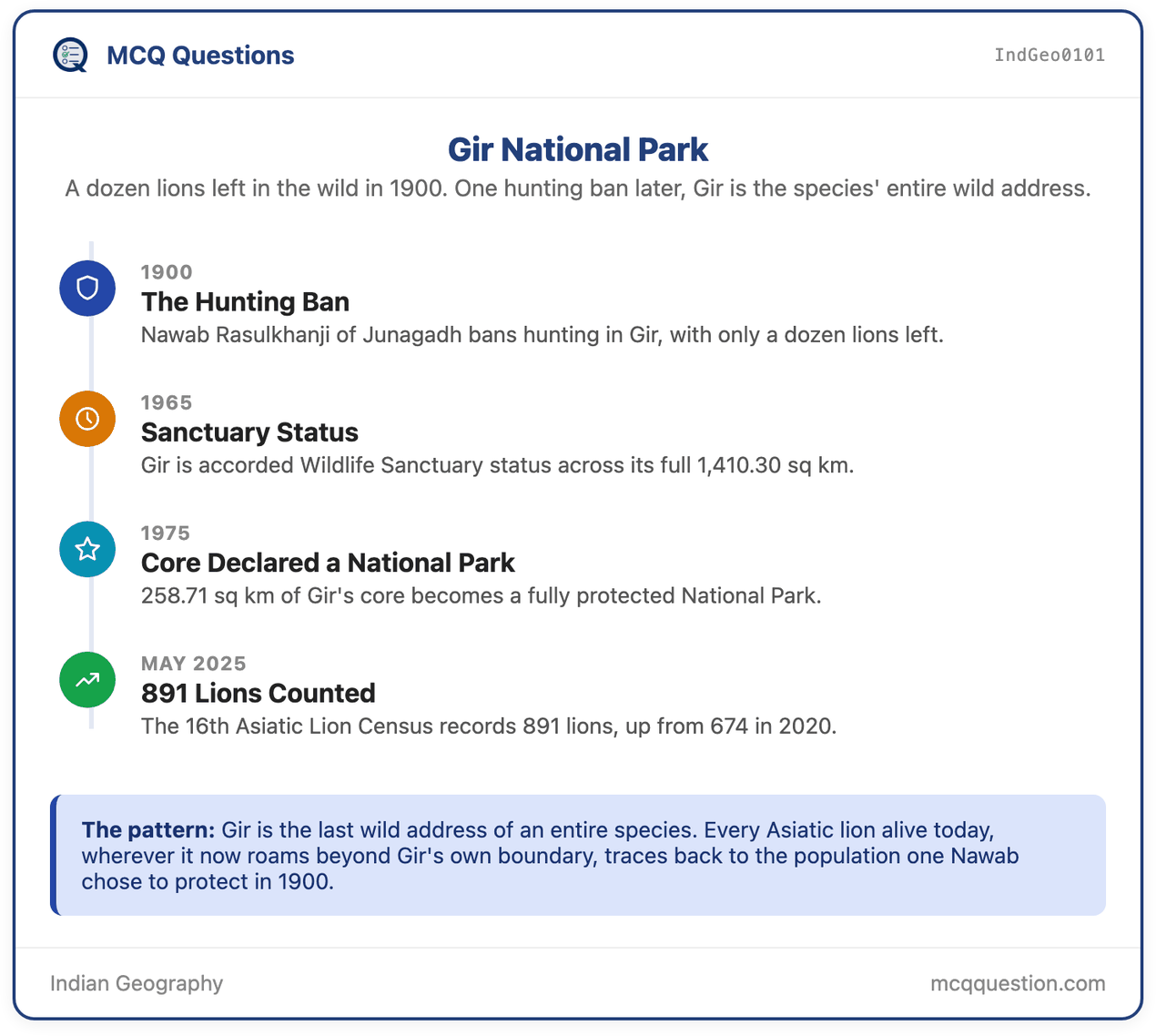
Gir National Park
A dozen lions left in the wild in 1900. One hunting ban later, Gir is the species’ entire wild address.
1900
The Hunting Ban
Nawab Rasulkhanji of Junagadh bans hunting in Gir, with only a dozen lions left.
1965
Sanctuary Status
Gir is accorded Wildlife Sanctuary status across its full 1,410.30 sq km.
1975
Core Declared a National Park
258.71 sq km of Gir’s core becomes a fully protected National Park.
MAY 2025
891 Lions Counted
The 16th Asiatic Lion Census records 891 lions, up from 674 in 2020.
The pattern: Gir is the last wild address of an entire species. Every Asiatic lion alive today, wherever it now roams beyond Gir’s own boundary, traces back to the population one Nawab chose to protect in 1900.
Indian Geographymcqquestion.com
Timeline
- 1900: Nawab Rasulkhanji of Junagadh bans hunting in the Gir forest. Only about a dozen Asiatic lions remain at this point.
- 1965: Gir is accorded Wildlife Sanctuary status, across its full 1,410.30 square kilometres.
- 1975: The core 258.71 square kilometres of Gir is declared a National Park.
- 15 August 2020: Prime Minister Narendra Modi announces Project Lion, on India’s 74th Independence Day.
- May 2025: The 16th Asiatic Lion Census records 891 lions, up from 674 in 2020.
Must Know
- Gir National Park and Wildlife Sanctuary sits across Junagadh, Gir Somnath, and Amreli districts of Gujarat. It is also called Sasan Gir.
- Gir is the world’s only wild home of the Asiatic lion (Panthera leo persica).
- Gir covers 1,410.30 sq km in total. Of this, 258.71 sq km is a fully protected National Park; the remaining 1,151.59 sq km is Wildlife Sanctuary.
- Gir was accorded sanctuary status in 1965. Its core area became a National Park in 1975.
- The 16th Asiatic Lion Census, held in May 2025, recorded 891 lions in and around Gir. That is up from 674 in 2020.
- By the late 19th century, hunting had reduced Gir’s Asiatic lions to about a dozen individuals.
- Nawab Rasulkhanji of Junagadh banned hunting in the Gir forest in 1900. This single decision is credited with saving the species from extinction.
Good to Know
- Gir sits in the Kathiawar Peninsula, in dry scrubland known as the Khathiar-Gir dry deciduous forests ecoregion.
- Teak covers about half the forest, concentrated in its eastern half. Sal, dhak, and acacia also grow here.
- Seven perennial rivers cross Gir: the Hiran, Shetrunji, Dhatarvadi, Shingoda, Machhundri, Ambajal, and Raval.
- Four dams create Gir’s main water reservoirs. The largest, Kamleshwar Dam on the Hiran River, is called “the lifeline of Gir.”
- Gir closes to visitors every year, from 16 June to 15 October, during the monsoon.
- The Maldhari, a pastoral community, live inside Gir alongside the lions.
- Besides lions, Gir holds about 38 mammal species and 300 bird species. These include leopards, chital (spotted deer), and nilgai.
- Prime Minister Narendra Modi announced Project Lion on 15 August 2020, India’s 74th Independence Day.
Test Yourself


Great to Know
- Barda Wildlife Sanctuary, in Devbhumi Dwarka district, is being developed as a “second home” for lions. It held just 8 lions when this began; that number has since grown into double digits, as lions bred and spread naturally.
- Gir’s story mirrors Kaziranga National Park, in Assam. Both trace their protection back to a single early-20th-century decision, and both are now conservation successes built around one flagship species.
- Gir connects to India’s wider wildlife-conservation architecture, through statutory bodies like the National Board for Wildlife (NBWL).
- See also Kailash Sankhala: The Tiger Man of India, for the parallel conservation story behind India’s tiger reserves.
Current Affairs
- 5 February 2026: The Union government told Rajya Sabha that Asiatic lion numbers rose from 674 in 2020 to 891 in 2025. It listed new conservation steps too, including satellite telemetry tracking, Machans for farmers, and train-speed restrictions in lion habitats. (Source: PIB)
- 10 August 2025: World Lion Day 2025 was marked at Barda Wildlife Sanctuary. Union Minister Bhupender Yadav noted the lion population had grown 32% since 2020, and over 70% in the past decade, up from just 284 lions in 1990. A separate ₹180 crore wildlife-conservation initiative was also launched that day. (Source: PIB)
- 1 March 2025: The Union Environment Ministry approved full funding for Project Lion, ₹2,927.71 crore over 10 years. (Source: ANI)
Leave a Reply