In 1904, Baroness Mary Curzon visited Kaziranga hoping to see its famous rhinoceros. She saw none, only hoof marks. Her husband, Viceroy Lord Curzon, set aside a reserve forest in response. That reserve is now Kaziranga National Park, a UNESCO World Heritage Site sheltering roughly two-thirds of the world’s Indian one-horned rhinoceroses.


 MCQ Questions
IndGeo0100
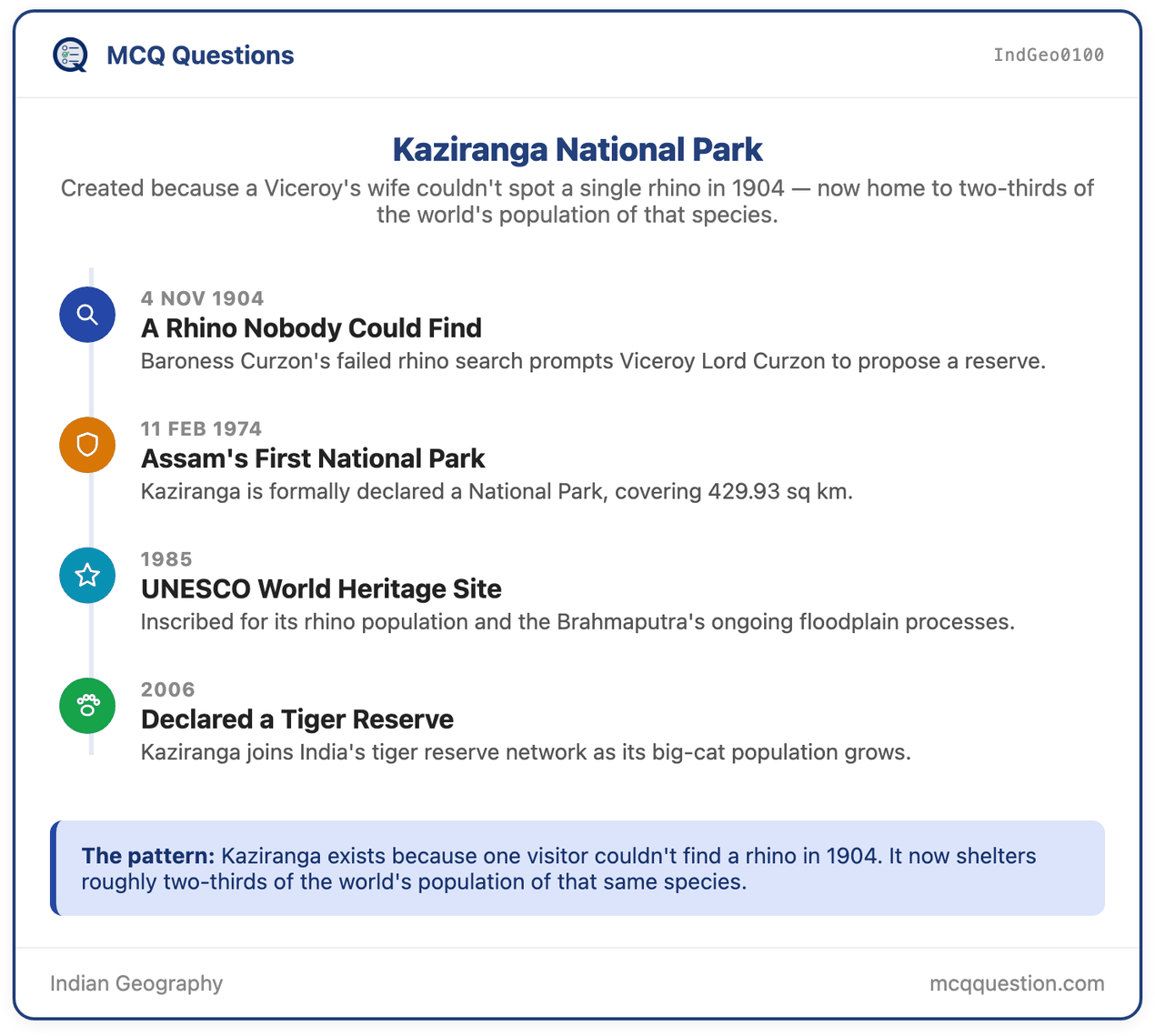
Kaziranga National Park
Created because a Viceroy’s wife couldn’t spot a single rhino in 1904 — now home to two-thirds of the world’s population of that species.
4 NOV 1904
A Rhino Nobody Could Find
Baroness Curzon’s failed rhino search prompts Viceroy Lord Curzon to propose a reserve.
11 FEB 1974
Assam’s First National Park
Kaziranga is formally declared a National Park, covering 429.93 sq km.
1985
UNESCO World Heritage Site
Inscribed for its rhino population and the Brahmaputra‘s ongoing floodplain processes.
2006
Declared a Tiger Reserve
Kaziranga joins India’s tiger reserve network as its big-cat population grows.
The pattern: Kaziranga exists because one visitor couldn’t find a rhino in 1904. It now shelters roughly two-thirds of the world’s population of that same species.
Indian Geographymcqquestion.com
Timeline
- 4 November 1904: Baroness Mary Curzon’s failed search for a rhino leads Viceroy Lord Curzon to propose a reserve at Kaziranga.
- 1 June 1905: The Kaziranga Proposed Reserve Forest is notified, covering 231.78 square kilometres.
- 11 February 1974: Kaziranga is formally declared a National Park, Assam’s first, covering 429.93 square kilometres.
- 1985: UNESCO declares Kaziranga a World Heritage Site.
- 2006: Kaziranga is declared a Tiger Reserve, as its tiger population grows.
Must Know
- Kaziranga National Park sits across Golaghat, Nagaon, and Sonitpur districts in Assam.
- It lies on the south bank of the Brahmaputra River, bordered by the Karbi Anglong (Mikir) Hills.
- Kaziranga was formally declared a National Park on 11 February 1974. Its core area covered 429.93 square kilometres.
- It was Assam’s first national park.
- UNESCO declared Kaziranga a World Heritage Site in 1985.
- Kaziranga holds the world’s largest population of the Indian one-horned rhinoceros. As of March 2022, the census recorded 2,613 rhinos, about two-thirds of the global population.
- The park was declared a Tiger Reserve in 2006.
- Kaziranga’s “Big Five” species are the rhinoceros, Asian elephant, Royal Bengal tiger, wild water buffalo, and eastern swamp deer.
Good to Know
- The Kaziranga Proposed Reserve Forest was notified on 1 June 1905. It covered 231.78 square kilometres.
- The reserve grew through several additions, in 1913, 1917, and 1967.
- It formally became a Reserve Forest in 1908, then a Game Sanctuary in 1916.
- Shooting was banned there from 1926. The area opened to visitors in 1938.
- After independence, it became a Wildlife Sanctuary in 1950. Forest officer Patrick D. Stracey played a key role in this, and later founded the Assam Forest School.
- The Assam (Rhinoceros) Bill, 1954, gave rhinos specific legal protection.
- The Assam National Park Act, 1968, created the legal basis for a national park. No such provision existed before it.
- Wet alluvial grasslands cover about two-thirds of the park. Annual flooding and controlled burning maintain them, under the Wild Life (Protection) Act, 1972 framework.
- The park is an Important Bird Area. Migratory birds like the lesser white-fronted goose and Baer’s pochard arrive from Central Asia each winter.
- The endangered Ganges River dolphin lives in the park’s oxbow lakes.
- National Highway 37 runs along Kaziranga’s southern border. UNESCO has flagged it as a threat to wildlife movement.
Test Yourself


Great to Know
- Kaziranga’s conservation record is a genuine turnaround. It went from near-extinction levels around 1900, to housing the single largest rhino population on Earth.
- The park has also suffered severe flood losses. The 1988 flood killed 38 rhinos and submerged 70% of the park; the 1998 flood killed 42 more.
- By 1999, additions had pushed the park’s area well past its original 430 square kilometres. Assam’s Cabinet approved a further major expansion on 21 May 2025, adding 47,306.33 hectares.
- Kaziranga’s Tiger Reserve status connects it to Project Tiger, the national scheme founded by Kailash Sankhala, its first director.
- Assam holds another notable protected wetland in Deepor Beel, its only Ramsar Site.
- UNESCO’s Criterion (ix) recognised Kaziranga for an ongoing ecological process, not just for its species count. The Brahmaputra’s annual flooding and shifting channels actively rebuild the park’s grasslands and wetlands, year after year.
Current Affairs
- 29 May 2026: Kaziranga logged 5.48 lakh tourists in the 2025-26 season. That included over 32,000 foreign visitors, its best year on record. Chief Minister Himanta Biswa Sarma also reported zero rhino poaching that year, plus rare sightings of a golden tiger. (Source: Devdiscourse/ANI)
- 21 May 2025: Assam’s Cabinet approved a major expansion of Kaziranga National Park and Tiger Reserve. It added 47,306.33 hectares, moving the park’s total protected area from about 1,302 towards roughly 1,775 square kilometres. (Source: The Sentinel)
Leave a Reply