Good governance is a specific, evolving concept in Indian public administration. This article covers its meaning, evolution and challenges.


Must Know
Good Governance: Concepts, Evolution and Hindrances
Governance, Good Governance, and Five Year Plans
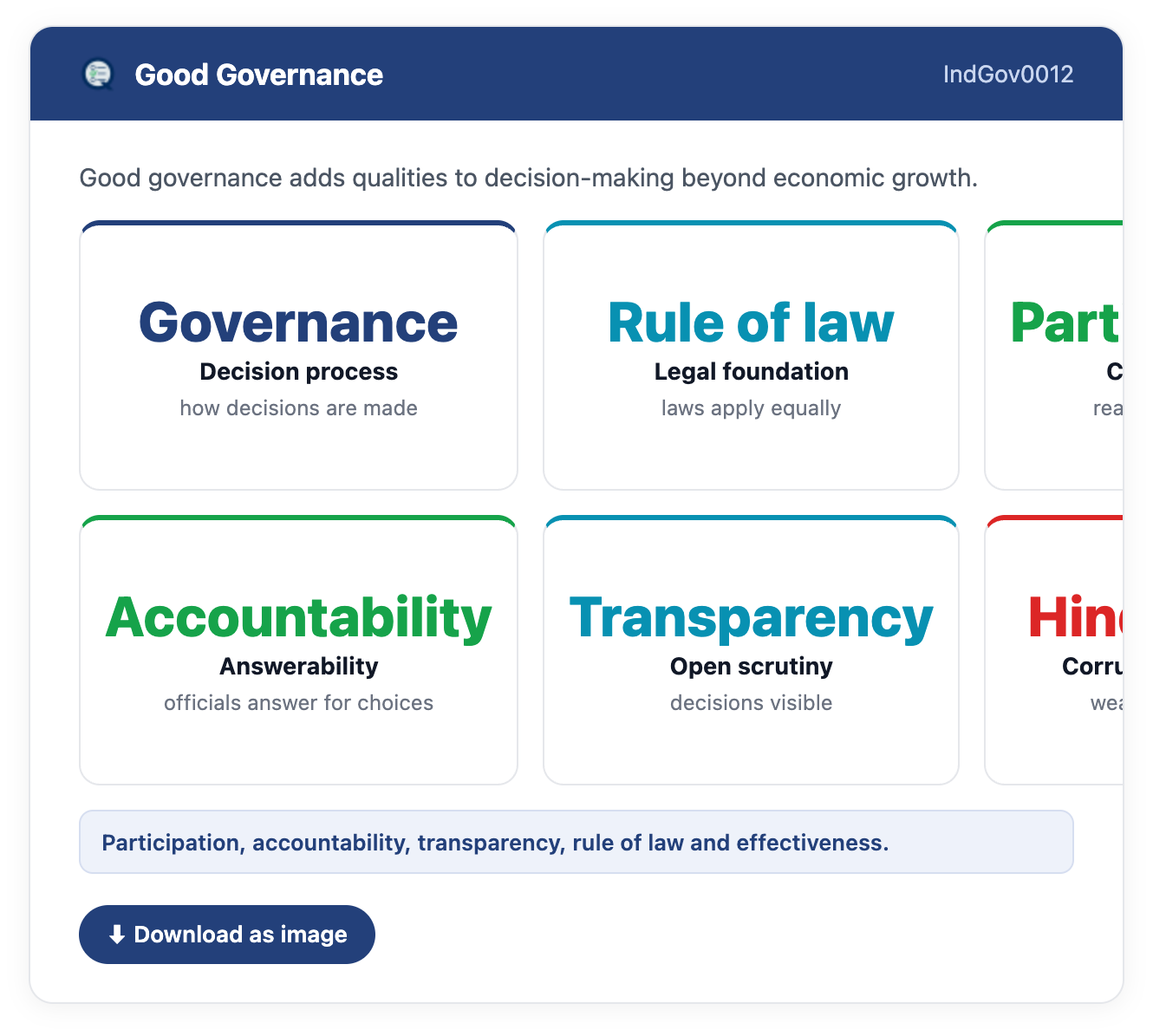
- GovernanceGovernance is the process of decision-making and implementation itself. It covers how choices get made and carried out, regardless of whether they are made well or badly.
- Good governanceGood governance adds specific qualities to that process: participation, accountability, and transparency, turning a neutral process into one judged by real standards.
- Five Year PlansIndia’s Five Year Plans progressively included good-governance initiatives, going beyond pure economic growth targets. Growth alone did not guarantee real benefit reached citizens.
- Why it mattersThis shift shows good governance was not always the framework India used. It was added deliberately, once growth-only planning proved insufficient on its own.
Rule of Law
- The ideaRule of law means government action is bound by publicly known laws, applied equally to everyone, rather than depending on an individual official’s personal discretion.
- The contrastIt stands directly opposed to arbitrary official discretion, where the same situation could be handled differently depending on who is in charge that day.
- A concrete exampleUnder rule of law, a citizen filing an identical application should get the same outcome in any office. It should not depend on which official happens to review it.
- Why it mattersRule of law is a foundational legal principle, but it is a narrower concept than good governance, which this article’s own later card explains further.
Hindrances to Good Governance
- The main hindrancesCorruption, red tape, and weak inter-agency coordination are the most commonly cited obstacles to good governance in India.
- Why they persistThese hindrances are stubborn precisely because they reinforce each other. Complex procedures create opportunities for informal payments, and corruption then further entrenches those procedures.
- A concrete exampleA permit requiring approval from five separate departments creates five separate opportunities for delay. Each of those is also a chance for an informal payment to speed things along.
- Why it mattersFixing one hindrance in isolation rarely works. Real reform usually has to target multiple hindrances together, since they feed each other.
Good to Know
Features and Evolution
Evolution of Good Governance
- Where it startedEarly development models focused almost entirely on economic growth, treating a rising GDP as the primary, sometimes only, measure of national progress.
- What changedGovernance quality was later added as a precondition for growth to actually reach citizens. Strong GDP growth alone did not guarantee real improvements in people’s lives.
- A real triggerDevelopment agencies noticed that countries with similar growth rates could show very different poverty and welfare outcomes, depending on how well their institutions actually functioned.
- Why it mattersThis shift explains why modern development frameworks track governance indicators alongside growth figures, not growth figures alone.
Participation
- The core ideaParticipation means citizens and civil society have a genuinely real voice in decisions that affect them, not just a formal, symbolic one that changes nothing.
- What real participation looks likeReal participation involves actual consultation before a decision is made. An announcement afterward asking for feedback that cannot change the outcome does not count.
- A concrete exampleGram Sabha meetings that genuinely shape a village’s development plan are real participation. A meeting held only to formally approve a plan already finalised elsewhere is not.
- Why it mattersExams sometimes test this exact distinction between symbolic and substantive participation, since the difference is central to what “good” in good governance actually means.
Red Tape, Corruption, and Key Principles
- Red tape and corruptionRed tape and corruption often reinforce each other directly. Complex procedures create real opportunities for informal payments, since a citizen may pay simply to move a stuck file forward.
- The mechanismEach extra approval step in a process is another point where a delay can be manufactured. It is also another point where money can be asked for to remove it.
- Key principlesGood governance rests on a recognised set of principles: accountability, transparency, participation, rule of law, and effectiveness, standardised by bodies like the United Nations.
- Why it mattersExams test this specific list of principles directly. Remember all five together, since a question may ask which one is missing from a shorter list.
Test Yourself
Loading practice…
Great to Know
Distinctions and Persistence
Rule of Law vs. Good Governance
- Rule of lawThe rule of law is a necessary legal foundation: laws exist, are known, and apply equally to everyone, at least on paper.
- Good governanceGood governance is a broader, genuinely harder-to-measure standard of how fairly that same legal foundation is actually applied in real, day-to-day practice.
- A concrete exampleA country can have excellent laws on paper, satisfying rule of law. It can still deliver them slowly, unfairly, or with real corruption, failing at good governance.
- Why it mattersRule of law is necessary for good governance, but genuinely not sufficient on its own. Exams test this exact relationship between the two concepts.
Inter-Agency Coordination
- A stubborn problemWeak inter-agency coordination often survives individual reform efforts, since fixing one department’s own processes does not automatically fix how it works with others.
- The real lessonReform must target coordination across agencies directly, not just single institutions in isolation, or the same handoff problems simply resurface at the next department’s door.
- A concrete exampleA land dispute can require the revenue department, the police, and the local court to all act together. If any one of the three is slow, the whole case stalls regardless of the other two.
- Why it mattersThis is why many modern reforms focus on single-window systems and shared digital platforms, specifically to force coordination rather than hope for it.
Governance as an Outcome
- The shiftDevelopment agencies now treat governance quality as a genuine development outcome in its own right, not merely a means toward other economic ends.
- What this means practicallyA country is now judged partly by how well it governs itself, alongside how much its economy grows, as two related but genuinely separate measures.
- A concrete exampleThe World Bank’s own Worldwide Governance Indicators track dimensions like rule of law and control of corruption separately from GDP growth figures for each country.
- Why it mattersThis reframing means a government cannot claim full success through growth numbers alone. Governance quality is now its own, separately-tracked measure of success.
Current Affairs
📰 Current Affairs
Governance Reforms
- March 2026DARPG’s 47th monthly CPGRAMS report recorded 1,81,279 grievances redressed by central ministries and departments, with an average disposal time of 13 days.
- A real reform milestoneMay 2026 marked the 47th consecutive month that monthly grievance disposal crossed one lakh cases in the Central Secretariat. This is part of a 10-step CPGRAMS reform process.
- A concrete new toolThe government launched an AI-enabled CPGRAMS voice chatbot, “Samadhan Didi,” on 30 May 2026. It aims to make grievance filing more accessible for citizens less comfortable with typed forms.
- Why it fits hereThis is the real, current scale behind this article’s own coordination and outcome cards: governance reform measured in actual disposal numbers, not just stated intent.
- LinkSource: PIB, DARPG 47th Monthly CPGRAMS Report, March 2026.
PYQ
Exam Point of View
MCQ Questions
- PrelimsGood governance, rule of law and hindrances appear in UPSC and other competitive exams.
Written Answer Questions
- ThemeGovernance concepts and reform are recurring GS-II themes.
Beyond the answer
Browse all indian-polity-and-constitution topics →
📚 Keep reading
IndEco0050 — India's Five Year PlansPolity0153 — India's National Anti-Narcotics Coordination Mechanism (NCORD)IndEco0020 — Inclusive Growth: Definition, Strategies and ChallengesIndEco0014 — Objectives, Strategies and Outcomes of Indian PlanningIndEco0013 — Planning Commission and Five Year Plans❓ Practice this topic
Preamble Quiz: 5 Questions with ExplanationsPolity0391 — Article 47 of the ConstitutionPolity0390 — Article 46 of the ConstitutionPolity0389 — Article 30 of the Constitution🎲 Take a Indian Polity And Constitution Quiz
Leave a Reply