Sixteen months ago, the Prime Minister asked a Danish shipping executive to help build container factories in India. In July 2026, the first India-made shipping container rolled off the line, and Maersk immediately ordered a thousand more. It’s one small piece of a much bigger plan to make India a top-five global maritime power by 2047.
 MCQ Questions
1. The Two Visions
- Overview India’s maritime sector covers ports, shipping, shipbuilding, and inland waterways. The Ministry of Ports, Shipping and Waterways oversees national policy for the sector.
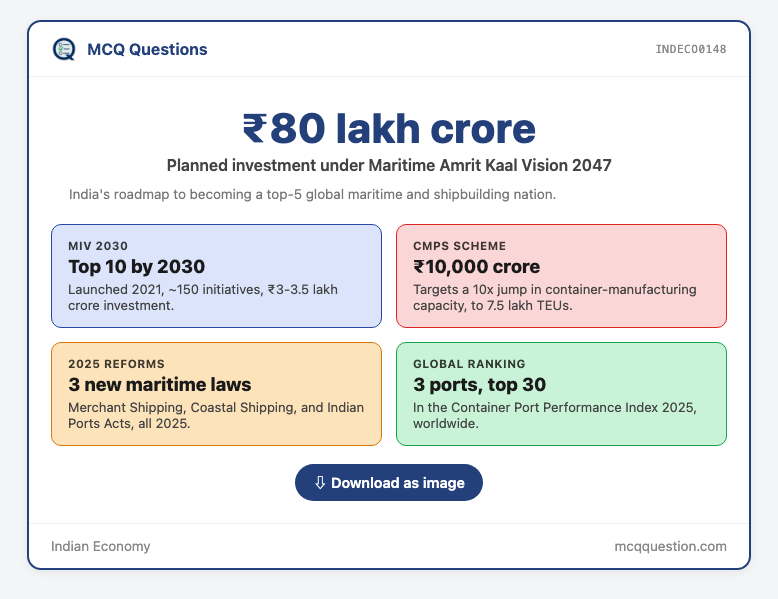
- MIV 2030 Maritime India Vision 2030, launched in 2021, is India’s medium-term maritime roadmap. It targets the world’s top 10 maritime nations by 2030, through roughly 150 initiatives and ₹3–3.5 lakh crore in investment.
- MAKV 2047 Maritime Amrit Kaal Vision 2047 builds on MIV 2030 with a longer horizon. PM Modi launched it at the Global Maritime India Summit in Mumbai, on 17 October 2023.
- Target MAKV 2047 targets India’s top 5 maritime and shipbuilding nations by 2047. It outlines over 300 initiatives and roughly ₹80 lakh crore in planned investment, including raising port capacity to 10,000 MTPA.
2. Legal & Digital Reforms
- Legal Reform Five major maritime laws took effect in 2025: the Merchant Shipping Act, the Coastal Shipping Act, the Indian Ports Act, the Bills of Lading Act, and the Carriage of Goods by Sea Act. See IndEco0166 — GIFT City and IFSC for a 2026 exemption under the Coastal Shipping Act.
- Digital Digital reforms supporting the sector include One Nation One Port Process (ONOP), the Maritime Single Window, and e-Samudra. These aim to ease maritime business processes.
1. Financing and the CMPS Scheme
- Finance The government backs shipbuilding with a ₹70,000 crore Shipbuilding Financial Assistance Package. A Bharat Container Shipping Line has also been proposed, to give India its own major container-shipping presence.
- CMPS Scheme The Container Manufacturing Promotion Scheme, announced in the Union Budget 2026, carries a ₹10,000 crore outlay. It targets a tenfold jump in India’s annual container manufacturing capacity, to roughly 7.5 lakh TEUs.
- Support CMPS supports the sector three ways: Capex support for new and expanded manufacturing facilities, Opex support to close the per-container cost gap with imports, and R&D support for research, testing, and skilling.
India’s ports and shipping ecosystem connects to other GI-tagged and manufacturing-linked coverage on this site. See EnvEco0030 — Recycling in India and India Becomes the World’s Top Ship Recycling Nation for the recycling side of India’s maritime story.
Test Yourself

1. Recycling Leadership and the Bigger Picture
- Recycling India already leads the world in ship recycling by volume, alongside its newer push into container manufacturing. Together, they show India building capability across a ship’s entire lifecycle.
- Policy Pattern Nesting a medium-term plan (MIV 2030) inside a longer-term vision (MAKV 2047) is a recurring pattern in recent Indian economic policy. It lets the government report progress against nearer, checkable milestones while still communicating a bigger 25-year ambition.
2. Major Infrastructure Projects
- Underway Vadhavan Port, the International Container Transshipment Port at Galathea Bay, Tuna Tekra Container Terminal, and the Outer Harbour Container Terminal are the physical infrastructure meant to actually deliver MAKV 2047’s capacity targets, not just its policy framework.
This article covers the trade and infrastructure side of India’s maritime story. For the government’s crisis response protecting Indian seafarers during the 2026 Strait of Hormuz attacks, see IndGov0041 — India’s Maritime Vigil and Seafarer Safety in West Asia. For the chokepoint geography itself, and how much of India’s crude oil depends on it, see IntlRel0084 — The Strait of Hormuz and India’s Energy Security.
Why It’s a Structural Shift
- Location The Vizhinjam International Seaport, near Thiruvananthapuram, Kerala, is India’s first automated deep-water transshipment port.
- Deep Draft Its natural deep draft, roughly 18–20 metres, lets it dock Ultra Large Container Vessels, “mother ships,” that most Indian ports cannot handle.
- Revenue Handling transshipment on Indian soil keeps cargo, and the foreign exchange that comes with it, away from rival regional hubs like Colombo, Singapore, and Salalah.
- International It is explicitly an international hub, built on foreign shipping collaboration, not a domestic-only cargo terminal that isolates India from global trade.
- Dedication 2 May 2025: PM Modi formally dedicated the port to the nation, an ₹8,800 crore project tied to the wider Sagarmala and PM Gati Shakti push above.
Previous Year Question
Asked as: “In what way(s) does the Vizhinjam International Seaport represent a structural shift in India’s maritime trade and logistics policy?” (UPSC CSP 2026, GS Paper I).
1. Mega Infrastructure & Port Upgrades
- Mega Project 4 Aug 2026: Vadhavan Port (Maharashtra): Cabinet approved this ₹76,220 crore greenfield deep-draft port. It is expected to handle 298 MT of cargo a year. (Source: PIB)
- Draft Upgrade 7 Jul 2026: Kamarajar Port: Became India’s 2nd Major Port, after Visakhapatnam, to reach an 18-metre draft. That lets it handle fully laden Capesize vessels, up to 1,70,000 DWT. (Source: PIB)
- Infra 7 Aug 2026: Mumbai Port: A ₹192 crore PPP Cruise Terminal, plus the ₹470 crore Viksit Bharat Mumbai Marina. Renewable energy now meets 57% of the port’s electricity needs. (Source: PIB)
2. Core Schemes & Financial Push
- Finance 4 Aug 2026: Maritime Development Fund: A ₹25,000 crore corpus, split into ₹20,000 crore equity and ₹5,000 crore for debt-reduction. It targets India reaching the world’s top 10 shipbuilders by 2030. (Source: PIB)
- Policy 28 Jul 2026: Coastal Cargo Promotion Scheme: Aims to raise coastal shipping’s freight share from 6% to 12% by 2047. GST on bunker fuel fell from 18% to 5%. Ro-Pax ferries have already cut the Ghogha–Hazira crossing from 12 hours by road to 4 by sea. (Source: PIB)
- Manufacturing 15 Jul 2026: Shipbuilding Clusters: A greenfield cluster was approved at Porbandar, Gujarat, with 1.2–1.5 million gross tonnage annual capacity. A ₹1,570 crore ship-repair facility at Vadinar was approved too, under the Shipbuilding Development Scheme (SbDS). (Source: PIB)
3. Inland Waterways (IWT) & Jalvahak
- Scheme 4 Aug 2026: Jalvahak Scheme: Offers up to 35% incentives for inland cargo movement. A new Jalyan & Navic portal tracks it, with 9,953 vessels and 1,215 crew registered as of 30 July 2026. (Source: PIB)
- Data Point 21 Jul 2026: Target Surpassed: IWT cargo throughput grew twelvefold, to 218 MT. That already beats the Maritime India Vision 2030 target of 200 MT. Operational National Waterways rose from 3 to 32, also past target. (Source: PIB)
- Infrastructure 7 Aug 2026: NW-4 (Krishna River): IWAI commissioned a new Ro-Ro terminal at Muktyala, Andhra Pradesh. It also handed over 4 floating jetties to the state’s Tourism Development Corporation. (Source: PIB)
4. Digital Governance & Security
- Digital 8 Aug 2026: E-Samudra Launch: A unified digital single-window for seafarers, shipping companies, and ports. It moves the sector toward faceless administration, with online payments and real-time tracking. (Source: IANS)
- Security 6 Aug 2026: Bureau of Port Security (BoPS): Created under the Merchant Shipping Act, 2025. It standardises security against cyberattacks, drone incursions, and supply-chain threats. (Source: PIB)
- AI 23 Jun 2026: PortGPT: VOC Port became the first major Indian port to launch a dedicated generative-AI app. The same green-and-digital push also cut its net carbon emissions by about 45%. (Source: PIB)
5. Green Maritime & Global Standing
- Environment Jul 2026: Harit Sagar Guidelines: Renewable energy’s share in Major Ports’ power mix rose from under 1% to 28%. The 2030 target is 60%. (Source: PIB)
- Global Rank 8 Aug 2026: Seafarer Hub: India is now the world’s 2nd largest supplier of seafarers, at 12.16% globally. It has climbed from 5th place in 2015. The government’s Mission 20% aims for one in five global seafarers to be Indian. (Source: IANS)
- Rankings 7 Aug 2026: World Bank Index: Jawaharlal Nehru Port ranked 22nd globally on the 2025 Container Port Performance Index. That’s ahead of Shanghai (23rd) and far ahead of Rotterdam (333rd). (Source: PIB)
Beyond the answer
Browse all indian-economy topics →
📚 Keep reading
IndEco0253 — The Sagarmala ProgrammeIndGeo0087 — Indian RailwaysIndGeo0074 — India's National Highway NetworkGenSci0027 — ICMR (Indian Council of Medical Research)IndGov0024 — Skill India Mission❓ Practice this topic
Atal Innovation Mission is set up under theD0231 — Which statement about India's fisheries sector is correct?D0230 — Why is the Rann of Kutch important for non-farm primary activity?D0229 — Which pairing of a non-farm primary activity with its physiographic setting is correct?🎲 Take a Indian Economy Quiz
Leave a Reply