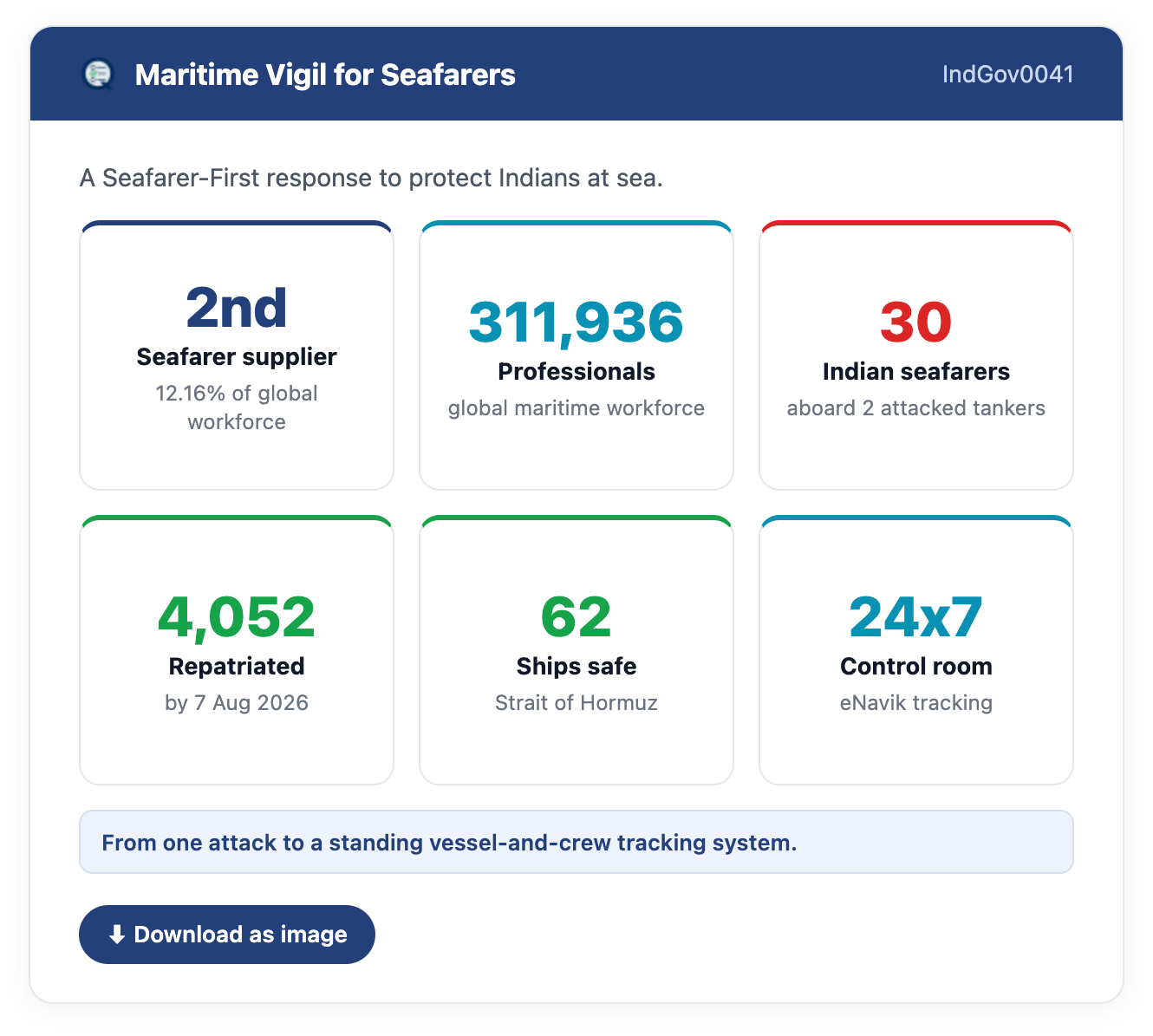
Two tankers came under attack in the Strait of Hormuz in July 2026, with 30 Indian seafarers aboard. Within hours, India launched a Seafarer-First response to track and protect every Indian at sea.


Must Know
India’s Maritime Vigil for Seafarers
What Is a Seafarer?
- PlainA seafarer is a person who works on a ship at sea.
- RolesThey include captains, navigation officers, marine engineers, deckhands and cooks.
- ShipsThey work on tankers, cargo ships, container vessels and passenger ferries.
- Why hereWhen a ship is attacked far from home, protecting its crew becomes a governance task.
India’s Seafarer Supply, and Who Regulates Seafarers, and The 14 July Attack, and The Seafarer-First Response
- RankIndia is the world’s second-largest supplier of seafarers, after the Philippines.
- ShareIt contributes 311,936 professionals, or 12.16% of the global workforce.
- Full formDGS is the Directorate General of Shipping.
- JobDGS certifies seafarers and regulates their training and welfare.
- Why it mattersWithout valid certification, a seafarer cannot legally work on a foreign ship.
- MinistryIt sits under the Ministry of Ports, Shipping and Waterways.
- EventOn 14 July 2026, two tankers were attacked in the Strait of Hormuz.
- CrewThey carried 30 Indian seafarers; one was killed and several injured.
- LaunchUnion Minister Sarbananda Sonowal launched a “Seafarer-First” response the same day.
- OrderIt ordered vessel-by-vessel monitoring and a liaison officer for every affected seafarer.
- CoordinationIt involved the MEA, Indian Navy, DGS and Indian missions in the Gulf.
- Full formMEA is the Ministry of External Affairs, which runs India’s diplomacy abroad.
- HowA liaison officer keeps each seafarer’s family informed and pushes the case with insurers and ship owners.
Good to Know
Tracking and Support
A Vessel Dashboard
- ToolDGS built a dashboard tracking position, ownership, cargo and crew welfare.
- AreaIt covers the Persian Gulf, Strait of Hormuz and Gulf of Oman.
- WhyOfficials need one live view of every India-linked vessel to act fast in a crisis.
Test Yourself
Question 1 of 1
Great to Know
Wider Context
Why the Strait of Hormuz Matters
- ChokepointHormuz is a narrow sea lane between the Persian Gulf and the Arabian Sea.
- EnergyA large share of the world’s oil moves through it every day.
- RiskAn attack there can disrupt global energy supplies and endanger crews.
- StakeThat is why India tracks every India-linked vessel passing through it.
International Coordination
- Full formIMO is the International Maritime Organization, the UN body for shipping rules.
- In practiceWhen a ship’s master reports an attack in real time, it usually goes to UKMTO first. UKMTO is the UK Maritime Trade Operations, a regional reporting hub for the Gulf that then alerts other navies and shipowners.
- Full formMICA is a France-led Maritime Information Centre that shares attack warnings across the same waters, working alongside UKMTO rather than replacing it.
- India’s own presenceIndia runs its own long-standing naval operation in these same waters, Operation Sankalp, launched in June 2019. Its warships have kept escorting Indian-flagged ships through the Gulf ever since, working alongside these international reporting networks, not apart from them.
The Merchant Shipping Act, 2025
- LawThe Act modernised India’s seafarer-welfare framework, in force since 15 March 2026.
- ProtectionIt gives abandoned seafarers statutory legal protections for the first time.
- MeaningAn abandoned seafarer is one left behind by a ship owner without wages or a way home.
- EffectSuch crews now have a clear legal right to wages, food, medical care and repatriation.
Current Affairs
📰 Current Affairs
Results Reported
- DataOn 7 August 2026, India told Parliament 4,052 seafarers had been repatriated.(PIB; Lok Sabha reply, 7 Aug 2026)
- Ships62 India-bound vessels had safely transited the Strait of Hormuz.(PIB; Lok Sabha reply, 7 Aug 2026)
- SourcePIB; Lok Sabha reply.(PIB; Lok Sabha reply, 7 Aug 2026)
PYQ
Exam Point of View
MCQ Questions
- PrelimsIndia’s maritime vigilance and seafarer welfare appear in UPSC and other competitive exams.
Written Answer Questions
- ThemeMaritime safety and welfare are recurring GS-III themes.
Was this helpful?
Leave a Reply