India’s public-sector steel giant once dominated the industry it helped build. Today it makes up barely a seventh of the country’s steel capacity.

19 January 1954
Hindustan Steel Limited (HSL) is set up, the forerunner of India’s public-sector steel industry.
24 January 1973
The Steel Authority of India Limited (SAIL) is established, India’s largest steel PSU.
2017
The Cabinet approves the National Steel Policy, targeting 300 MT of crude steel capacity by 2030-31.
July 2021
The Cabinet approves a Production-Linked Incentive (PLI) Scheme for Specialty Steel, with a ₹6,322 crore outlay.
Ministry and oversight
The Ministry of Steel oversees India’s steel sector, including major public-sector undertakings.
National Steel Policy targets
The National Steel Policy, 2017 targets 300 MT of crude steel capacity by 2030-31.
SAIL establishment
SAIL (Steel Authority of India Limited) is India’s largest steel PSU, established on 24 January 1973.
PLI Scheme for Specialty Steel
The PLI Scheme for Specialty Steel, approved in July 2021, carries a ₹6,322 crore outlay.
Current capacity
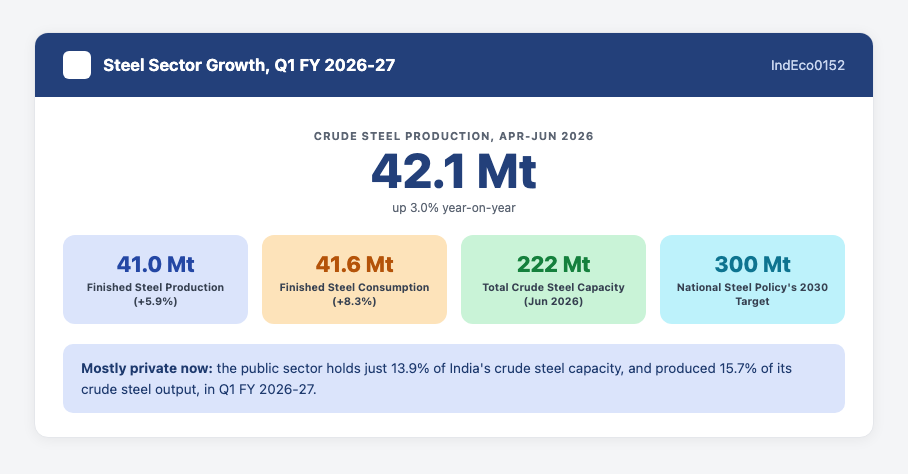
India’s total crude steelmaking capacity reached about 222 MTPA as of June 2026.
HSL to SAIL history
SAIL traces its roots to Hindustan Steel Limited (HSL), set up on 19 January 1954. HSL was reorganised into SAIL in 1973.
Per-capita steel consumption target
Beyond capacity, the National Steel Policy also targets per-capita steel consumption. The goal is 160 kg by 2030-31, up from about 61 kg when the policy was approved.
PLI Scheme timeline and scope
The PLI Scheme for Specialty Steel runs from 2023-24 to 2027-28. It aims for about ₹40,000 crore in investment and 25 MT of added specialty-steel capacity.
PLI investment progress
As of 30 June 2026, companies had invested about ₹26,320 crore under the specialty-steel PLI scheme, against a ₹56,106 crore total investment commitment.
India’s Top 7 steel producers
India’s “Top 7” steel producers are SAIL, RINL, NMDC Steel, Tata Steel Group, ArcelorMittal Nippon Steel, JSW Group, and Jindal Steel & Power (JSPL). Together they hold about half the country’s crude steel capacity.
Public sector share decline
The public sector’s share of India’s total crude steel capacity is now small, at about 14%. Private steelmakers now dominate the industry SAIL once led.
Test Yourself

SAIL’s shrinking share reflects liberalisation
SAIL’s shrinking share isn’t decline. It reflects liberalisation. Private players like Tata Steel, JSW, and ArcelorMittal Nippon Steel expanded fast, after economic reforms opened the sector to private and foreign capital.
India as net importer despite production
India was a net importer of finished steel by quantity in Q1 FY 2026-27, even while ranking among the world’s largest producers. Domestic demand is growing faster than domestic supply can currently match it.
Steel in India’s industrial story
Steel sits at the intersection of India’s industrial and public-sector story. See IndGeo0010 for industrial regions, IndEco0080 for the PLI mechanism, and IndEco0054 for SAIL’s place among India’s other PSUs.
Q1 FY27 crude steel production
6 July 2026: The Ministry of Steel reports Q1 FY 2026-27 (April-June 2026) performance. Crude steel production rose to 42.1 Mt, up 3.0% year-on-year. Finished steel production rose to 41.0 Mt, up 5.9%. Hot metal production rose to 23.5 Mt, up 1.4%. (Source: PIB)
Finished steel consumption and net imports
Finished steel consumption rose to 41.6 Mt, up 8.3% year-on-year. Despite this growth, India remained a net importer of finished steel by quantity over the quarter. (Source: PIB)
Public sector capacity and production share
The public sector’s share of national crude steel capacity stood at 13.9%, and its share of crude steel production at 15.7%, for the quarter. (Source: PIB)
Beyond the answer
Browse all indian-economy topics →
📚 Keep reading
Economy0032 — Global Crude Oil Benchmarks: WTI, Brent, and Dubai/OmanIndGeo0151 — Iron and Steel Industry in India: From the Coalfield to the CoastIndEco0117 — Petroleum and Natural Gas Sector in IndiaIndEco0275 — Edible Oil Production in IndiaIndEco0295 — Steel Industry in India: Coking Coal Dependence and Import Strategy❓ Practice this topic
In which year was the Pradhan Mantri Bhartiya Janaushadhi Pariyojana (PMBJP) launched?The EPFO was formally established under which Act, on 4 March 1952?The Reserve Bank of India set up the Committee on Capital Account Convertibility in 1997, chaired by whom?In September 2002, the Finance Ministry set up two task forces, chaired by which economist, to recommend tax reforms?🎲 Take a Indian Economy Quiz
Leave a Reply