A body the Indian government doesn’t own accredits the hospitals and labs the government relies on. That body is the Quality Council of India, a non-profit society set up in 1996. In July 2026, it signed a new pact with NSIC to help small businesses meet those same quality standards.
 MCQ Questions
IndEco0156
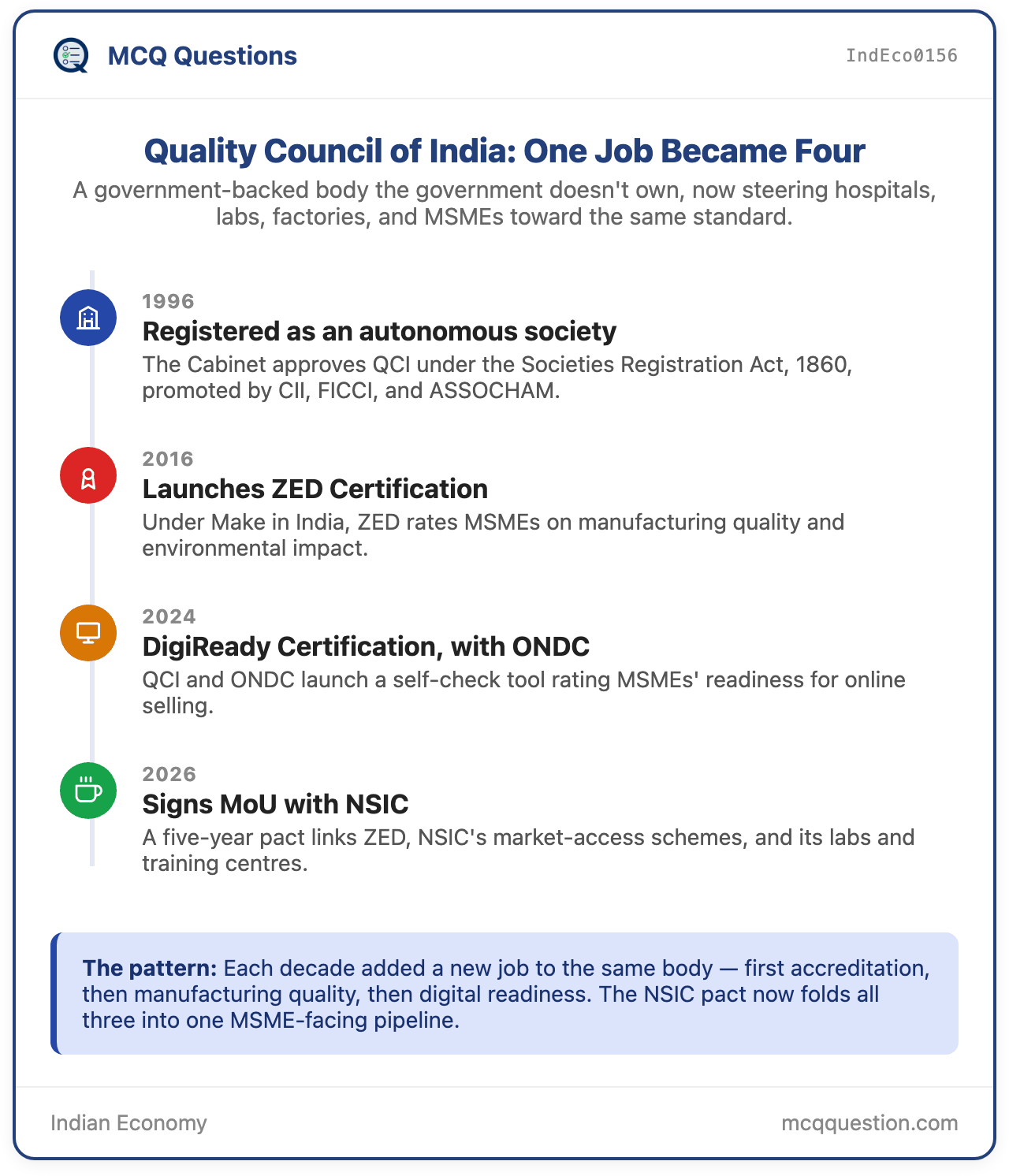
Quality Council of India: One Job Became Four
A government-backed body the government doesn’t own, now steering hospitals, labs, factories, and MSMEs toward the same standard.
1996
Registered as an autonomous society
The Cabinet approves QCI under the Societies Registration Act, 1860, promoted by CII, FICCI, and ASSOCHAM.
2016
Launches ZED Certification
Under Make in India, ZED rates MSMEs on manufacturing quality and environmental impact.
2024
DigiReady Certification, with ONDC
QCI and ONDC launch a self-check tool rating MSMEs’ readiness for online selling.
2026
Signs MoU with NSIC
A five-year pact links ZED, NSIC’s market-access schemes, and its labs and training centres.
The pattern: Each decade added a new job to the same body — first accreditation, then manufacturing quality, then digital readiness. The NSIC pact now folds all three into one MSME-facing pipeline.
Indian Economymcqquestion.com
✊ Must Know
Set Up Jointly by Government and Industry
- PYQ-relevant QCI was registered as an autonomous, non-profit society in 1996, under the Societies Registration Act, 1860. It was set up jointly by the Government of India and Indian industry, represented by CII, FICCI, and ASSOCHAM.
Administrative Control
- Structure QCI works under the administrative control of the Department for Promotion of Industry and Internal Trade (DPIIT), Ministry of Commerce and Industry.
Who Promoted Its Creation
- History Three apex industry bodies promoted its creation: the Confederation of Indian Industry (CII), FICCI, and ASSOCHAM.
How the Chairman Is Appointed
- PYQ-relevant The Chairman of QCI is appointed by the Prime Minister, on the recommendation of industry to the government. This joint govt-industry character runs through both QCI’s founding and its leadership.
Self-Sustaining, Not Government-Funded
- Structure QCI is not funded by the government. It runs as a self-sustaining body, funded through its own fees and services.
The Governing Body
- Structure A 38-member Governing Body runs QCI, with equal representation from government, industry, and other stakeholders.
Five Accreditation Boards
- Structure QCI works through five accreditation boards: NABCB, NABET, NABH, NABL, and the National Board for Quality Promotion (NBQP).
💡 Good to Know
NABL: Labs and Calibration
- Board The National Accreditation Board for Testing and Calibration Laboratories (NABL) accredits testing and calibration labs. It links Indian labs to global bodies like ILAC and APLAC.
NABH: Hospitals and Healthcare
- Board The National Accreditation Board for Hospitals & Healthcare Providers (NABH), set up in 2006, accredits hospitals and other healthcare providers across India.
NABET: Education and Training
- Board The National Accreditation Board for Education and Training (NABET) accredits schools and vocational training providers, and assesses their teaching standards.
ZED Certification
- Scheme QCI’s ZED (Zero Defect Zero Effect) Certification, launched in 2016 under Make in India, rates MSMEs on manufacturing quality and environmental impact.
DigiReady Certification
- Scheme In February 2024, QCI launched DigiReady Certification with the Open Network for Digital Commerce (ONDC). It checks whether a small business is ready to sell online.
Wider Policy Landscape
- Cross-link See IndEco0055 — MSMEs and Industrial Policy for the wider policy landscape QCI’s accreditation work fits into.
Test Yourself

🏆 Great to Know
The Netherlands Model
- Analysis QCI’s model borrows from the Netherlands. There, an independent body ran national accreditation, with state support but no state ownership. India adapted this into its own quality-infrastructure body.
Authority Rests on Trust, Not Law
- Analysis Because QCI isn’t a government department, its authority rests on trust, not law. Businesses and hospitals seek its accreditation voluntarily, to prove quality to customers and regulators.
Five Boards, One Governing Body
- Structure QCI’s five boards work independently, each within its own domain. Policy and oversight still stay centralised, through the shared Governing Body.
📰 Current Affairs
QCI-NSIC MoU (9 Jul 2026)
- Policy QCI and the National Small Industries Corporation (NSIC) signed a five-year MoU on 9 July 2026. It aims to strengthen quality, competitiveness, and market access for MSMEs. The pact links QCI’s ZED Certification with NSIC’s MSME Global Mart, TEAM Initiative, and Single Point Registration Scheme (SPRS). ZED-certified MSMEs get onboarding help on ONDC, through the TEAM Initiative. NSIC’s own testing facilities will now seek NABL accreditation, and its training centres will get NABET-led assessment. A Joint Coordination Committee, with members from both organisations, will meet every quarter to guide the MoU’s rollout. (Source: PIB, Ministry of Commerce and Industry)
National Quality Conclave (23 Feb 2026)
- Policy QCI and DPIIT held the first National Quality Conclave, at Bharat Mandapam, New Delhi, on 23 February 2026. Union Minister Piyush Goyal said “zero defect, zero effect” and equal opportunity were key pillars of India’s growth story. He urged sectors like textiles, leather, and pharma to focus on process improvement and workforce skilling. (Source: All India Radio News)
📝 Previous Year Questions
UPSC CSP 2017 — QCI’s Setup and Chairman Appointment
- UPSC 2017 Asked as: “With reference to ‘Quality Council of India (QCI)’, consider the following statements”, testing whether QCI was set up jointly by government and industry, and whether its Chairman is appointed by the PM on industry’s recommendation. The correct answer is (c) Both 1 and 2 — both statements are true. See UPSC CSP 2017 GS Paper I, Q39.
Leave a Reply