A quarter of everything the government buys is reserved for small businesses. One company decides which of them get access to it.
 mcqquestion.com
Indian Economy · IndEco0222
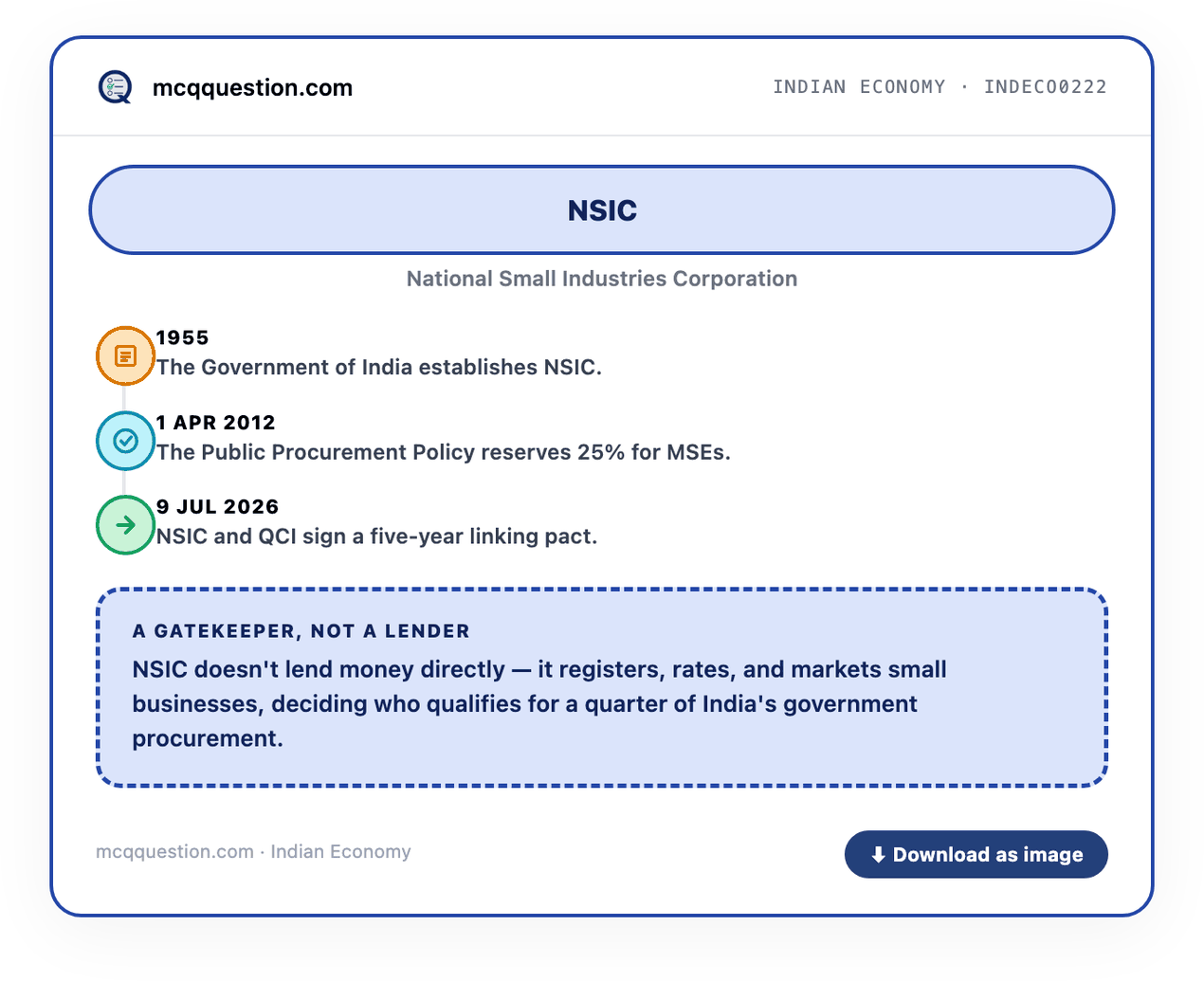
NSIC
National Small Industries Corporation
1955
The Government of India establishes NSIC.
1 Apr 2012
The Public Procurement Policy reserves 25% for MSEs.
9 Jul 2026
NSIC and QCI sign a five-year linking pact.
A Gatekeeper, Not a Lender
NSIC doesn’t lend money directly — it registers, rates, and markets small businesses, deciding who qualifies for a quarter of India’s government procurement.
Timeline
- 1955: The Government of India establishes the National Small Industries Corporation (NSIC).
- 1 April 2012: The Public Procurement Policy for MSEs, Order 2012 comes into force, reserving 25% of government procurement for micro and small enterprises.
- 9 July 2026: NSIC and the Quality Council of India sign a five-year pact, linking their two flagship schemes.
Must Know
- NSIC was established in 1955, by the Government of India.
- It is a Mini Ratna Category-I Central Public Sector Enterprise, wholly owned by the government.
- NSIC works under the Ministry of MSME, and is headquartered in Okhla Industrial Estate, New Delhi.
- Its core mission is to support Micro and Small Enterprises through credit, marketing, and raw-material assistance.
- NSIC also administers the Single Point Registration Scheme (SPRS), which qualifies MSEs for government procurement benefits.
Good to Know
- Under the Public Procurement Policy for MSEs, Order 2012, Central Ministries and PSUs must source at least 25% of annual procurement from MSEs.
- Within that 25%, sub-targets set aside 4% for SC/ST-owned MSEs, and 3% for women-owned MSEs.
- NSIC’s Raw Material Assistance scheme buys raw materials in bulk, then resells them to small units at cost.
- Its Consortia and Tender Marketing scheme groups small units together, so they can bid for large government tenders they couldn’t win alone.
- The Performance and Credit Rating Scheme gives MSEs an independent credit-worthiness rating, helping them borrow at better interest rates.
Test Yourself

Great to Know
- SPRS registration is valid for two years, and requires an active Udyam Registration to qualify.
- NSIC’s schemes complement, rather than duplicate, other MSME institutions. It focuses on marketing and procurement access, not on direct lending like SIDBI.
- As a Mini Ratna Category-I company, NSIC enjoys greater financial and operational autonomy than an ordinary government department.
- The Public Procurement Policy itself rests on a statutory basis. It was issued under Section 11 of the MSME Development Act, 2006, not just an executive order.
Current Affairs
- 9 July 2026: NSIC and the Quality Council of India (QCI) signed a five-year pact in New Delhi. It links QCI’s Zero Defect Zero Effect (ZED) Certification with NSIC’s market-access schemes for MSMEs. See IndEco0156 — Quality Council of India (QCI) for the full details of that pact.
Leave a Reply