More than 8.9 crore Indian enterprises now carry an official government identity. Almost none of them existed on paper before 2020.
 MCQ Questions
IndEco0180
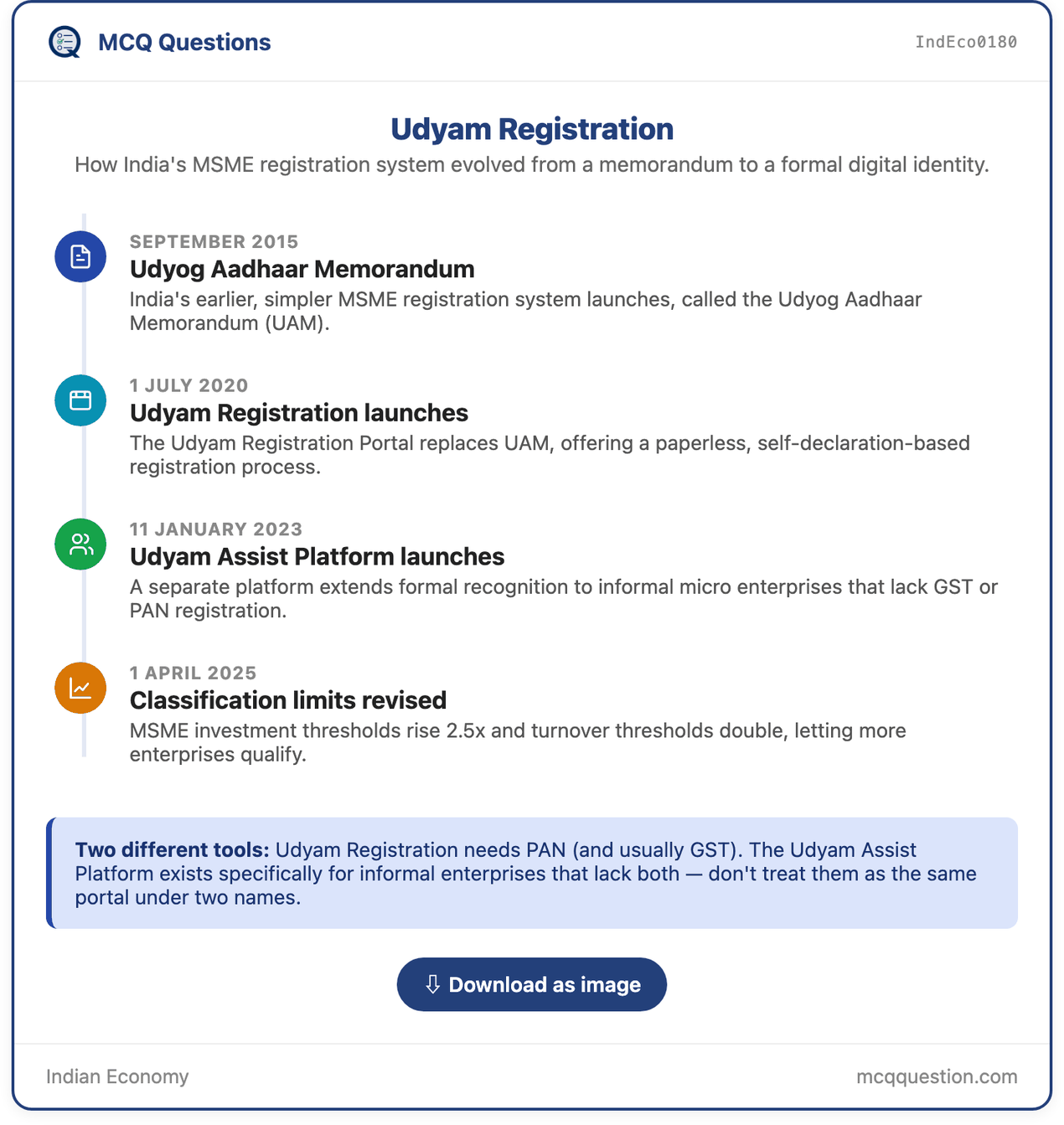
Udyam Registration
How India’s MSME registration system evolved from a memorandum to a formal digital identity.
September 2015
Udyog Aadhaar Memorandum
India’s earlier, simpler MSME registration system launches, called the Udyog Aadhaar Memorandum (UAM).
1 July 2020
Udyam Registration launches
The Udyam Registration Portal replaces UAM, offering a paperless, self-declaration-based registration process.
11 January 2023
Udyam Assist Platform launches
A separate platform extends formal recognition to informal micro enterprises that lack GST or PAN registration.
1 April 2025
Classification limits revised
MSME investment thresholds rise 2.5x and turnover thresholds double, letting more enterprises qualify.
Two different tools: Udyam Registration needs PAN (and usually GST). The Udyam Assist Platform exists specifically for informal enterprises that lack both — don’t treat them as the same portal under two names.
Indian Economymcqquestion.com
Must Know
- The Udyam Registration Portal is the Ministry of MSME’s official, free, paperless system for registering micro, small, and medium enterprises.
- It launched on 1 July 2020, replacing the earlier Udyog Aadhaar Memorandum (UAM) system, which had run since September 2015.
- Registration needs the applicant’s Aadhaar and the business’s PAN, verified through self-declaration. It produces an instant e-Certificate carrying a unique Udyam Registration Number.
- The Udyam Assist Platform launched on 11 January 2023. It exists specifically for informal micro enterprises that lack GST registration or aren’t covered under the Income Tax system.
- SIDBI, the Small Industries Development Bank of India, implements the Udyam Assist Platform.
Good to Know
- MSME classification uses two criteria together: investment in plant, machinery, and equipment, and annual turnover.
- Since 1 April 2025, the revised thresholds are: Micro (investment up to ₹2.5 crore, turnover up to ₹10 crore), Small (up to ₹25 crore investment, ₹100 crore turnover), and Medium (up to ₹125 crore investment, ₹500 crore turnover).
- Udyam registration unlocks real benefits. These include easier institutional credit, and protection against delayed payments through the MSME Online Dispute Resolution (ODR) Portal.
- Registered enterprises also get priority in government procurement, and support for quality certification and technology upgrades.
- The main channel for this procurement priority is the Government e-Marketplace (GeM). In FY 2025-26, Udyam-registered MSEs executed 68% of all GeM orders, worth 47.1% of its total Gross Merchandise Value.
- Udyam Assist Certificate holders are treated on par with regular Udyam-registered enterprises, for Priority Sector Lending benefits.
- The original MSMED Act, 2006 classified enterprises very differently — for manufacturing, medium enterprises were those with investment in plant and machinery above ₹5 crore and up to ₹10 crore, far below today’s revised thresholds. A common UPSC trap cites incorrect figures like ₹15–25 crore for this original 2006 slab.
- Per RBI’s Priority Sector Lending (PSL) directions, all bank loans to MSMEs qualify for PSL classification — unlike most other PSL categories, MSME lending carries no loan-amount ceiling.
Test Yourself

Great to Know
- Don’t cite the original 2020 classification thresholds as current. They were significantly revised upward, effective 1 April 2025 — investment limits rose 2.5 times, and turnover limits doubled. This article’s own figures reflect the current, post-revision thresholds.
- Udyam Registration and the Udyam Assist Platform solve two different formalisation problems, not the same one twice. Udyam Registration needs PAN and usually GST. The Udyam Assist Platform exists specifically because many informal micro enterprises lack both.
- See IndEco0055 — MSMEs and Industrial Policy for the broader MSME policy and definition history that Udyam Registration operationalises.
- The MSMED Act itself was amended again in 2026. See IndEco0218 — MSME Development (Amendment) Bill, 2026, which gives Udyam Registration statutory backing.
Current Affairs
- 14 July 2026: PIB reported that the Udyam Registration Portal and Udyam Assist Platform, combined, had crossed 8.9 crore registered enterprises, providing employment to over 38 crore people across the country. (Source: PIB)
- 14 July 2026: PIB highlighted that these platforms are especially expanding access for women, SC/ST entrepreneurs, rural enterprises, traditional artisans, first-generation entrepreneurs, and youth-led start-ups. (Source: PIB)
Previous Year Question
- UPSC 2023: Only Statement 2 is correct. The original MSMED Act, 2006 did not classify medium enterprises as ₹15-25 crore investment (Statement 1 is false); but all bank loans to MSMEs do qualify under priority sector lending, with no ceiling limit (Statement 2 is true). See UPSC CSP 2023 GS Paper I, Q71.
Beyond the answer
Browse all indian-economy topics →
📚 Keep reading
IndEco0218 — MSME Development (Amendment) Bill, 2026IndEco0055 — MSMEs and Industrial PolicyEconomy0026 — TReDS and MSME Invoice FinancingIndEco0072 — SIDBI: Small Industries Development Bank of IndiaIndEco0112 — Textile Industry in India❓ Practice this topic
Atal Innovation Mission is set up under theD0231 — Which statement about India's fisheries sector is correct?D0230 — Why is the Rann of Kutch important for non-farm primary activity?D0229 — Which pairing of a non-farm primary activity with its physiographic setting is correct?🎲 Take a Indian Economy Quiz
Leave a Reply