The Aspirational Districts Programme (ADP) targets India’s most backward districts for rapid, data-driven development.
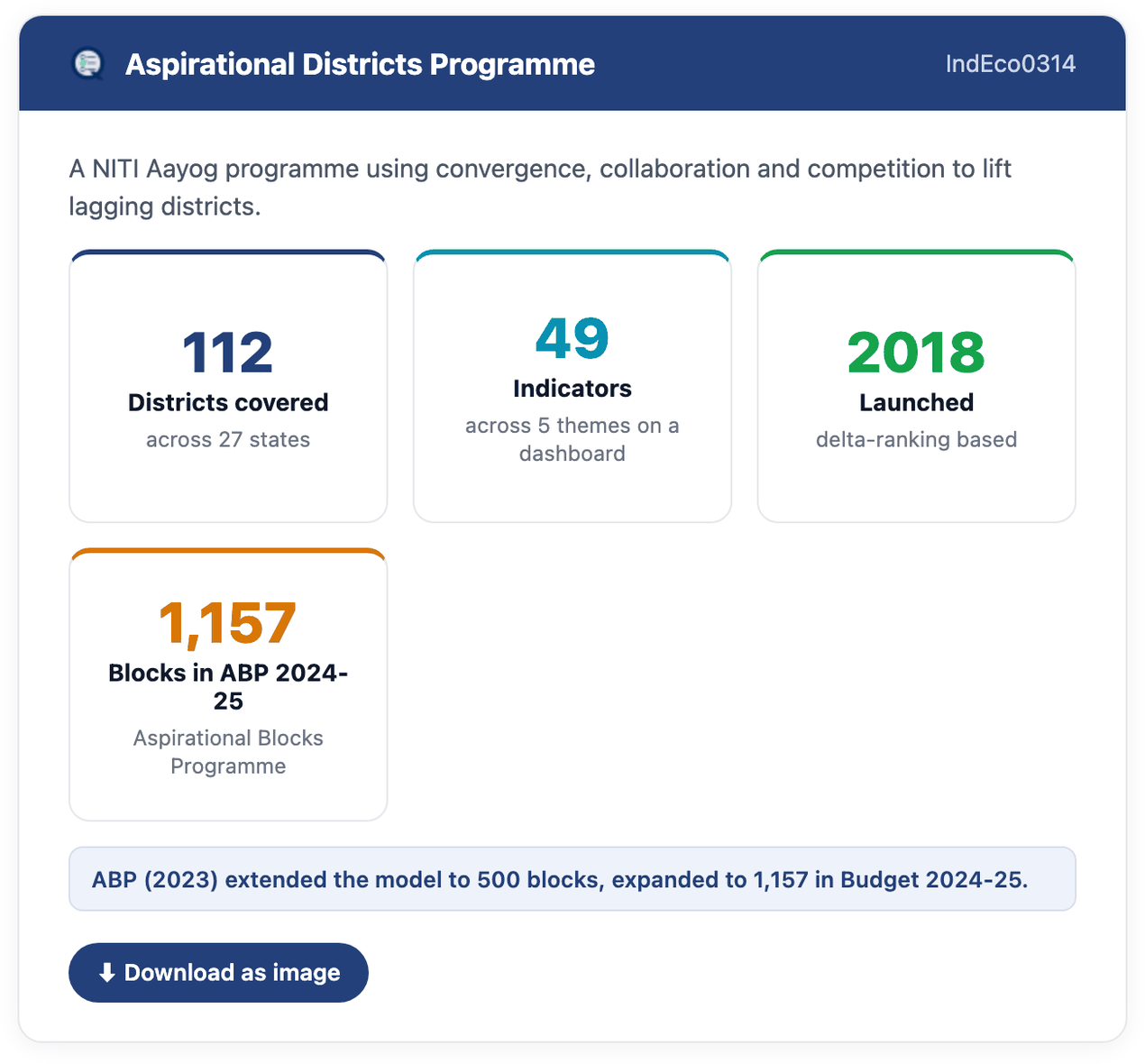
Launched in 2018, it uses convergence, collaboration and competition to speed up basic services.


Must Know
Must Know
What the ADP is and when it began
- LaunchPrime Minister Narendra Modi launched the ADP in January 2018.
- ScopeIt covers 112 districts across 27 states.
- AimThe goal is to close gaps in basic services and living standards.
- ApproachA public dashboard tracks progress on a set of social indicators.
How the 112 districts were chosen
- SelectionDistricts were picked using a composite index of deprivation.
- DataThe index drew on the SECC 2011 and other official surveys.
- ProfileChosen districts lagged most on health, education and infrastructure.
- RegionMost lie in central and eastern India, plus the northeast.
The five themes and 49 indicators
- ThemesThe dashboard covers health, education, agriculture, financial inclusion and infrastructure.
- CountForty-nine indicators measure progress across these five themes.
- PortalDistricts enter real-time data on the Champions of Change portal.
Who runs the programme
- NITINITI Aayog anchors the programme at the national level.
- MinistriesCentral ministries give sectoral support and guidance.
- StatesStates appoint nodal officers and district-level teams.
- CollectorsDistrict Collectors lead implementation on the ground.
Good to Know
Good to Know
Convergence: pooling schemes and funds
- ConvergenceConvergence merges central and state schemes at the district level.
- One PlanEach district prepares one plan for all its schemes.
- FundsFunds from many programmes converge on the same priorities.
- SaturationServices aim for full saturation instead of scattered coverage.
Collaboration: many hands, one goal
- CollaborationCollaboration links the centre, states, districts and citizens.
- EmpowermentCollectors get freedom to act and stay accountable.
- PartnersPrivate firms, NGOs and volunteers support district teams.
- ReviewThe PMO reviews district performance every month.
Competition: ranking that drives change
- CompetitionCompetition pushes districts to beat their own past scores.
- DeltaMonthly delta rankings reward improvement from each district’s baseline.
- PublicRankings are public on the Champions of Change dashboard.
- PressurePublic ranking builds healthy peer pressure among districts.
Why delta ranking is fair
- FairnessDelta ranking compares a district with its own past.
- LogicEvery district can win, whatever its starting point.
- IncentiveThis keeps laggards motivated instead of demoralised.
Test Yourself


Great to Know
Great to Know
Core strategies for transformation
- DataData-driven governance puts real-time numbers at the centre.
- SaturationSaturation of services leaves no household behind.
- CitizenCitizen-centric delivery designs services around people’s needs.
- LeadershipEmpowered local leadership lets Collectors move fast.
- ReviewMonthly reviews keep every level alert and accountable.
How districts apply the strategies
- HealthHealth camps and nutrition drives target mothers and children.
- EducationEnrolment drives and teacher training lift school outcomes.
- FarmingWater harvesting and farm extension raise farm incomes.
- BankingBank account and insurance drives deepen financial inclusion.
Evidence of progress
- GainsMost districts improved on most indicators within a few years.
- PaceAspirational districts often outpaced the national average.
- NutritionHealth and nutrition showed some of the fastest gains.
- ChallengesData quality and fund flow remain real challenges.
Current Affairs
📰 Current Affairs
The ADP’s model now scales down to blocks through the Aspirational Blocks Programme (ABP).
Aspirational Blocks Programme launched (2023)
- Launch The ABP was launched in January 2023 to replicate the ADP at block level.
- Scale It began with 500 blocks across 329 districts.
- Model It uses the same themes, indicators and delta rankings.
- Source NITI Aayog — Aspirational Districts and Blocks Programme
ABP expands to 1,157 blocks
- Budget The Union Budget 2024-25 expanded the ABP to 1,157 blocks.
- Coverage Coverage nearly doubled beyond the original 500 blocks.
- Signal The expansion shows the district model scaling to more areas.
- Source NITI Aayog — Aspirational Districts and Blocks Programme
ADP completes six years
- Report In January 2024, NITI Aayog released a six-year review of the ADP.
- Findings It reported broad gains, with health and nutrition improving fastest.
- Outlook The review framed the ADP as a template for other missions.
- Source NITI Aayog — Aspirational Districts and Blocks Programme
Previous Year Questions
Previous Year Questions
2018 Mains — GS Paper I
- UPSC 2018UPSC CSM 2018 GS Paper I, Q17 (View this question)
- AskThe question wants the core strategies and the three C’s explained.
- PlanName the strategies first, then explain the three C’s.
- TipCite the 49 indicators, delta ranking and dashboard for full marks.
📚 Related Articles
Beyond the answer
Browse all indian-economy topics →
📚 Keep reading
Polity0122 — NITI Aayog: Founding, Structure, and MandateSciTech0012 — NITI AayogIndEco0205 — PM Dhan-Dhaanya Krishi YojanaIndEco0013 — Planning Commission and Five Year PlansPolity0260 — Article 235 of the Constitution❓ Practice this topic
Atal Innovation Mission is set up under theD0231 — Which statement about India's fisheries sector is correct?D0230 — Why is the Rann of Kutch important for non-farm primary activity?D0229 — Which pairing of a non-farm primary activity with its physiographic setting is correct?🎲 Take a Indian Economy Quiz
Leave a Reply