Instead of one more new scheme, the government tried something different: pointing 36 existing ones at the same 100 districts.

Timeline
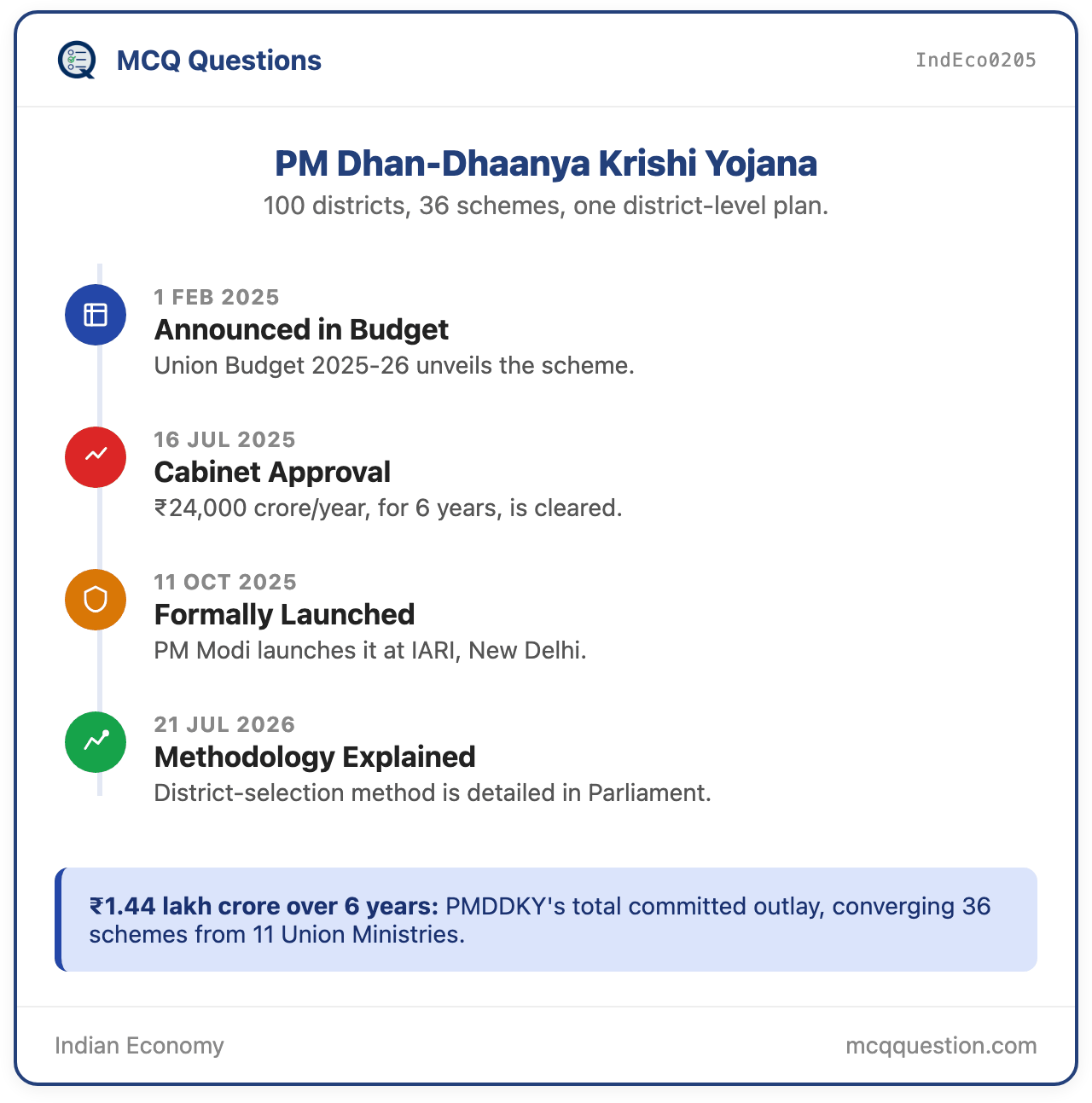
- 1 February 2025: The scheme is announced in the Union Budget 2025-26.
- 16 July 2025: The Union Cabinet approves it, with a 6-year outlay.
- 11 October 2025: Prime Minister Modi formally launches it, at IARI, New Delhi.
- 21 July 2026: The government explains its district-selection methodology, in a Lok Sabha reply.
Must Know
- The PM Dhan-Dhaanya Krishi Yojana (PMDDKY) is a district-focused agriculture scheme. It is explicitly modelled on NITI Aayog’s Aspirational Districts Programme.
- It was announced in the Union Budget 2025-26, on 1 February 2025. The Union Cabinet approved it on 16 July 2025, and it was formally launched on 11 October 2025.
- The scheme covers 100 districts. These were selected on three indicators: farm output per unit of land, cropping frequency, and access to institutional credit.
- Rather than building a new delivery system, PMDDKY converges 36 existing schemes from 11 Union Ministries into one district-level plan.
- Its total outlay is ₹24,000 crore a year, for six years, from 2025-26 to 2030-31. That totals ₹1.44 lakh crore.
- The scheme aims to benefit 1.7 crore farmers, with particular focus on small and marginal landholders.
- Local delivery runs through District Dhan-Dhaanya Samitis. Each prepares its own district-specific Agriculture and Allied Activities Plan.
Good to Know
- PMDDKY launched alongside a second new scheme, the Mission for Aatmanirbharta in Pulses (₹11,440 crore). Together, the two schemes carried a combined outlay of ₹35,440 crore.
- Progress is tracked through a digital dashboard, using 117 Key Performance Indicators. This mirrors the data-driven monitoring the Aspirational Districts Programme itself used.
- Implementation responsibility sits with each district’s own District Magistrate or Collector, not just with farmers. This lets district plans adjust to local soil and climate conditions.
- The scheme’s guiding idea is “convergence, collaboration, and competition” among districts. This is the same three-part approach credited with the Aspirational Districts Programme’s own results.
Test Yourself

Great to Know
- Among PMDDKY’s 36 converged schemes is the National Mission on Natural Farming, itself a standalone scheme with its own budget. See IndEco0203 — Zero Budget Natural Farming.
- Other converged schemes include PM-KISAN (cash transfers), PMFBY (crop insurance), and PMKSY (irrigation). PMDDKY doesn’t replace these; it coordinates their delivery within the 100 chosen districts.
- The Aspirational Districts Programme, PMDDKY’s own model, has a strong track record. Road connectivity, child immunisation, and school electrification all rose sharply across its 100-plus districts.
- PMDDKY’s objectives span the whole farming cycle. These include better productivity, crop diversification, and post-harvest storage at the panchayat and block level. They also include improved irrigation and easier access to credit.
Current Affairs
- On 21 July 2026, Minister of State for Agriculture and Farmers Welfare Ramnath Thakur explained the district-selection method, in a written Lok Sabha reply. (Source: PIB)
- He confirmed the 100 districts were chosen using three published indicators: low productivity, low cropping intensity, and low agricultural credit disbursement. (Source: PIB)
- Each State’s share of districts was set by its net cropped area and number of operational holdings, for balanced regional coverage. (Source: PIB)
- Every State received at least one district under the scheme, so no State was excluded. States may also replicate the same method on their own, for additional districts. (Source: PIB)
Leave a Reply