Zero Budget Natural Farming began as one farmer’s idea. It is now a nationwide government mission, backed by thousands of crores in public funding.

Timeline
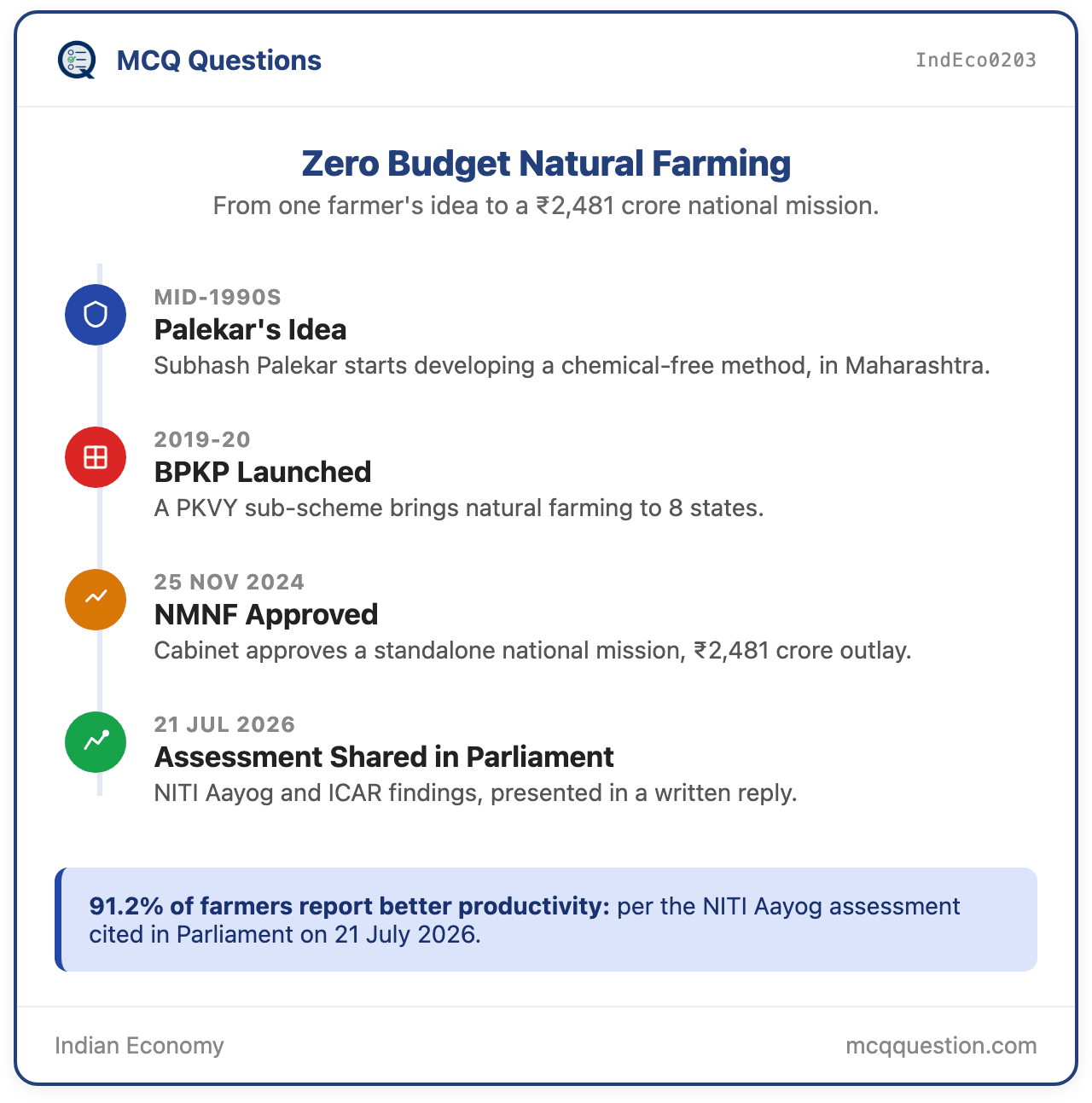
- Mid-1990s: Agriculturist Subhash Palekar begins developing Zero Budget Natural Farming, in Maharashtra.
- 2019-20: The government launches BPKP, a natural-farming sub-scheme under PKVY, in 8 states.
- 25 November 2024: The Union Cabinet approves the National Mission on Natural Farming, as a standalone scheme.
- 21 July 2026: The government shares NITI Aayog and ICAR assessment findings, in a written Lok Sabha reply.
Must Know
- Zero Budget Natural Farming (ZBNF) is a chemical-free farming method. It avoids all purchased synthetic fertilisers and pesticides.
- Agriculturist and Padma Shri awardee Subhash Palekar began developing ZBNF in the mid-1990s. He offered it as an alternative to the Green Revolution’s chemical-intensive approach.
- ZBNF relies on farmer-made inputs, not purchased ones. Jeevamrutha, a fermented mix of cow dung, cow urine, jaggery, and pulse flour, boosts soil microbes.
- Beejamrutha is a related mixture used to treat seeds. It protects young crops from soil-borne disease.
- Government support began with BPKP (Bharatiya Prakritik Krishi Paddhati). It launched in 2019-20, as a PKVY sub-scheme, in 8 states. PKVY itself promotes organic farming more broadly, with its own certification route — see IndEco0300 — National Programme for Organic Production (NPOP) and Organic Farming in India.
- On 25 November 2024, the Union Cabinet upgraded this into the National Mission on Natural Farming (NMNF), a standalone Centrally Sponsored Scheme.
- NMNF has a total outlay of ₹2,481 crore, through the 15th Finance Commission period. The Centre contributes ₹1,584 crore, and States contribute ₹897 crore.
- Within two years of launch, NMNF aims to reach 1 crore farmers. It targets 15,000 Gram Panchayat clusters, covering 7.5 lakh hectares.
Good to Know
- BPKP gives farmers ₹12,200 per hectare, spread over 3 years. This covers cluster formation, training, certification, and residue testing.
- NMNF plans 10,000 Bio-input Resource Centres (BRCs). These centres make ready-to-use natural-farming inputs easily available to farmers.
- Around 2,000 Model Demonstration Farms will be set up. They will run at Krishi Vigyan Kendras, agricultural universities, and farmers’ own fields.
- The Mission plans to train 18.75 lakh farmers directly. It will also deploy 30,000 Krishi Sakhis and community resource persons, for outreach.
- Farmers get a simple certification system and common branding. This is meant to help them market their natural-farming produce.
- Since 2020-21, ICAR has run the All India Network Programme on Natural Farming. It spans 20 centres in 16 states, testing 8 major cropping systems.
- Palekar developed ZBNF personally in Maharashtra, but it grew into a real farmer movement in Karnataka. From around 2002, the state farmers’ association Karnataka Rajya Raitha Sangha (KRRS) worked with Palekar to spread it widely.
Test Yourself

Great to Know
- “Zero Budget” describes a farmer’s own out-of-pocket input costs, not government spending. NMNF itself commits ₹2,481 crore in public funds.
- ZBNF developed partly as a response to the Green Revolution’s costs and side effects. See IndEco0052 — The Green Revolution and Crop Policy.
- ICAR’s network trials found some natural-farming cropping systems matched, or slightly exceeded, yields from organic farming and integrated crop management. Results varied by crop system and location.
- ZBNF is not the only term now in official use. Government schemes increasingly use the broader label “Natural Farming,” reserving “Zero Budget” for the original Palekar-era concept.
- NMNF is now also one of 36 schemes converged under a newer, district-focused mission. See IndEco0205 — PM Dhan-Dhaanya Krishi Yojana.
Current Affairs
- On 21 July 2026, Minister of State for Agriculture and Farmers Welfare Ramnath Thakur gave a written Lok Sabha reply, on natural farming’s progress. (Source: PIB)
- He cited a NITI Aayog assessment: 91.2% of surveyed farmers reported higher productivity and better soil health, after adopting natural farming. (Source: PIB)
- 90.1% of farmers reported lower input costs. In Himalayan-region ICAR trials, soil organic carbon rose from about 0.90% to 1.15%, over 2-3 years. (Source: PIB)
- The reply confirmed an Output-Based Incentive: ₹4,000 per acre, per year, for 2 years, up to 1 acre per farmer, to support NF adoption. (Source: PIB)
Beyond the answer
Browse all indian-economy topics →
📚 Keep reading
IndEco0032 — Technology Missions in Indian AgricultureIndEco0022 — Budget Process and Documents in IndiaIndEco0027 — E-Technology in FarmingIndEco0004 — Agriculture In Indian EconomyUPSC CSP 2026 — General Studies Paper I (Full Question Paper)❓ Practice this topic
Atal Innovation Mission is set up under theD0231 — Which statement about India's fisheries sector is correct?D0230 — Why is the Rann of Kutch important for non-farm primary activity?D0229 — Which pairing of a non-farm primary activity with its physiographic setting is correct?🎲 Take a Indian Economy Quiz
Leave a Reply