UPSC’s 2018 Prelims asked candidates to judge three statements about organic farming in India — and most people who miss it get tripped by the same one. The National Programme for Organic Production is not run by the Ministry of Rural Development. It sits under the Ministry of Commerce and Industry, with APEDA as its Secretariat. This article covers NPOP, its certification system, Sikkim’s organic-state story, and the related Paramparagat Krishi Vikas Yojana.


✊ Must Know
1. What NPOP is
- Definition The National Programme for Organic Production (NPOP) is India's national system for organic certification and standards. It covers both domestic use and exports.
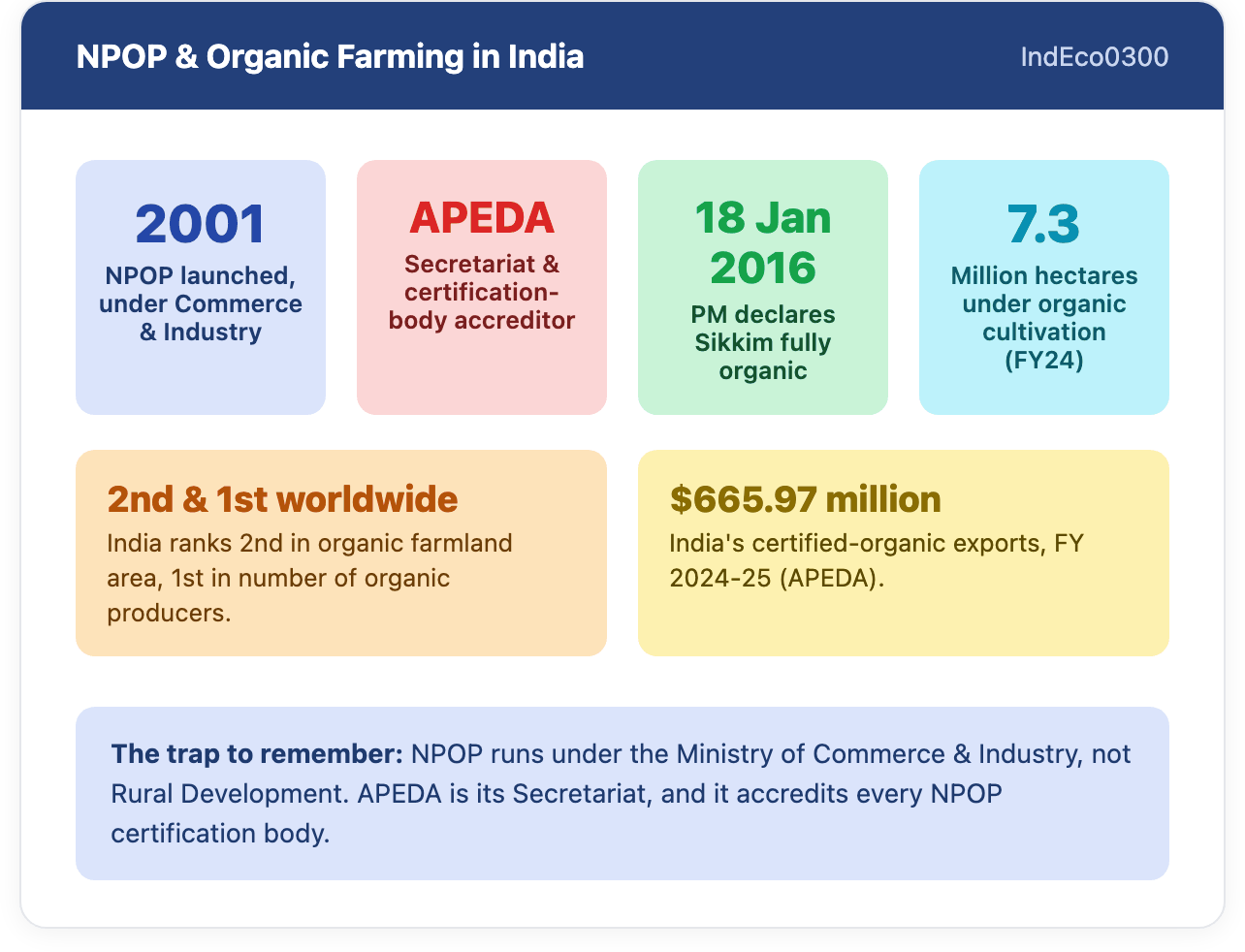
- Launch NPOP was launched in 2001, by the Department of Commerce. Its main original goal was enabling exports of certified organic products.
- Coverage NPOP sets production standards for organic crops, livestock, and processed products. It also accredits the bodies that certify individual farms and processors.
2. The nodal ministry — the exam trap
- Ministry NPOP operates under the Ministry of Commerce and Industry, not the Ministry of Rural Development. This is the single most-tested fact about NPOP.
- Why the trap works Organic farming sounds like a rural-development or agriculture subject. But NPOP itself is framed as a trade and export-standards programme, so Commerce runs it.
3. APEDA's role as Secretariat
- Secretariat The Agricultural and Processed Food Products Export Development Authority (APEDA) functions as NPOP's Secretariat. APEDA itself also sits under the Ministry of Commerce and Industry.
- Accreditation APEDA accredits the certification bodies that inspect and certify individual organic farms and processing units under NPOP.
- Standards recognition NPOP's own production and accreditation standards are recognised as equivalent by the European Commission and Switzerland, for unprocessed plant products. India also has a mutual recognition arrangement with Taiwan.
📘 Good to Know
1. Two certification routes under NPOP
- Third-party NPOP's main route is third-party certification. An APEDA-accredited certification body inspects a farm or processor and issues a formal organic certificate.
- PGS-India A second, lighter-touch route is the Participatory Guarantee System (PGS-India). It relies on peer review among local farmer groups, rather than a paid external inspector.
- When each applies Third-party NPOP certification is generally required for exports. PGS-India mainly supports small and marginal farmers selling in the domestic market.
2. How the certification process works
- Conversion period A farm must go through a multi-year conversion period, farming organically without certification first, before it can be certified organic.
- Inspection An accredited certification body inspects the farm's practices, inputs, and records against NPOP's national standards.
- Traceability Certified operators must maintain full traceability records, from field to final product, so buyers can verify the organic claim.
3. India's organic sector, by the numbers
- Area India had about 7.3 million hectares under organic cultivation in FY 2023-24, per APEDA data.
- Global rank India ranks 2nd worldwide by total organic-farmland area, and 1st worldwide by number of organic producers.
- Exports India exported about 3.68 lakh metric tonnes of certified organic products in FY 2024-25, worth roughly $665.97 million.
Test Yourself

🎓 Great to Know
1. How Sikkim became fully organic
- Decision Sikkim's state government officially decided to go fully organic in 2003. It then banned chemical fertilisers and pesticides in stages, over more than a decade.
- Conversion The state converted all of its farmland, about 75,000-76,000 hectares, to certified organic cultivation across roughly 66,000 farming families.
- Announcement Prime Minister Narendra Modi formally declared Sikkim India's first fully organic state on 18 January 2016. He made the announcement at a national sustainable-agriculture conference in Gangtok. See GK0056 — Sikkim: Capital, Government, and India’s First Organic State for the full state profile.
- Recognition Sikkim's model later won the Future Policy Gold Award in 2018, from the UN Food and Agriculture Organization, IFOAM-Organics, and the World Future Council.
2. Paramparagat Krishi Vikas Yojana (PKVY) — related scheme
- What it is PKVY is a central scheme, launched in 2015, that promotes organic farming through farmer clusters. It runs as a component of Soil Health Management, under the National Mission on Sustainable Agriculture.
- Certification route PKVY promotes PGS-India certification, not the full third-party NPOP route, since it targets small farmer clusters rather than export-scale operations. A related mission, natural farming (no external inputs at all, not just organic ones), is covered in IndEco0203 — Zero Budget Natural Farming.
- Support Farmers under PKVY get about ₹31,500 per hectare over three years, covering production, certification, and marketing support.
- Scale By early 2025, PKVY covered around 15 lakh hectares, across roughly 52,289 farmer clusters, benefiting about 25.30 lakh farmers.
3. Why UPSC keeps testing this topic
- Exam pattern UPSC likes pairing one easy-sounding fact (Sikkim's organic status) with one commonly-confused fact (NPOP's actual ministry) in the same question.
- Test-taking tip Any statement naming a scheme's "nodal ministry" deserves a second look. A plausible-sounding wrong ministry is one of UPSC's most repeated distractor patterns.
📝 Previous Year Questions
NPOP's Real Nodal Ministry — a Common Trap
- Ministry The National Programme for Organic Production (NPOP) is not run by the Ministry of Rural Development. It operates under the Ministry of Commerce and Industry.
- Secretariat APEDA functions as NPOP's Secretariat. It also accredits the certification bodies under NPOP.
- Sikkim Sikkim became India's first fully organic state. The Prime Minister formally announced this in January 2016, after the state converted all its farmland to organic certification.
- PYQ UPSC CSP 2018, GS Paper I, Q100. Full question and answer: UPSC CSP 2018 — General Studies Paper I, Q100.
Beyond the answer
Browse all indian-economy topics →
📚 Keep reading
UPSC CSP 2018 — General Studies Paper I (Full Question Paper)GK0056 — Sikkim: Capital, Government, and India's First Organic StateIndEco0203 — Zero Budget Natural Farming: From One Farmer's Idea to a National MissionIndEco0127 — The Golden Revolution: Horticulture and Honey in IndiaUPSC CSP 2026 — General Studies Paper I (Full Question Paper)❓ Practice this topic
Atal Innovation Mission is set up under theD0231 — Which statement about India's fisheries sector is correct?D0230 — Why is the Rann of Kutch important for non-farm primary activity?D0229 — Which pairing of a non-farm primary activity with its physiographic setting is correct?🎲 Take a Indian Economy Quiz
Leave a Reply