The Fiscal Health Index (FHI) measures the fiscal performance of Indian states on one composite score.
NITI Aayog released the first edition of this index in January 2025.


Must Know
What the Fiscal Health Index is
- DefinitionThe FHI is a NITI Aayog index of state fiscal health.
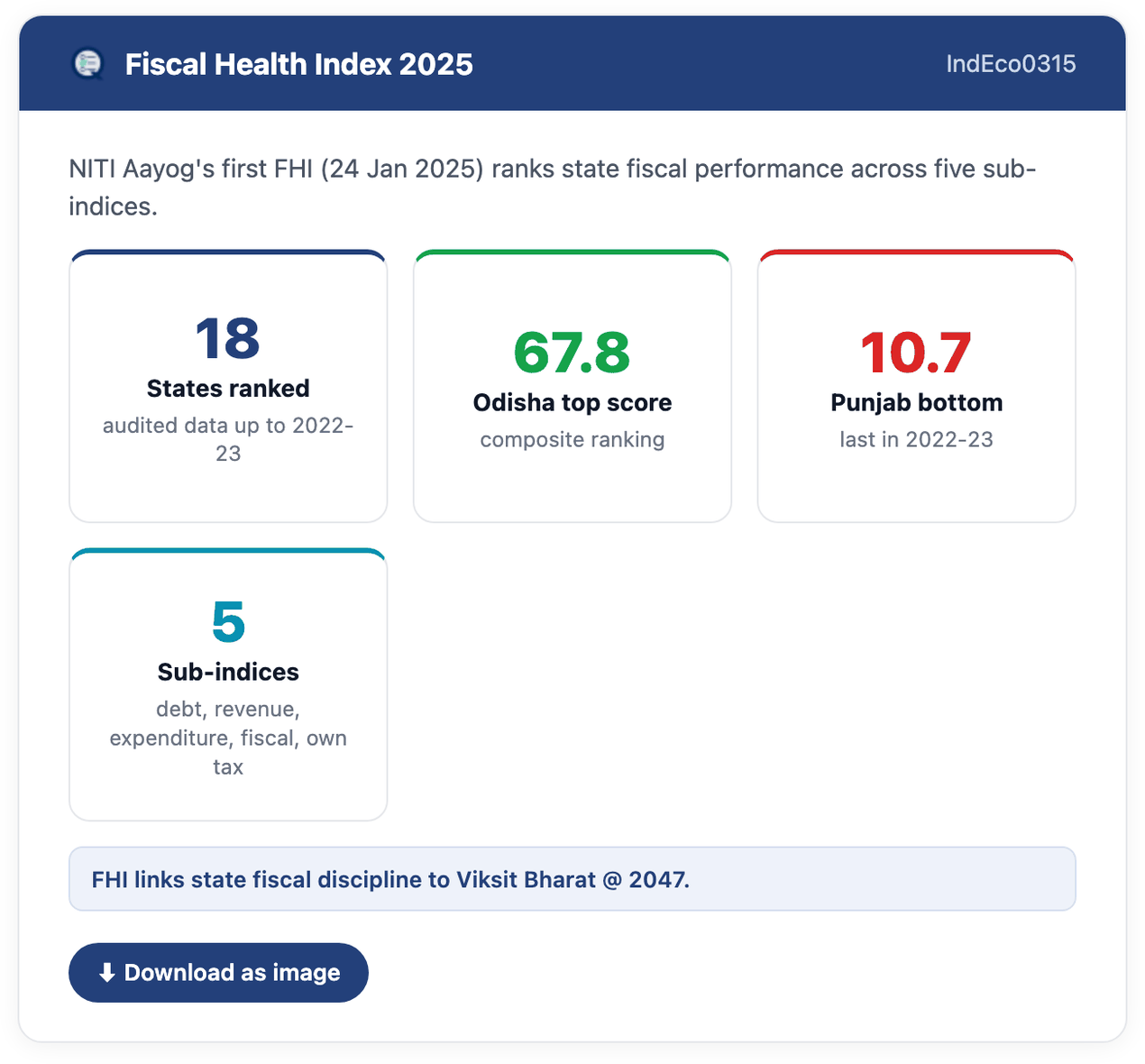
- LaunchFHI 2025, the first edition, was released on 24 January 2025.
- LauncherDr. Arvind Panagariya, Chairman of the 16th Finance Commission, launched it.
- AnnualThe report is designed as an annual publication.
- CoverageIt ranks 18 major states using audited data up to 2022-23.
The five sub-indices of the FHI
- ExpenditureQuality of Expenditure checks how spending supports growth.
- RevenueRevenue Mobilization measures a state’s own revenue effort.
- PrudenceFiscal Prudence tracks deficits against fiscal rules.
- DebtThe Debt Index captures the burden of outstanding debt.
- SustainabilityDebt Sustainability tests the ability to service debt over time.
- InputNine minor sub-indices feed these five major indicators.
- SourceThe index is built on data from the Comptroller and Auditor General (CAG).
The 2025 ranking at a glance
- TopOdisha topped the composite ranking with a score of 67.8.
- NextChhattisgarh (55.2) and Goa (53.6) took second and third place.
- BottomPunjab ranked last with a score of 10.7.
- SlipKarnataka fell from rank 3 to rank 10 in the 2022-23 data.
- RiseJharkhand improved on fiscal prudence and debt sustainability.
How states are classified
- AchieverStates with a composite score above 50 are Achievers.
- Front RunnerScores above 40 and up to 50 mark Front Runners.
- PerformerScores above 25 and up to 40 mark Performers.
- AspirationalScores of 25 or below mark Aspirational states.
Good to Know
What each sub-index actually measures
- ExpenditureIt weighs development spending and capital outlay against GSDP.
- RevenueIt compares state own revenue to GSDP and to total expenditure.
- PrudenceIt checks gross fiscal deficit and revenue deficit against GSDP.
- DebtIt tracks the state’s total outstanding liabilities.
- SustainabilityIt links interest payments and debt with revenue receipts.
- FairnessOne official CAG data set keeps every state on the same basis.
Why the index was created
- InsightIt offers data-driven insight into state-level fiscal health.
- ReformIt helps policymakers spot areas that need intervention.
- CompetitionIt promotes healthy competition among states.
- VisionIt links state fiscal discipline to Viksit Bharat @2047.
- FederalismIt strengthens cooperative federalism between Centre and states.
- ConsolidationIt offers a roadmap for fiscal consolidation and transparency.
Findings that matter
- OdishaOdisha topped the Debt Index (99.0) and Debt Sustainability (64.0).
- KarnatakaWeaker spending quality and debt management pulled it down.
- JharkhandBetter fiscal prudence lifted Jharkhand up the ranking.
- GapWide score gaps show deep fiscal disparity among states.
Test Yourself


Great to Know
How FHI encourages prudent fiscal policy
- RankingA public ranking names strong and weak performers every year.
- PressureNo state wants to sit at the bottom of a national index.
- LearningStates can copy the practices of top-ranked peers.
- TargetingSub-index scores reveal exactly where a state lags.
- AccountabilityYearly editions keep states answerable over time.
- RewardVisible improvement raises a state’s image with investors.
How a state can improve its score
- RevenueStates should widen their own tax and non-tax revenue base.
- SpendingShift expenditure toward capital and development outlays.
- DeficitsKeep fiscal and revenue deficits within FRBM limits.
- BorrowingManage debt so it stays within sustainable limits.
- StrategyA medium-term debt strategy lowers interest costs.
- EfficiencyBetter spending quality lifts the composite score directly.
Limits to keep in mind
- CoverageThe 2025 edition excludes Himalayan and north-eastern states.
- ContextOne score cannot capture every state-specific constraint.
- Data LagAudited CAG data means the index lags by about a year.
- RoleThe FHI complements, not replaces, Finance Commission transfers.
- MethodA composite score can hide mixed performance on single sub-indices.
Previous Year Questions
UPSC CSM 2025 — GS Paper III, Q11
- UPSC 2025UPSC CSM 2025 GS Paper III, Q11 — View this question
- AskThe question tests the FHI as an assessment tool, not just its definition.
- PlanOpen with the FHI’s purpose and its five sub-indices.
- LinkShow how each sub-index rewards prudent fiscal behaviour.
- TipClose with the incentives and limits of a public state ranking.
Leave a Reply