India sits on some of the world’s largest mineral reserves — and mining still barely registers as a share of its economy.

 MCQ Questions
✅ Must Know
India’s mineral wealth
- India ranks among the world’s top producers of coal, iron ore, bauxite, manganese, chromite, and mica. Its mineral base is genuinely large by global standards.
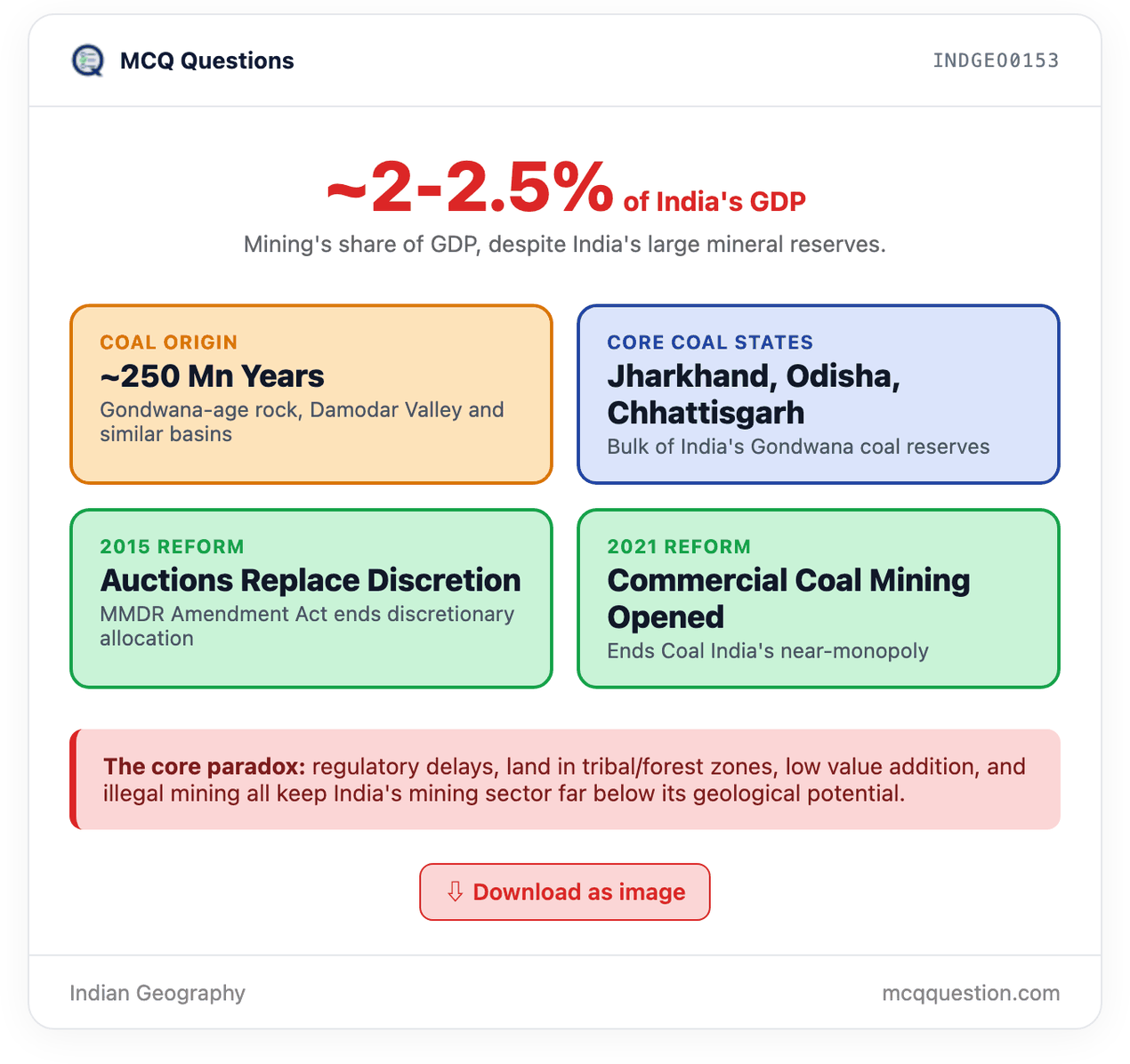
A surprisingly small GDP share
- Despite this wealth, mining contributes only about 2-2.5% of India’s GDP. Countries with comparable mineral abundance, like Australia, often see mining contribute a far larger share.
The Gondwana connection
- India was once part of the ancient supercontinent Gondwana. Most of India’s coal sits in Gondwana-age rock, formed roughly 250 million years ago in ancient river basins like the Damodar Valley.
Where the coal actually sits
- Jharkhand, Odisha, Chhattisgarh, West Bengal, and Madhya Pradesh hold the bulk of India’s Gondwana coal reserves. These deposits concentrate along old river-basin formations.
💡 Good to Know
Regulatory delays slow development
- Environmental clearances, forest clearances, and land acquisition each add years to opening or expanding a mine. Known reserves stay underexploited far longer than the geology alone would require.
Many reserves sit in sensitive, contested land
- A large share of India’s mineral wealth lies in ecologically sensitive or tribal-dominated states like Jharkhand, Odisha, and Chhattisgarh. Fifth Schedule protections and litigation, like the Niyamgiri case, have repeatedly slowed mining projects there.
Low value addition on raw ore
- India has often exported raw ore rather than processing it domestically into higher-value metals. This captures less economic value from its own minerals than a more processing-heavy model would.
Illegal mining leaks value out of the formal sector
- Unregulated and illegal mining diverts real economic activity away from the formal, measured sector. This understates mining’s true contribution while also costing the exchequer royalty revenue.
Test Yourself


🌟 Great to Know
Outdated technology limits productivity
- Many Indian mines still use older extraction methods with lower productivity than global best practice. The same reserve ends up yielding less output per unit of investment than it could.
Commodity price cycles amplify the swings
- Mining’s GDP contribution moves with global mineral prices. Prices have often stayed subdued for extended periods, further compressing an already modest sectoral share.
The 2015 reform: auctions over discretion
- The Mines and Minerals (Development and Regulation) Amendment Act, 2015, replaced discretionary allocation of mineral concessions with competitive auctions. This aimed to cut the opacity and delay that discretionary allotment had allowed.
The 2021 reform: opening commercial coal mining
- A 2021 amendment opened commercial coal mining to private players, ending Coal India’s near-monopoly. It also removed end-use restrictions on captive mines, letting captive-mine output be sold commercially instead of only used in-house.
📝 Previous Year Questions
UPSC Mains 2021 GS Paper I, Q5
Beyond the answer
Browse all indian-geography topics →
📚 Keep reading
IndEco0123 — Coal Sector in India: From Nationalisation to the Coal ExchangeIndEco0295 — Steel Industry in India: Coking Coal Dependence and Import StrategyGK0026 — Jharkhand: Mineral Wealth, Tribal Heritage, and Tata SteelIndGeo0055 — Gondwanaland and the Gondwana Rock System: India's Coal BackboneIndEco0175 — Critical and Strategic Minerals in India❓ Practice this topic
D0311 — Consider the following statements: 1. Filling a lake removes natural flood storage. 2. Wetlands recharge groundwater aquifers. 3. Reclaimed water bodies increase local heat island effects. How many of the statements are correct?D0310 — Which of the following directly governs wetland conservation in India?D0309 — Why is the East Kolkata Wetlands ecologically valuable?D0308 — Which of the following is a direct environmental effect of filling an urban lake?🎲 Take a Indian Geography Quiz
Leave a Reply