Roughly three out of every four new infectious diseases start in animals before reaching a human. India’s newest health strategy tries to catch the next one before it spreads.


Must Know
Zoonotic Disease Control and One Health in India
What Zoonoses Are
- DefinitionZoonoses are diseases that spread between animals and humans.
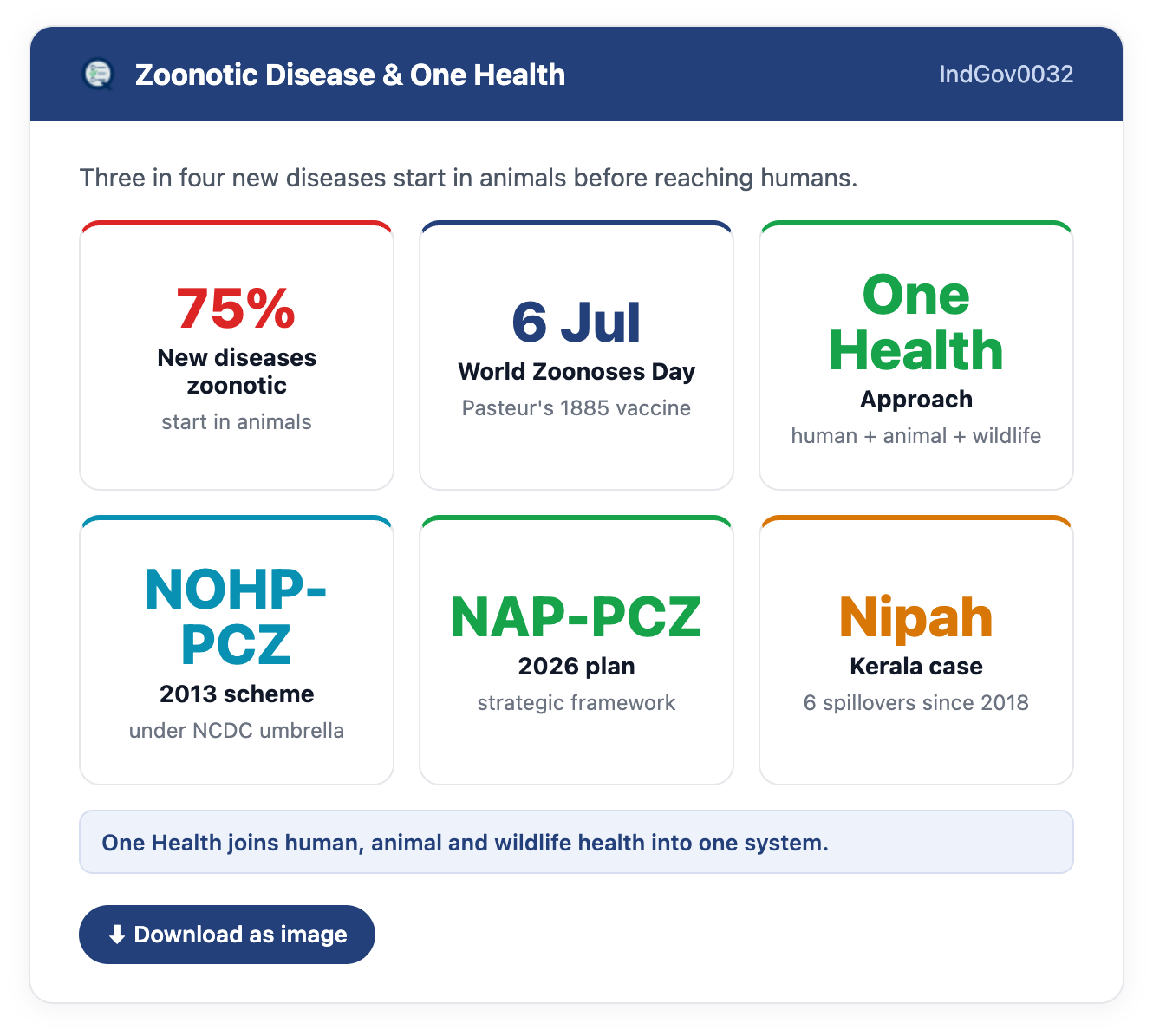
- ScaleAbout 60% of all infectious diseases, and up to 75% of new ones, are zoonotic.
- ExamplesRabies, Nipah, bird flu and COVID-19 share this origin.
- MechanismThey pass when a pathogen jumps from an animal host into a human.
- JumpContact can come from bites, animal products, or shared land and water.
What One Health Is, and World Zoonoses Day, and Why India Is a Hotspot
- ApproachOne Health coordinates human, animal and environmental health together.
- IdeaIt treats these as one connected system, not separate silos.
- WhyA sick animal in a forest can seed an outbreak in a crowded city.
- SoVets, doctors and ecologists share data so warnings travel fast.
- DateIt is observed every year on 6 July.
- OriginIt marks Pasteur’s first rabies vaccine, given on 6 July 1885.
- RiskIndia carries a high burden of rabies, anthrax, leishmaniasis and leptospirosis.
- ContextDeforestation and human-wildlife contact raise spillover risk.
- HowClearing forest pushes animals and people onto shared ground.
- ResultThat contact gives animal pathogens more chances to reach humans.
Good to Know
Programmes and Framework
NOHP-PCZ
- Full formNOHP-PCZ is the National One Health Programme for Prevention and Control of Zoonoses.
- ApprovedIt was approved in 2013.
- What it actually fundsOn the ground, NOHP-PCZ sets up “State One Health Cells”, dedicated units in each state with their own trained staff, funding, and technical support for zoonotic surveillance.
- Who it brings togetherThese cells bring veterinarians, doctors, wildlife experts, and environmental scientists into one coordinated team, rather than each working in their own separate department.
- Full formNCDC is the National Centre for Disease Control.
- UmbrellaSince FY 2017-18 it runs under the NCDC’s umbrella scheme.
The NAP-PCZ, and Proposed MoU
- Full formNAP-PCZ is the National Action Plan for Prevention and Control of Zoonoses.
- PlanIt is a strategic framework for tackling zoonotic disease.
- ScopeIt covers governance, surveillance, laboratories, outbreak response, risk communication and financing.
- Full formAn MoU is a Memorandum of Understanding, a formal agreement between bodies.
- BodiesIt is proposed among Animal Husbandry, Health and the Wildlife Institute of India.
- WhyIt would let the three share data and act together on spillover risk.
Test Yourself
Question 1 of 1
Great to Know
Why One Health Matters
A Shift Away from Silos
- ChangeHuman, animal and wildlife agencies historically operated separately.
- WhyThe diseases themselves cross those boundaries freely.
The Nipah Case
- RecurrenceKerala has recorded six Nipah spillovers since 2018.
- LessonOngoing surveillance matters more than one-off outbreak response.
- WhyIf you only react after cases appear, the virus has already spread.
- SoTeams watch fruit-bat populations and test early symptoms.
A Structural Problem
- CauseSpillover risk is tied to deforestation and land-use change.
- LessonIt is a structural problem, not only a medical one.
- ImplicationFixing it needs land policy, farming practice and ecosystem care.
Current Affairs
📰 Current Affairs
National Consultation
- EventOn 6 July 2026, the Health Ministry held a consultation on the NAP-PCZ, marking World Zoonoses Day.
- LaunchIt launched learning modules on 10 priority zoonotic diseases.
- SourcePIB.
PYQ
Exam Point of View
MCQ Questions
- PrelimsZoonoses and One Health appear in UPSC and other competitive exams.
Written Answer Questions
- ThemePublic health and One Health are recurring GS-II/GS-III themes.
Was this helpful?
Leave a Reply