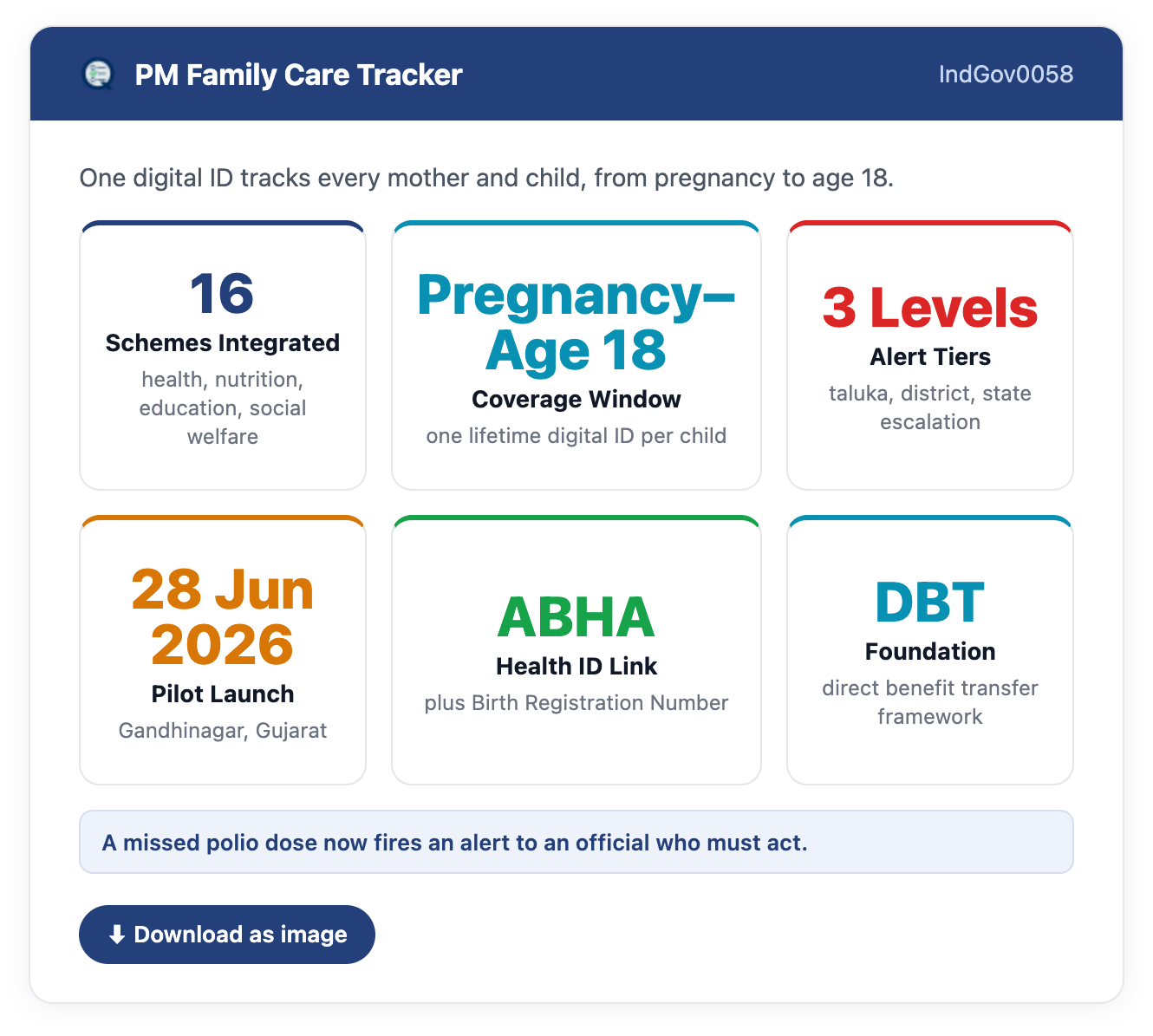
A child misses a polio dose, and in most welfare systems nobody notices. The PM Family Care Tracker changes that — an alert fires automatically and an official must act on it. Here is what the platform is, how it works, and why it matters for Indian governance.


Must Know
Must Know
What is the PM Family Care Tracker?
- Full formPM-FCT stands for PM Family Care Tracker.
- DefinitionIt is a Government of India digital platform that tracks welfare-scheme delivery to mothers and children.
- CoverageIt follows every mother and child from pregnancy until the child turns 18.
- Why it existsThe goal is to make sure no eligible mother or child is missed.
The Lifetime Digital ID, and 16 Welfare Schemes, One Platform, and The Pilot Launch in Gandhinagar, and What Happens Next
- Digital IDEvery child and every mother gets a unique digital ID.
- Linked recordsThe ID links to the Birth Registration Number and the ABHA health ID.
- Full formABHA stands for Ayushman Bharat Health Account.
- Why it mattersOne lifetime ID connects a child’s record from birth to age 18.
- IntegrationThe platform integrates around 16 welfare schemes.
- SectorsThe schemes span health, nutrition, education, and social welfare.
- CoverageSeveral schemes come from the Department of Social Justice and Empowerment, which serves Dalit and tribal children.
- Also includedThe National Child Labour Scheme is part of the platform.
- BenefitA child’s entitlements stay connected in a single record.
- WhoUnion Home Minister Amit Shah inaugurated the pilot.
- WhenThe pilot was launched on 28 June 2026.
- WhereThe launch happened in Gandhinagar, Gujarat.
- ContextGandhinagar is Amit Shah’s own Lok Sabha constituency.
- Next stepThe pilot’s success will decide the way forward.
- ExpansionIf the pilot succeeds, the plan is to expand the platform across Gujarat.
- ReplicationIt could later be replicated in other states.
- SignificanceGandhinagar is effectively the test case for a national rollout.
Good to Know
Good to Know
Two Trackers, One System
- Not from scratchPM-FCT links two existing systems.
- Health dataThe Poshan Tracker holds health and nutrition data.
- Education dataThe Child Tracking Portal holds education data.
- How it links upOne alert system can flag a missed service anywhere in a child’s record.
How the Alert Mechanism Works, and Real-Time Dashboards, and Built on the DBT Framework, and Launch Day in Gandhinagar
- MechanismThe platform runs an automated alert mechanism.
- TriggerIf a child misses a service, such as a scheduled polio dose, the system flags officials.
- EscalationAlerts escalate to the taluka, district, or state level, depending on the case.
- ActionOfficials must act on each alert.
- TrackingThe system tracks compliance until the case is resolved.
- DashboardsPM-FCT offers real-time dashboards for planning and monitoring.
- LevelsDashboards exist at the state, district, and taluka levels.
- BenefitOfficials can see live progress instead of waiting for reports.
- OutcomeGaps become visible quickly, so action can follow fast.
- Full formDBT stands for Direct Benefit Transfer.
- What DBT doesDBT channels welfare payments straight to beneficiaries.
- LinkPM-FCT builds on the Modi government’s wider DBT framework.
- Shared ideaThe aim is to cut out middlemen, delays, and leakage.
- Division of workDBT fixes payments; PM-FCT fixes service delivery and tracking.
- Ground realityThe launch was not just a ceremony.
- Polio dropsChildren in Gandhinagar were given polio drops on the launch day.
- Nutrition kitsNutrition kits were also distributed.
- SignalThe platform began delivering real services on day one.
Test Yourself
Question 1 of 1
Great to Know
Great to Know
Fixing a Long-Standing Governance Gap
- The problemThe tracker addresses a long-standing governance problem.
- Hidden beneficiariesPeople who qualify for welfare schemes often go unidentified.
- Siloed departmentsOthers fall through the gaps between departments.
- Why it happenedEach department kept separate records, so nobody saw the whole picture.
- The fixPM-FCT connects the dots across departments in one record.
From Request-Based to Automatic Welfare
- Design shiftThe tracker changes how welfare delivery works.
- Old modelOlder systems are request-based — the beneficiary must apply and prove eligibility.
- New modelPM-FCT links a birth record to a lifetime of scheme entitlements.
- ResultDelivery shifts toward an automatic, tracked model.
- Core ideaEntitlements follow the child, instead of the child chasing entitlements.
The ABHA and Digital Health Link
- Full formABHA stands for Ayushman Bharat Health Account.
- OriginThe ABHA ID system was built under the Ayushman Bharat Digital Mission.
- Full formPM-JAY stands for Pradhan Mantri Jan Arogya Yojana.
- EcosystemPM-FCT complements this existing digital-health infrastructure.
- Connected identityThe tracker’s ID links ABHA with the birth registration record.
- ContextSee Ayushman Bharat (PM-JAY) — the scheme that ABHA itself was built under.
Current Affairs
Current Affairs
PM Family Care Tracker Pilot Inaugurated
- 28 June 2026Union Home Minister Amit Shah inaugurated the PM-FCT pilot in Gandhinagar, Gujarat.(PIB, 28 Jun 2026)
- PresentGujarat Chief Minister Bhupendra Patel was also present.(PIB, 28 Jun 2026)
- Full formPIB stands for Press Information Bureau.(PIB, 28 Jun 2026)
- Source(Source: PIB)(PIB, 28 Jun 2026)
Exam Point of View
Exam Point of View
MCQ Questions
- RelevancePM-FCT is a fresh, exam-worthy topic for UPSC and other competitive exams.
- Key factsMemorise the coverage window (pregnancy to age 18) and the number of integrated schemes (around 16).
- Linked systemsRemember the Poshan Tracker and the Child Tracking Portal.
- ID linksRemember the Birth Registration Number and the ABHA health ID.
- Alert orderThe escalation order — taluka, district, state — is a favourite detail.
- PracticeTest yourself with the quiz below.
Written Answer Questions
- GS themeAnalyse how digital platforms can improve the delivery of welfare schemes to mothers and children in India.
- Start with the basicsDefine PM-FCT and explain its coverage and the unique digital ID.
- Explain the mechanismDescribe the alert system, escalation levels, and compliance tracking.
- Connect the dotsLink it to the governance gap, the DBT framework, and digital health infrastructure like ABHA.
- ConcludeEnd with the pilot-to-national rollout plan and its dependence on pilot success.
Was this helpful?
Leave a Reply