Walk into most Indian government hospitals and you’ll find them built to treat sickness, not to prevent it. That’s not an accident of funding — it’s baked into how the system was designed.


mcqquestion.com
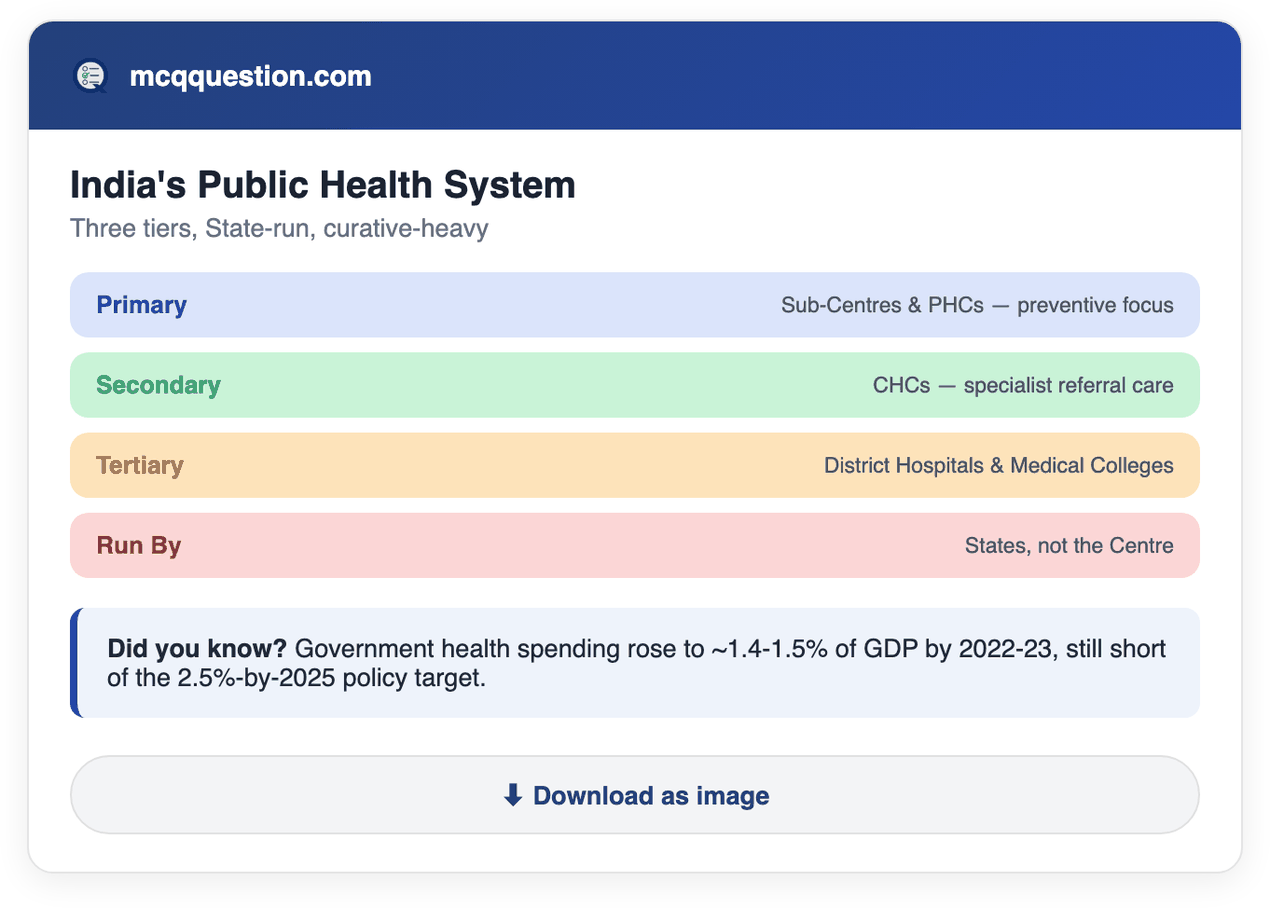
India’s Public Health System
Three tiers, State-run, curative-heavy
PrimarySub-Centres & PHCs — preventive focus
SecondaryCHCs — specialist referral care
TertiaryDistrict Hospitals & Medical Colleges
Run ByStates, not the Centre
Did you know? Government health spending rose to ~1.4-1.5% of GDP by 2022-23, still short of the 2.5%-by-2025 policy target.
🏛️ Must Know
India’s Three-Tier Public Health System
- Primary Care Sub-Centres (one per ~5,000 population in the plains, ~3,000 in hilly/tribal/desert areas) and Primary Health Centres (PHCs) deliver mostly preventive and promotive care, with basic curative services.
- Secondary Care Community Health Centres (CHCs) are 30-bedded referral hospitals offering specialist care in medicine, obstetrics, surgery, and paediatrics for cases referred up from PHCs.
- Tertiary Care Sub-District and District Hospitals, plus Medical Colleges, handle specialist and advanced treatment — as of March 2023, India had over 1.69 lakh Sub-Centres, 31,882 PHCs, 6,359 CHCs, and 714 District Hospitals.
- Health Is a State Subject Under India’s decentralised approach to health care delivery, the States are primarily responsible for organising health services — health falls under the State List of the Constitution.
- Centre Supports, Doesn’t Run The Central Government contributes financial and technical support through the National Health Mission (NHM) and other centrally sponsored schemes, but day-to-day service delivery remains a State responsibility.
🏘️ Good to Know
A Curative-Heavy System
- Curative Bias Despite this tiered structure, India’s public sector health care system largely focuses on curative care, with limited emphasis on preventive, promotive, and rehabilitative care.
- Structural Roots This bias runs through resource allocation and medical training, not just funding — hospitals and specialists are concentrated around treating illness after it occurs.
- Not Causally Linked The curative bias and State-level decentralisation are both real, independently true facts — but decentralisation isn’t what causes the curative bias. The bias stems from historical resource-allocation and policy priorities, not from which level of government runs the system.
- Policy Response National Health Policy documents explicitly call for expanding preventive, promotive, curative, palliative, and rehabilitative services, acknowledging the existing imbalance.
- Related Reading See GenSci0035 — Healthcare Affordability and Accessibility in India for the cost and access side of India’s health system.
⚡ Great to Know
Spending Trends and Targets
- Rising But Short of Target Government health expenditure rose from 1.15% of GDP in 2013-14 to about 1.4-1.5% in 2022-23 — still well below the National Health Policy, 2017’s target of 2.5% of GDP by 2025.
- Government Share Growing Within total health spending, the government’s own share rose from 29% in FY15 to 48% in FY22, as out-of-pocket spending by households gradually declined.
- Per Capita Spending Total health expenditure reached roughly ₹6,600 per person in FY22, about 3.8% of GDP when private spending is included alongside government spending.
Test Yourself
Question 1 of 1
📝 Previous Year Question
UPSC CSP 2023 — India’s Public Sector Health Care Statements
- UPSC 2023 Both statements are correct — India’s public health system is curative-heavy, and States are primarily responsible for organising health services under decentralisation — but Statement II is NOT the correct explanation for Statement I; the curative bias isn’t caused by decentralisation itself. See UPSC CSP 2023 GS Paper I, Q75.
Was this helpful?
Leave a Reply