One stretch of India’s plateau makes so much steel that geographers gave it a German nickname. This article covers India’s eight major industrial regions, and why each one grew where it did.


Must Know
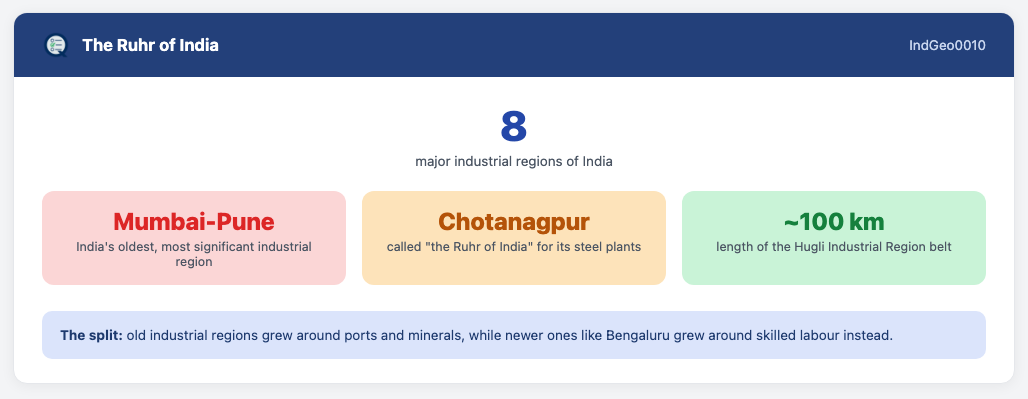
- India has eight major industrial regions, by the standard classification: Mumbai-Pune, Hugli, Bangalore-Tamil Nadu, Gujarat, Chotanagpur, Vishakhapatnam-Guntur, Gurgaon-Delhi-Meerut, and Kollam-Thiruvananthapuram.
- The Mumbai-Pune region is India’s oldest and most significant industrial region. It began with colonial-era cotton textiles and now spans petrochemicals, engineering, and automobiles.
- The Chotanagpur Plateau is called “the Ruhr of India” for its concentration of heavy industry, built on coal, iron ore, manganese, and mica. It hosts major steel plants at Jamshedpur, Bokaro, Rourkela, and Durgapur.
- The Hugli Industrial Region runs about 100 km along the Hugli river, from Bansbaria and Naihati in the north to Birlanagar in the south. It grew on jute and cotton textiles.
Good to Know
- The Gujarat region, centred on Ahmedabad-Vadodara, also began with textiles and has since shifted toward petrochemicals.
- The Bangalore-Tamil Nadu region is India’s newest major hub, built on IT and electronics rather than raw materials.
- Within that belt, Coimbatore built a separate, older engineering base. Pioneered in the 1920s-30s by inventor-industrialist G.D. Naidu, it earned Coimbatore the nickname “Pump City.” The city now supplies roughly 40% of India’s pumps and motors.
- The Gurgaon-Delhi-Meerut region, part of the National Capital Region, grew around automobiles and IT services.
- The general principles behind why industries cluster where they do, including footloose industries and agglomeration economies, are covered in WorldGeo0005 — Industry Location: Factors, Classification and Clustering.
Test Yourself

Great to Know
- The “Ruhr of India” nickname is a deliberate comparison. Germany’s Ruhr Valley became Europe’s industrial heartland on coal and steel; Chotanagpur followed the same resource-driven logic on Indian soil.
- India’s oldest industrial regions almost all trace back to colonial-era ports: Mumbai, Kolkata (via the Hugli), and Chennai. Colonial trade geography still shapes where India’s heavy industry sits today, decades after independence.
- Jamshedpur was built by a private company, Tata, while Bokaro, Rourkela, and Durgapur were public-sector steel towns. The same Chotanagpur belt shows both models of Indian industrialisation side by side.
- Bengaluru’s rise proves industrial geography isn’t fixed forever. A region with no major mineral wealth or port became a top industrial hub purely on skilled labour, showing how the “footloose” logic can reshape the map over time.
Steel production is one of the anchors of India’s industrial belts. See IndEco0152 — Steel Sector in India for the full picture.
Beyond the answer
Browse all indian-geography topics →
📚 Keep reading
IndEco0152 — Steel Sector in IndiaIndGeo0151 — Iron and Steel Industry in India: From the Coalfield to the CoastIndEco0038 — Evolution of India's Industrial PolicyGK0023 — Chhattisgarh: Steel, Minerals, and the Bastar RegionWorldGeo0074 — Iron and Steel Industry in the World: China's Dominance and the Global Geography❓ Practice this topic
D0311 — Consider the following statements: 1. Filling a lake removes natural flood storage. 2. Wetlands recharge groundwater aquifers. 3. Reclaimed water bodies increase local heat island effects. How many of the statements are correct?D0310 — Which of the following directly governs wetland conservation in India?D0309 — Why is the East Kolkata Wetlands ecologically valuable?D0308 — Which of the following is a direct environmental effect of filling an urban lake?🎲 Take a Indian Geography Quiz
Leave a Reply