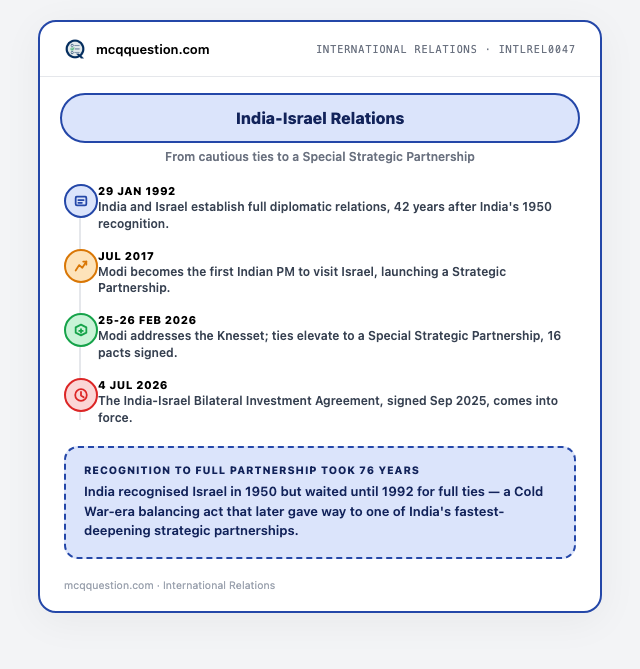
India recognised Israel in 1950, but the two countries waited 42 years to establish full diplomatic relations. Since 1992, the relationship has grown into a Special Strategic Partnership, anchored in defence, agriculture, and technology.
 mcqquestion.com
International Relations · IntlRel0047
India-Israel Relations
From cautious ties to a Special Strategic Partnership
29 Jan 1992
India and Israel establish full diplomatic relations, 42 years after India’s 1950 recognition.
Jul 2017
Modi becomes the first Indian PM to visit Israel, launching a Strategic Partnership.
25-26 Feb 2026
Modi addresses the Knesset; ties elevate to a Special Strategic Partnership, 16 pacts signed.
4 Jul 2026
The India-Israel Bilateral Investment Agreement, signed Sep 2025, comes into force.
Recognition to full partnership took 76 years
India recognised Israel in 1950 but waited until 1992 for full ties — a Cold War-era balancing act that later gave way to one of India’s fastest-deepening strategic partnerships.
Must Know
- India recognised Israel on 17 September 1950, but the two countries only established full diplomatic relations on 29 January 1992.
- Before 1992, Israel maintained only a Consulate in Mumbai, open since 1953. It became a full Consulate-General once the Embassy in New Delhi opened.
- In July 2017, Narendra Modi became the first Indian Prime Minister to visit Israel. The visit marked 25 years of diplomatic relations, and led to a Strategic Partnership.
- Defence is a core pillar. India co-developed the Barak-8 surface-to-air missile with Israel’s IAI and India’s DRDO, building on the earlier Barak-1 system from the 1990s.
- In 2004, India signed a $1.1 billion deal for Israel’s Phalcon airborne radar system, delivered between 2009 and 2011.
- India is now Israel’s largest arms buyer, worth roughly $1 billion a year.
- On 25-26 February 2026, Modi made his second visit to Israel. The two countries elevated ties to a Special Strategic Partnership, and signed 16 agreements.
- During that visit, Modi became the first Indian Prime Minister to address the Israeli Knesset. He received the Speaker of the Knesset Medal, the first foreign leader to be given that honour.
Good to Know
- Agriculture and water have been core cooperation pillars since the relationship began in 1992, alongside defence.
- During Modi’s 2017 visit, India and Israel signed a 3-Year Work Programme in Agriculture, expanding joint agricultural demonstration centres across India.
- India and Israel are both members of I2U2, a grouping that also includes the UAE and the United States. Its first leaders’ summit was held virtually on 14 July 2022.
- I2U2 focuses on water, energy, transportation, space, health, and food security, working through joint investment rather than treaty obligations.
- In 2022, Defence Ministers Rajnath Singh and Benny Gantz signed the India-Israel Vision on Defence Cooperation, a ten-year roadmap for emerging defence technologies.
- In January 2018, Israeli Prime Minister Benjamin Netanyahu paid a reciprocal visit to India, travelling to Agra, Ahmedabad, and Mumbai.
Test Yourself

Great to Know
- India’s 42-year gap between recognising Israel and establishing full diplomatic relations reflects its Cold War-era balancing act. Non-Alignment, ties with the Soviet bloc, and proximity to the Arab world all pulled against closer Israel ties.
- Modi’s 2026 Knesset address was symbolically significant because of that history. No Indian Prime Minister had addressed Israel’s Parliament before, in a relationship formal ties took over four decades to reach.
- I2U2 shows a broader pattern in India’s foreign policy. It uses small, flexible groupings, like the Quad in a different region, to link strategic partners across otherwise separate regions.
- The relationship shifted from cautious, defence-only engagement in the 1990s to a much wider “Special Strategic Partnership” by 2026. That later stage spans AI, agriculture, and investment, not just defence.
Current Affairs
- India and Israel signed a Bilateral Investment Agreement (BIA) on 8 September 2025, in New Delhi. (Source: PIB, Ministry of Finance, 4 Jul 2026)
- That BIA came into force on 4 July 2026. It protects investors and their investments, while preserving each government’s own policy space. (Source: PIB, Ministry of Finance, 4 Jul 2026)
- The government expects the BIA to boost cross-border investment and deepen the wider economic partnership between the two countries. (Source: PIB, Ministry of Finance, 4 Jul 2026)
- The BIA builds on the momentum from Modi’s February 2026 visit. That visit saw the two countries announce the India-Israel Innovation Centre for Agriculture (IINCA), focused on precision farming and satellite-based irrigation.
- 24 July 2026: India and Israel concluded the second round of talks for a proposed bilateral Free Trade Agreement (FTA).
- The four-day talks ran from 20 to 23 July 2026, at Vanijya Bhawan, New Delhi. Both sides discussed goods, services, rules of origin, and other chapters of the proposed FTA.
- The talks follow a Terms of Reference, signed in November 2025, that frames the negotiation areas. Total merchandise trade between the two countries stood at USD 3.93 billion, in FY 2025-26.
- India’s Chief Negotiator was Ajay Bhadoo, Additional Secretary, Department of Commerce. Israel’s was Yifat Alon Perel, Senior Director for Trade Policy and Agreements. (Source: PIB)
Leave a Reply