A 12-country trade deal was signed, then the US pulled out before it ever took effect. The remaining 11 countries rebuilt it under a new name, and it’s still growing today.
🕰️ Timeline
2016-2017 — TPP Signed, Then the US Withdraws
- 4 Feb 2016 Twelve countries sign the original Trans-Pacific Partnership (TPP) agreement.
- Jan 2017 US President Donald Trump signs an executive order withdrawing the US from TPP, before it takes effect.
2018 — CPTPP Rebuilds the Deal
- 8 Mar 2018 The remaining 11 countries sign the CPTPP, in Santiago, Chile.
- 30 Dec 2018 CPTPP enters into force, after ratification by six member countries.
2024 — The UK Joins
- 2024 The United Kingdom accedes to CPTPP, becoming its 12th member and the first new member since the deal took effect.
✊ Must Know
What TPP Actually Was
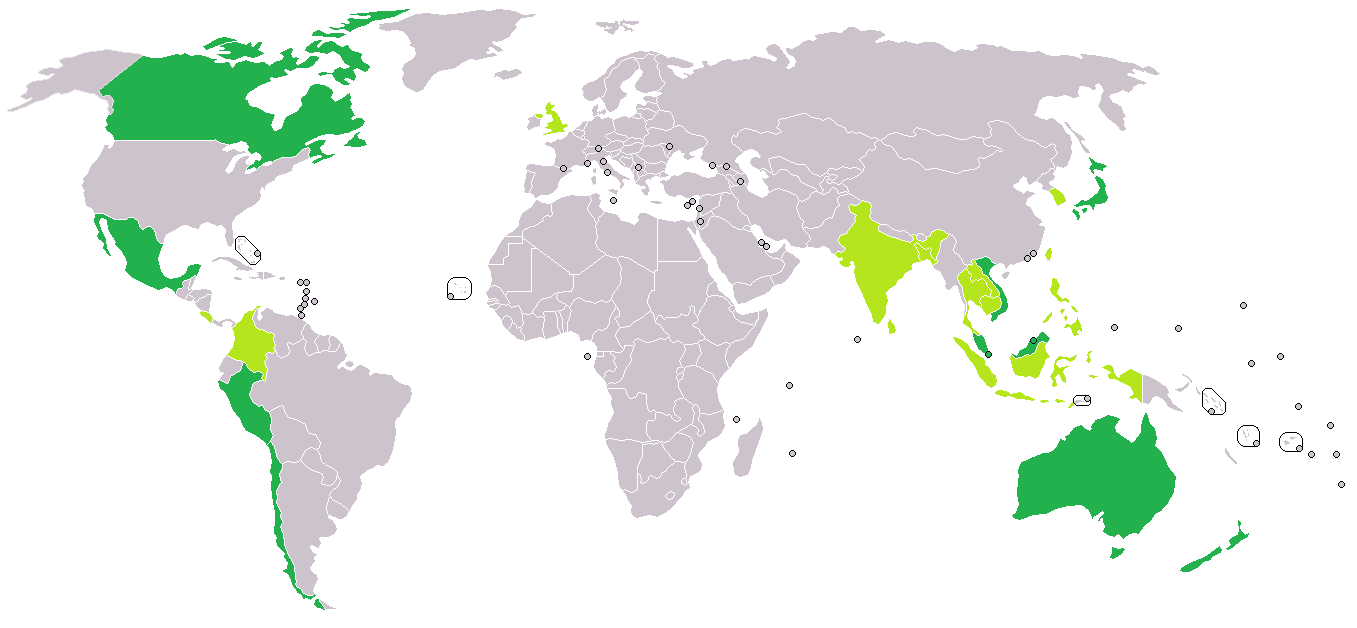
- Signatories The original TPP had 12 signatories, not “all” Pacific Rim countries. Many Pacific nations — South Korea, Indonesia, the Philippines, Taiwan — were never part of it.
- Nature TPP is a trade agreement, not a maritime-security alliance. It focused on tariffs, investment rules, and trade standards.
China and Russia’s Absence
- China China was excluded from the original TPP negotiations. It separately applied to join CPTPP in 2021, and that application still has no resolution.
- Russia Russia was never part of TPP or CPTPP negotiations — it isn’t generally treated as a Pacific Rim economy in this context.
💡 Good to Know
The 11 Founding CPTPP Members
- Members CPTPP started with 11 founding members. They are Australia, Brunei, Canada, Chile, Japan, Malaysia, Mexico, New Zealand, Peru, Singapore, and Vietnam.
- India India is not, and has never been, a member of either TPP or CPTPP.
What “Comprehensive and Progressive” Means
- CPTPP CPTPP kept most of the original TPP’s provisions, but suspended some contested ones, mainly around intellectual property.
- UK The UK’s 2024 accession made it CPTPP’s first new member, and the first European country in the bloc.
Test Yourself

🌟 Great to Know
A Common Exam Trap
- Trap UPSC has tested a false claim about TPP: that it covered “all Pacific Rim countries except China and Russia.” That framing is wrong on two counts. It excluded many other Pacific nations too. And it was never a security pact.
📝 Previous Year Questions
UPSC CSP 2016 — What TPP Actually Was
- UPSC 2016 The correct answer is Neither 1 nor 2. TPP wasn’t an agreement covering all Pacific Rim countries except China and Russia. It had just 12 signatories, leaving out many other Pacific nations too. It’s a trade agreement, not a maritime-security alliance. See UPSC CSP 2016 GS Paper I, Q41.
Beyond the answer
Browse all international-relations topics →
📚 Keep reading
UPSC CSP 2016 — General Studies Paper I (Full Question Paper)UPSC CSP 2025 — General Studies Paper I (Full Question Paper)IntlRel0161 — US–China Rivalry vs the Soviet Era: An Existential ComparisonUPSC CSP 2015 — General Studies Paper I (Full Question Paper)IntlRel0025 — PM Modi's Foreign Visits❓ Practice this topic
D0416 — Which event, eight years after Panchsheel, is often cited as the irony of the India-China framework of peaceful coexistence?D0415 — The principles of Panchsheel gained wider resonance at which 1955 gathering of newly independent Asian and African states?D0414 — The Five Principles of Panchsheel were primarily associated with which two leaders of India and China?D0413 — Which of the following is one of the Five Principles of Panchsheel?🎲 Take a International Relations Quiz
Leave a Reply