Israel really does have diplomatic ties with several Arab states — just not through the specific peace plan a tricky exam statement claims it signed.

 MCQ Questions
✅ Must Know
Israel does have Arab diplomatic ties
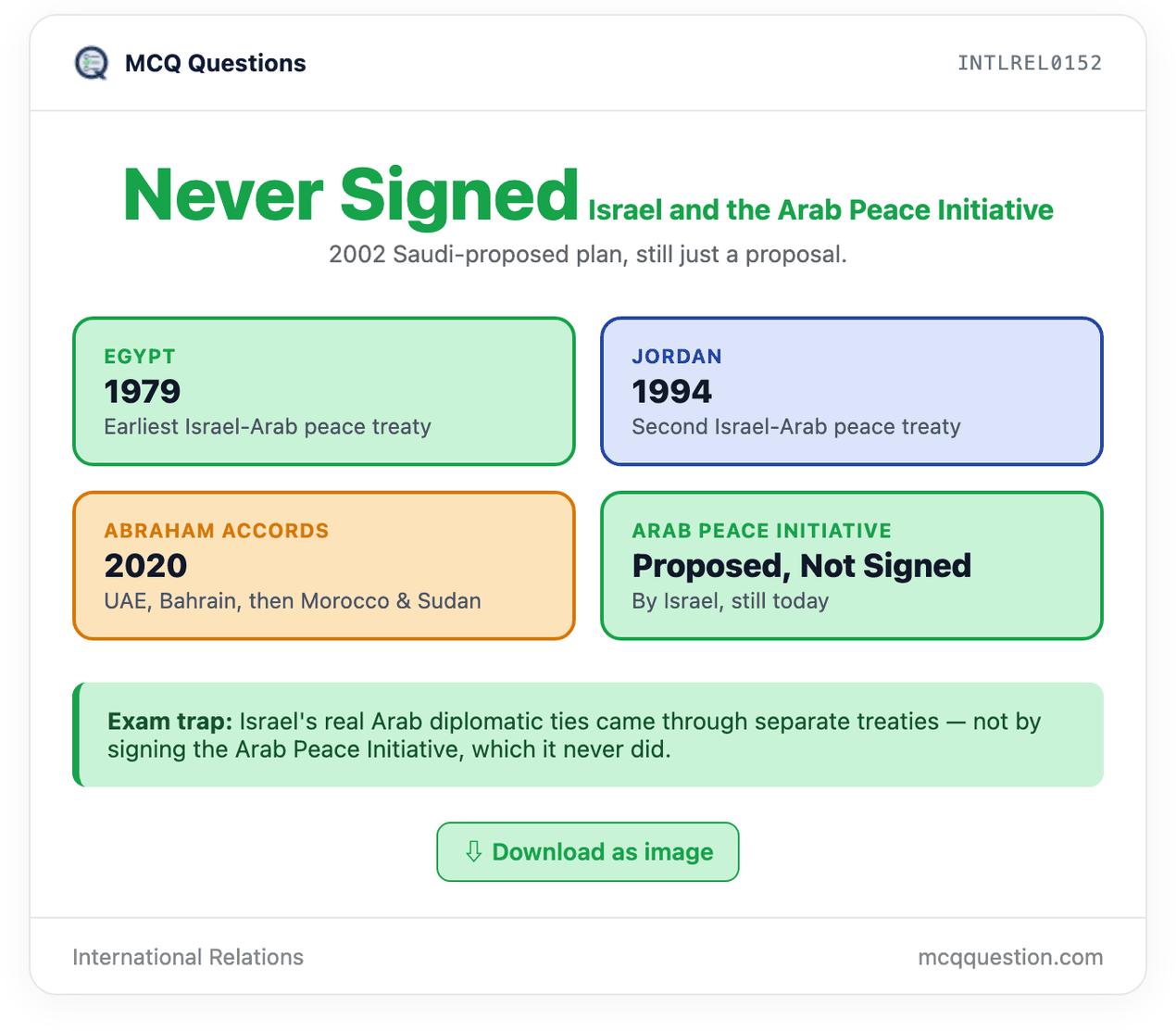
- Israel has established diplomatic relations with several Arab states: Egypt (1979), Jordan (1994), and via the 2020 Abraham Accords, the UAE, Bahrain, Morocco, and Sudan.
The Arab Peace Initiative, explained
- The Arab Peace Initiative is a 2002 peace plan, proposed by Saudi Arabia and adopted by the Arab League. It offers Israel full normalisation, in exchange for withdrawal from territory occupied since 1967.
Israel never signed it
- Israel never signed or formally accepted the Arab Peace Initiative. It remained an Arab League proposal, not a bilateral agreement.
Which statement is actually correct
- Israel’s diplomatic ties with some Arab states are real. But those ties came through separate agreements, not through Israel signing the Arab Peace Initiative.
💡 Good to Know
Who proposed the Initiative
- Saudi Arabia’s then-crown prince, Abdullah bin Abdulaziz, presented the Arab Peace Initiative at the 2002 Arab League summit in Beirut.
How it differs from the Abraham Accords
- The Arab Peace Initiative sets normalisation as a reward for Israeli withdrawal and Palestinian statehood. The Abraham Accords, signed in 2020, didn’t require that precondition.
Saudi Arabia’s own position
- Saudi Arabia has stayed outside the Abraham Accords framework. It continues to treat the Arab Peace Initiative as its main basis for any future normalisation with Israel.
The Accords’ actual signatories
- The Abraham Accords were signed by Israel, the UAE, and Bahrain in September 2020, with Morocco and Sudan joining soon after.
Test Yourself

.jpg)
🌟 Great to Know
A proposal is not an agreement
- The Arab Peace Initiative remains a standing Arab League offer, not a signed treaty. This distinction is exactly what many exam questions test.
Why Egypt and Jordan matter
- Egypt’s 1979 and Jordan’s 1994 peace treaties with Israel long predate both the Arab Peace Initiative and the Abraham Accords. Normalisation isn’t a purely recent phenomenon.
The assertion-reason format’s real test
- A two-statement question like this tests whether one true fact (Israel’s diplomatic ties) is wrongly explained by a false mechanism (a treaty Israel never signed).
Ongoing Saudi-Israel talk
- Discussions about eventual Saudi-Israeli normalisation continue, but as of now no formal agreement exists between the two countries.
Beyond the answer
Browse all international-relations topics →
📚 Keep reading
IndSoc0089 — North-East India: Internal Security Challenges and Peace AccordsUPSC CSP 2023 — General Studies Paper I (Full Question Paper)UPSC CDS (I) 2021 — English (Full Question Paper)IntlRel0157 — I2U2 Grouping: India, Israel, UAE and the USAIntlRel0047 — India-Israel Relations❓ Practice this topic
D0416 — Which event, eight years after Panchsheel, is often cited as the irony of the India-China framework of peaceful coexistence?D0415 — The principles of Panchsheel gained wider resonance at which 1955 gathering of newly independent Asian and African states?D0414 — The Five Principles of Panchsheel were primarily associated with which two leaders of India and China?D0413 — Which of the following is one of the Five Principles of Panchsheel?🎲 Take a International Relations Quiz
Leave a Reply