The Security Council created the Counter-Terrorism Committee in the aftermath of the 9/11 attacks.
Resolution 1373 makes counter-terrorism duties legally binding on every UN member state.


📑 Contents
Must Know
Establishment and mandate
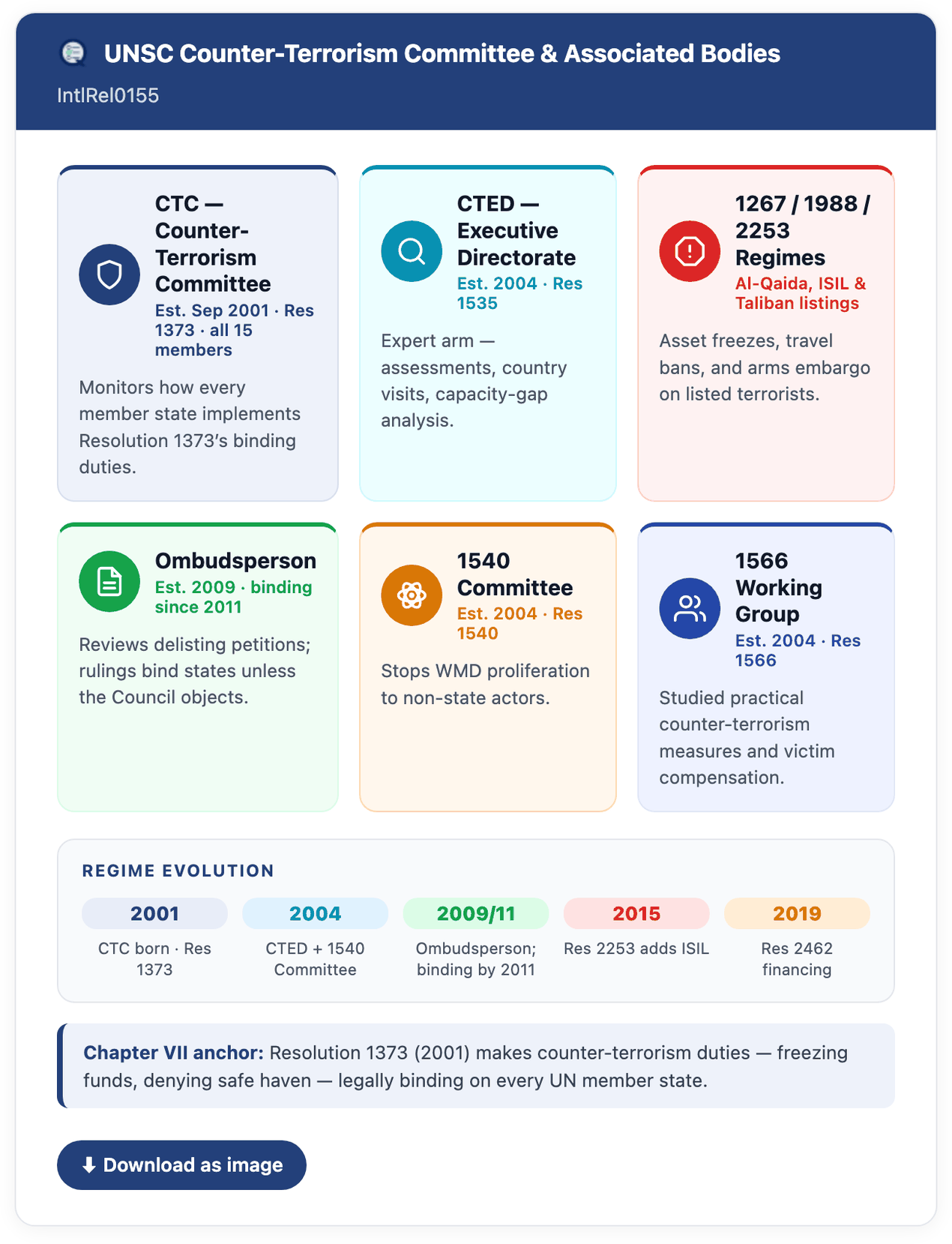
- ESTABLISHMENTThe Security Council set up the CTC in September 2001, weeks after the 9/11 attacks.
- RESOLUTION 1373Resolution 1373 created the Committee under Chapter VII of the UN Charter.
- CHAPTER VIIChapter VII gives the resolution’s obligations binding legal force on every state.
- MEMBERSHIPThe CTC is a committee of the whole, comprising all fifteen Council members.
- MANDATEIts core mandate is to monitor how states implement Resolution 1373.
- OBLIGATIONSThe resolution criminalizes terrorist financing, planning, recruitment, and preparation of attacks.
- SAFE HAVENStates must freeze terrorist funds, deny safe haven, and cooperate on intelligence.
How the CTC works
- REPORTINGEvery UN member state must report its implementation steps to the CTC.
- CHECKLISTA detailed self-assessment checklist helps each state evaluate its own capacities.
- DIALOGUEThe Committee reviews reports through an ongoing dialogue with each state.
- VISITSExpert country visits assess compliance on the ground and identify capacity gaps.
- ASSISTANCEThe CTC links states with technical assistance and capacity-building providers.
- PARTNERSIt cooperates closely with INTERPOL, FATF, UNODC, and regional bodies.
- COVERAGEReporting and follow-up now span member states across every region of the world.
CTED — the expert arm
- CTEDResolution 1535 (2004) established CTED as the CTC’s expert support body.
- ROLECTED provides expert analysis, conducts assessments, and arranges country visits.
- SPECIALISTSIts specialists cover law, finance, customs, borders, and aviation security.
- CONSENTCountry visits take place only with the host state’s consent.
- DELIVERABLESCTED identifies capacity gaps and facilitates delivery of technical assistance.
- REACHCTED assessments now cover nearly every member state of the United Nations.
Good to Know
Associated and subsidiary bodies
- 1267 REGIMEThe 1267 Committee runs sanctions against Al-Qaida, ISIL, and their associates.
- MEASURESSanctions include asset freezes, travel bans, and an arms embargo.
- 1988 REGIMEResolution 1988 (2011) created a separate Taliban sanctions regime.
- 2253 REGIMEResolution 2253 (2015) updated the regime to cover ISIL explicitly.
- OMBUDSPERSONThe Ombudsperson, created in 2009, reviews petitions for delisting.
- DUE PROCESSSince 2011, Ombudsperson recommendations bind states unless the Council objects.
- 1540 COMMITTEEResolution 1540 (2004) created a committee against WMD proliferation to non-state actors.
- 1566 WGThe 1566 Working Group studied practical counter-terrorism measures and victim compensation.
How the bodies interlock
- ARCHITECTURETogether these committees and bodies form the Council’s counter-terrorism architecture.
- DIVISIONThe CTC handles general obligations; sanctions committees manage specific listings.
- SHARINGCTED exchanges information with sanctions monitoring teams and 1540 experts.
- 2178Resolution 2178 (2014) added foreign terrorist fighters to the Council’s agenda.
- 2462Resolution 2462 (2019) sharpened obligations against terrorist financing.
- COORDINATIONJoint briefings and shared reporting keep the committees coordinated.
The Warsaw process and the GCTF
- GCTFThe Global Counter-Terrorism Forum launched in New York in September 2011.
- WARSAWThe Forum’s administrative unit sits in Warsaw, earning the name Warsaw process.
- INFORMALThe GCTF is an informal, non-binding platform of states and organizations.
- COMPLEMENTIt develops good practices that complement the UN’s binding framework.
- FOCUSThe Forum focuses on prevention, terrorist financing, and new technologies.
- LINKCTED draws on GCTF good practices in its assessments and guidance.
Test Yourself
Question 1 of 1
Great to Know
Genuine strengths
- UNIVERSALITYReporting under Resolution 1373 is near-universal among UN member states.
- NORM-SETTINGThe regime set a global norm for criminalizing terrorist financing.
- BINDINGChapter VII gives the core obligations real binding legal force.
- INFORMATIONReporting and visits create an unmatched pool of global information.
- SANCTIONSSanctions freeze the assets of named terrorists across the world.
- OMBUDSMANThe Ombudsperson brought due process into the listing and delisting system.
- CAPACITYTechnical assistance helps weaker states build legal and border capacities.
- EXPERTISECTED’s expertise gives the Council an independent assessment capability.
Clear limitations
- ENFORCEMENTThe CTC has no enforcement powers beyond the Council’s collective will.
- VOLUNTARYMost implementation remains voluntary and depends on state capacity.
- VETOPermanent members’ vetoes can block action and invite politicization.
- DEFINITIONNo agreed UN definition of terrorism weakens standards and listings.
- CAPACITY GAPSPoor and conflict-affected states struggle to implement their obligations.
- CONSENTCountry visits need host consent, so scrutiny remains uneven.
- LISTINGListing and delisting can be slow and politically contested.
- TECHNOLOGYDrone, cyber, and AI threats outpace the post-9/11 mandates.
India’s position
- CCITIndia first proposed the Comprehensive Convention on International Terrorism in 1996.
- DEFINITIONIndia wants an agreed definition to end double standards on terrorism.
- CROSS-BORDERNew Delhi repeatedly raises cross-border and state-sponsored terrorism at the Council.
- DESIGNATIONIndia secured Masood Azhar’s 1267 listing in 2019 after the Pulwama attack.
- PRESIDENCYIndia chaired high-level UNSC counter-terrorism debates during its presidencies.
- TECHNOLOGYIndia pushes for action against terrorist use of new technologies.
- NO MONEYIndia hosts the No Money for Terror conference against terrorist financing.
A balanced answer and the way forward
- STRUCTUREA strong answer runs: what it is, how it works, strengths, limits, India, and way forward.
- SKELETONThis familiar 15-point skeleton matches the tier structure of this article.
- CCITAdopting the CCIT would close the long-standing definitional gap.
- RESOURCESCTED needs more resources and stronger follow-up on technical assistance.
- COORDINATIONCloser ties with FATF, INTERPOL, and regional bodies would multiply impact.
- RIGHTSCounter-terrorism must respect human rights and international law.
- TECHNOLOGYNew mandates must address cyber, drone, and AI misuse.
- BALANCEExaminers reward balanced, evidence-based evaluation over one-sided praise.
📰 Current Affairs
The UN counter-terrorism architecture kept evolving through 2025–26: renewals, financing forums, and India’s renewed Council bid.
So-What: CTED’s mandate gets renewed
- Res 2810 (2025) On 29 December 2025 the Council unanimously adopted Resolution 2810 at its 10081st meeting, renewing the Counter-Terrorism Committee Executive Directorate’s mandate for one year. Source: UN Security Council press release SC/16267.
So-What: No Money for Terror goes global
- NMFT 2025 The fourth No Money for Terror ministerial conference was held in Munich on 13–14 February 2025, hosted by Germany, with India’s Minister of State for Home Affairs leading the Indian delegation. Source: PIB — Ministry of Home Affairs.
So-What: India’s Council return
- UNSC 2028–29 On 13 July 2026 External Affairs Minister S. Jaishankar launched India’s campaign for a non-permanent Security Council seat for the 2028–29 term, unveiling the ‘SHANTI’ framework. Source: News18.
Previous Year Questions
2024 Mains — GS Paper II
- MAINS 2024Evaluate the effectiveness of the UNSC’s Counter-Terrorism Committee (CTC) and its associated bodies (UPSC Mains 2024, GS Paper II, 15 marks)
- ASKThis question demands factual accuracy and a balanced evaluation.
- PLANOpen with the CTC’s origin, then mandate, tools, strengths, limits, and India.
- TIPCite Resolution 1373, CTED, and the 1267 regime to score well.
📚 Related Articles
Was this helpful?
Leave a Reply