Central Asia sits in India’s extended neighbourhood.
The five republics are drawing New Delhi into deeper engagement.

.svg)
Must Know
Who are the Central Asian Republics
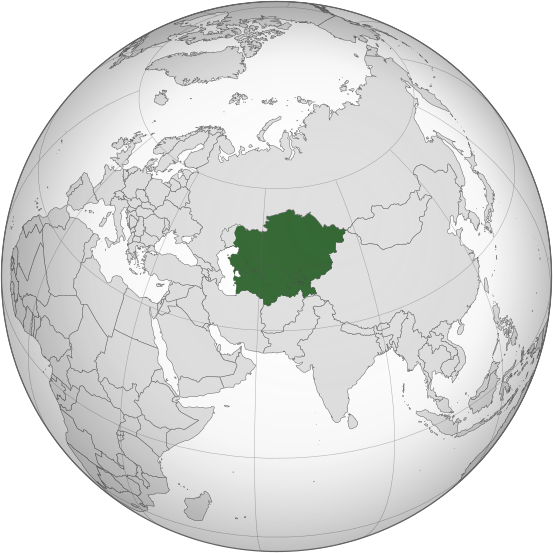
- FiveThe five republics are Kazakhstan, Kyrgyzstan, Tajikistan, Turkmenistan and Uzbekistan.
- Soviet PastAll five gained independence when the Soviet Union dissolved in 1991.
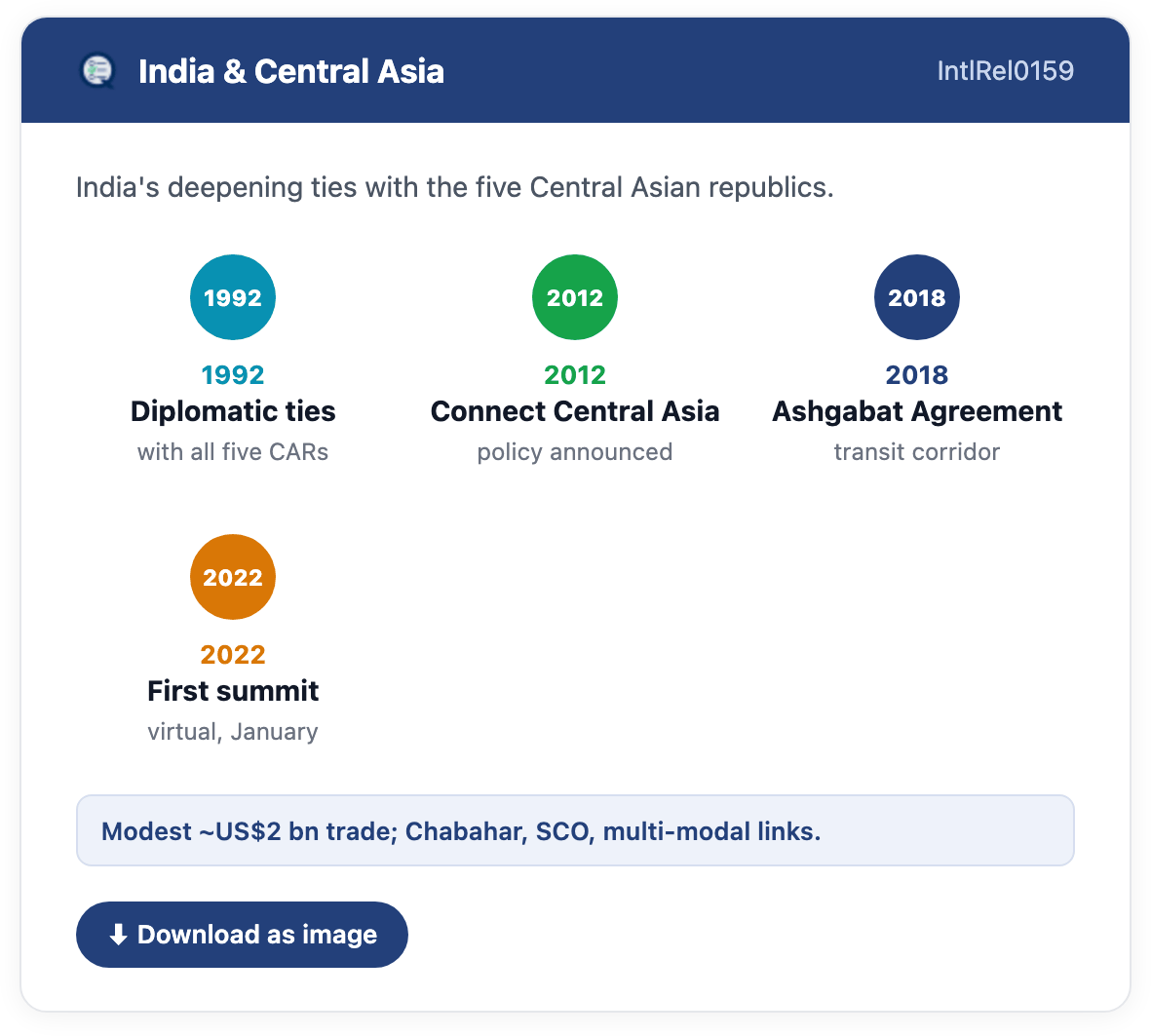
- India TiesIndia established diplomatic relations with all five in 1992.
- LandlockedEvery one of the five is landlocked, so transit routes matter greatly.
- ScaleKazakhstan is the largest republic; Uzbekistan is the most populous.
Why Central Asia matters to India, and The Connect Central Asia policy
- NeighbourhoodIndia treats Central Asia as part of its extended neighbourhood.
- EnergyThe region holds oil, gas and uranium that India needs.
- AfghanistanCentral Asian stability is closely tied to Afghanistan’s security.
- TerrorismIndia and the republics share concerns about terrorism and radicalisation.
- GeopoliticsThe region sits amid the interests of China, Russia and the United States.
- HeritageAncient Silk Road and Buddhist ties connect India to the region.
- WhyBecause what happens in Central Asia touches India’s energy, security and neighbourhood, so Delhi cannot afford to stay out of the region.
- LaunchIndia announced its Connect Central Asia policy in 2012.
- ScopeThe policy spans political, economic, security and cultural ties.
- SummitThe first India-Central Asia Summit was held virtually in January 2022.
- DeclarationThat summit adopted the Delhi Declaration on cooperation.
- FormatThe summit mechanism is now a standing part of the relationship.
Good to Know
Economic and energy engagement
- TradeIndia-Central Asia trade is modest, around US$2 billion a year recently.
- Top PartnerKazakhstan is India’s largest trading partner in the region.
- UraniumKazakhstan supplies uranium for India’s civil nuclear programme.
- ExportsIndia exports pharmaceuticals, tea, machinery and IT services.
- Energy BaseTurkmenistan holds huge gas reserves; Kazakhstan has major oil reserves.
- GapTrade remains far below its potential given the size of both sides.
- So whatSo the gap between promise and reality is the real story: small trade today means big room to grow if routes and payments improve.
Connectivity initiatives, and Defence and security cooperation, and Institutional and cultural platforms
- INSTCThe International North-South Transport Corridor links India to Russia via Iran.
- ChabaharIndia operates part of Iran’s Chabahar port as a gateway to Central Asia.
- AgreementIndia joined the Ashgabat Agreement transit corridor in 2018.
- TAPIThe TAPI pipeline would carry Turkmen gas to India through Afghanistan.
- BarrierPakistan’s denial of overland transit blocks direct road and rail links.
- StalledTAPI has faced repeated delays and remains far from completion.
- ExercisesIndia runs joint military exercises with Kazakhstan, Kyrgyzstan and Uzbekistan.
- KAZINDIndia and Kazakhstan hold the biennial KAZIND exercise.
- KhanjarIndia and Kyrgyzstan hold the biennial Khanjar exercise.
- DUSTLIKIndia and Uzbekistan hold the DUSTLIK exercise.
- TajikistanTajikistan hosts Farkhor, India’s only military facility abroad.
- AfghanistanA joint working group on Afghanistan was set up in 2022.
- NarcoticsDrug trafficking from Afghanistan is a shared security worry.
- WhyBecause none of these exercises are about territory; they build trust and shared skills so the region can counter terrorism and narcotics together.
- SCOIndia became a full member of the Shanghai Cooperation Organisation in 2017.
- BusinessAn India-Central Asia Business Council promotes trade ties.
- TrainingITEC offers training slots to Central Asian professionals.
- ChairsICCR runs Indian studies chairs at universities in the region.
- E-NetworkTele-education and tele-medicine projects link India with the region.
- BuddhismIndia is helping restore Buddhist heritage sites in Central Asia.
- HowThese platforms work by giving Central Asians direct experience of India, so goodwill grows person by person rather than through big projects alone.
✅ Test Yourself
Work through a 5-question chain on India & Central Asia, then keep practising with a random International Relations question.
Great to Know
Genuine strengths of the partnership
- SummitsThe 2022 summit gave the relationship high-level political momentum.
- SCOIndia’s SCO membership adds a working multilateral channel.
- SecurityCounter-terrorism cooperation is substantive and trust-based.
- Soft PowerEducation, Ayurveda and Buddhism give India cultural goodwill.
- ChabaharChabahar offers a route that bypasses Pakistan entirely.
- UraniumEnergy supply links give the partnership strategic weight.
Clear limitations, and India’s position and the way forward, and Mechanism: why geography shapes every policy, and India’s toolkit vs China’s toolkit
- GeographyIndia shares no border with any Central Asian republic.
- TransitPakistan blocks overland access; Afghanistan remains unstable.
- TradeTiny trade volumes show the economic promise is unfulfilled.
- ChinaChina’s Belt and Road investment dwarfs India’s footprint.
- RussiaRussia still holds strong security and economic influence.
- TAPIFlagship projects like TAPI remain stalled for years.
- CompetitionIndia competes with larger powers for influence in the region.
- AnswerA strong answer runs: context, policy, cooperation, limits, way forward.
- ConnectivityIndia must push the INSTC, Chabahar and Ashgabat routes harder.
- TradeDeeper trade needs better banking and payment links.
- EnergyEnergy imports, especially uranium and gas, can anchor ties.
- SecurityRegular defence and counter-terrorism cooperation should continue.
- RegionalIndia should use the SCO and summit platforms more actively.
- BalanceExaminers reward balanced, evidence-based critical analysis.
- Why it mattersBecause every limitation traces back to geography and competition, so the way forward must turn those limits into focused priorities rather than wishful promises.
- LandlockedAll five republics are landlocked, so every policy depends on who lets goods pass through.
- Old RoutesSoviet-era roads and railways still run through Russia, which keeps Moscow central to their trade.
- ChinaChina built roads, rails and ports across the region, giving it a big head start.
- IndiaIndia has no direct land link, so it must use Iran’s Chabahar port and the INSTC corridor.
- Why it mattersBecause whoever unlocks transit unlocks influence, and India needs its own routes to compete.
- So whatConnectivity is the single biggest test of India’s Central Asia policy in practice.
- ChinaChina offers big loans, ports and fast rail links through its Belt and Road projects.
- IndiaIndia offers skills, IT, pharmaceuticals, education and a trusted security partner.
- DifferenceChina builds infrastructure; India builds capacity in people and institutions.
- ExampleITEC training slots and Indian studies chairs give India soft-power reach China cannot copy.
- Why it mattersBecause the republics want more than one patron, and that gives India an opening.
- BalanceIndia cannot outspend China, so it must win by trust, quality and regional stability.
PYQ / Exam Angle
2024 Mains — GS Paper II
- UPSC 2024UPSC CSM 2024 GS Paper II, Q10 asks for a critical analysis of India’s evolving relations with the Central Asian Republics (15 marks). View this question
- AskThe question wants diplomacy, economy and strategy in one balanced answer.
- PlanOpen with the region’s importance, then ties, limits and the way forward.
- TipCite Connect Central Asia, the 2022 summit, Chabahar and SCO for depth.
Current Affairs / So What
KAZIND-2026 in Oskemen (28 Sep–11 Oct 2026)
- WhatThe ninth India-Kazakhstan exercise KAZIND is being held at Oskemen, Kazakhstan. (Source: The Hindu)
- WhoIndia sent 60 troops, mainly from the Garhwal Rifles, plus IAF personnel. (Source: The Hindu)
- FocusCounter-terror operations in semi-urban and mountain terrain, under a UN mandate, with drones and counter-drone systems. (Source: The Hindu)
PM’s State Visit to Uzbekistan (29–30 August 2026)
- WhoPrime Minister Narendra Modi is on a State Visit to Uzbekistan on 29–30 August 2026, at the invitation of President Shavkat Mirziyoyev. This is his fourth visit to Uzbekistan. (Source: PIB)
- TalksThe two leaders will hold delegation-level talks to strengthen the strategic partnership and review trade and investment, defence, digital connectivity, energy, education and people-to-people ties. (Source: PIB)
- Why it mattersBecause both sides share the development visions of Viksit Bharat 2047 and Uzbekistan-2030, and Central Asia matters to India’s extended neighbourhood and connectivity plans. (Source: PIB)
26th SCO Summit in Bishkek (31 Aug–1 Sep 2026)
- WhatFrom Tashkent, the PM travels to Bishkek for the 26th Shanghai Cooperation Organisation (SCO) Summit on 31 August – 1 September 2026. (Source: PIB)
- MilestoneThe summit marks 25 years of the SCO; India has been a full member since 2017. (Source: PIB)
- MessageIndia’s priorities at the forum are Security, Connectivity and Opportunity, and the PM will also attend the opening ceremony of the 6th World Nomad Games. (Source: PIB)
What the visit is about
- AgendaThe visit is meant to deepen India’s strategic partnership with Central Asia on trade, investment, digital connectivity, defence and energy. (Source: PIB – PM’s departure statement)
- CultureThe PM is also expected to visit the Shastri Memorial and the Mahatma Gandhi Centre at the Tashkent State University of Oriental Studies, a sign of the civilisational bond. (Source: PIB)
- Watch forBecause the visit is underway, watch for the joint statements and MoUs that come out of Tashkent and the SCO summit. (Source: PIB) (Source: PIB – PM’s departure statement)
Was this helpful?
Leave a Reply