Less than 1% of the ocean’s surface produces a fifth of the world’s fish catch. This article covers marine upwelling, the process behind that imbalance.


Must Know
- Marine upwelling brings cold, nutrient-rich water up from ocean depths to the surface. This fuels exceptionally high biological productivity.
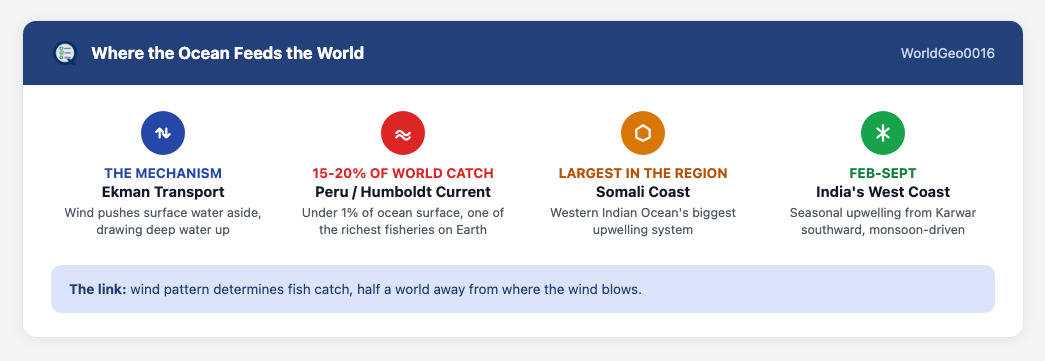
- The main driving mechanism is Ekman transport. Coastal winds push surface water offshore, and deeper water rises to replace it.
- The Peru/Humboldt Current upwelling zone covers under 1% of the world’s ocean surface. It still supplies 15-20% of the global marine fish catch.
- The Somali coast hosts the largest upwelling system in the Western Indian Ocean, and ranks fifth globally by importance.
- India’s west coast, from Karwar southward, sees seasonal upwelling from February through August or September, tied to the southwest monsoon.
Good to Know
- India’s west coast upwelling is driven by the Findlater Jet, a strong low-level wind stream blowing during the summer monsoon at 10-12 metres per second.
- Wind-driven upwelling works through two related processes. Ekman transport moves water horizontally; Ekman pumping causes vertical suction from wind-stress patterns.
- Coastal upwelling zones make up a tiny share of total ocean area. Yet they form the foundation of some of the world’s most productive fisheries.
Test Yourself


Great to Know
- Upwelling zones show how a purely physical process can shape an economy. Wind pattern and Earth’s rotation, not just fish stock or fishing effort, determine where an industry thrives.
- The Peru/Humboldt system’s productivity relative to its tiny area illustrates a broader oceanographic pattern. Nutrient supply, not surface area, is what drives fishery output.
- India’s monsoon-linked upwelling ties the country’s own weather system directly to its west-coast fishing economy. These are two systems that might otherwise seem unrelated.
- Upwelling depends on consistent wind patterns. Disruptions to those patterns, from climate shifts to El Niño events, can directly threaten fisheries far from where the wind itself changes.
Beyond the answer
Browse all world-geography topics →
📚 Keep reading
WorldGeo0003 — Oceanography and World Regional GeographyUPSC CSP 2021 — General Studies Paper I (Full Question Paper)IndEco0210 — Renewable Energy in IndiaUPSC CSP 2024 — General Studies Paper I (Full Question Paper)WorldGeo0002 — Climatology: Atmosphere, Weather and Climate❓ Practice this topic
D0095 — Where and when are small tornadoes most often reported in India?D0094 — Which statement correctly distinguishes a tornado from a tropical cyclone?D0093 — Why do the majority of the world's tornadoes form around the Gulf of Mexico?D0092 — On what basis does the Enhanced Fujita (EF) scale rate the intensity of a tornado?🎲 Take a World Geography Quiz
Leave a Reply