A king ruled an empire so large that no single official could watch it all. So Chandragupta Maurya built an empire of watchers instead. Spies disguised as monks reported on his own ministers. Courts split civil disputes from criminal ones. A council advised him, with no fixed size at all. This system held together one of the largest empires ancient India ever saw.


Chandragupta Maurya built this administrative system after founding the empire. Read more: AncHist0013 — The Mauryan Empire: Chandragupta Maurya. Much of what we know about it comes from Kautilya’s Arthashastra. Read more: AncHist0106 — Kautilya’s Arthashastra: Statecraft and Political Theory.
Provincial Structure
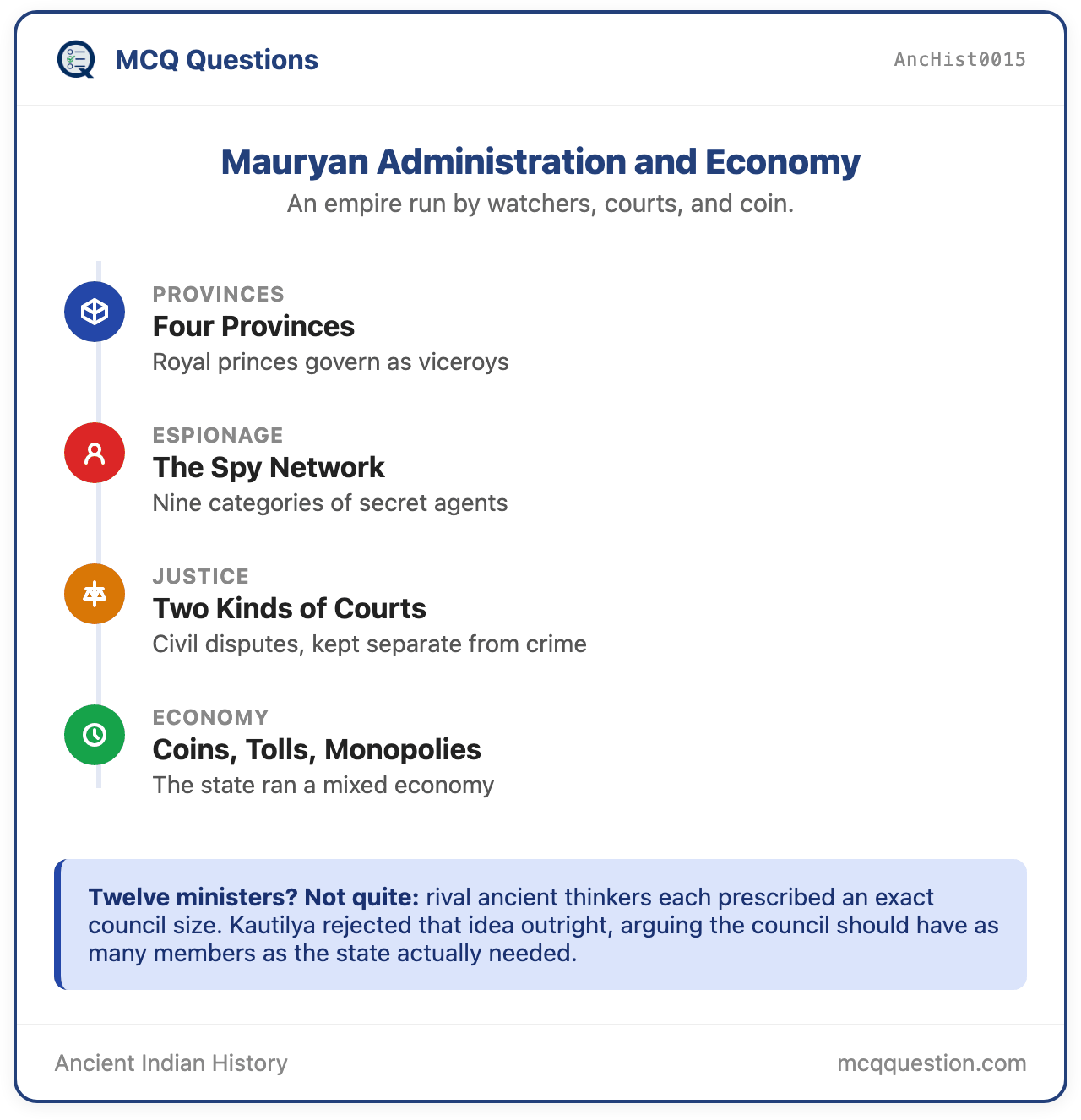
- The empire was split into four provinces, beyond the core region around the capital, Pataliputra.
- The Four Uttarapatha (capital Taxila), Avantiratha (capital Ujjain), Dakshinapatha (capital Suvarnagiri), and Prachyapatha (capital Tosali, in conquered Kalinga territory).
- Governance Each province was governed by a Kumara, a prince of royal blood acting as viceroy. A council of senior officials, called Mahamatyas, assisted him. Buddhist tradition holds that Ashoka himself served as a young viceroy, at Ujjain and Taxila, before he became emperor. Read more: AncHist0014 — Ashoka and His Edicts.
- Districts Provinces were further divided into districts, called ahara or vishaya. A Pradeshika headed the district. Rajukas measured land and administered justice there, assisted by clerical officers called Yuktas. Ashokan inscriptions name all three as district-level officers.
The Spy Network
- The Arthashastra describes a detailed network of spies, split into two broad types. Sanstha spies stayed in one fixed post, blending permanently into local life. Sanchara spies travelled from place to place, gathering intelligence on the move.
- Disguises A Kapatika posed as a sharp student, and an Udasthita posed as a wandering recluse. A Vaidehaka posed as a merchant, checking trade quality and tax collection.
- Purpose These agents watched officials for disloyalty or corruption. They also tracked public sentiment, army morale, and the doings of foreign courts.
Two Kinds of Courts
- Dharmasthiya Courts handled civil disputes, like inheritance, debt, and marriage.
- Kantakashodhana Courts handled criminal matters instead, literally “removing the thorns” of corruption and crime from society.
- Final Appeal The king himself sat as the final court of appeal, above every provincial and district court in the system.
The Mantriparishad
- Amatyas All senior officials in the empire were called this — a broad class covering most of the civil service. From among the most trusted Amatyas, the king drew a smaller inner circle of ministers, forming the Mantriparishad, or council of ministers.
- Rival Views Ancient thinkers set exact numbers for this council. The Manu school said twelve members; Brihaspati said sixteen; Usanas said twenty. Kautilya explicitly rejected a fixed number, arguing the council should have as many members as the state’s actual needs required.
- Role The Mantriparishad advised the king on major policy and crises, making it the practical, working core of the “Amatya” limb in the Saptanga theory of the state.
Guilds
- Outside government, traders and artisans organised themselves into guilds, called Shrenis. Each guild elected its own head and regulated prices, quality, and training within its own trade.
- These guilds gave ordinary people real economic organisation, alongside the state’s own bureaucracy. Read more: AncHist0071 — Life of the People in the Mauryan Empire.
Test Yourself

Coinage and Trade
- Karshapana The main Mauryan coin was this punch-marked silver coin, weighing roughly 3.4 to 3.6 grams. Smaller copper coins covered petty transactions.
- Monopolies The state held direct monopolies over several sectors: mining, salt, and forest products, plus liquor through an officer called the Suradhyaksha.
- Textiles Production was overseen by the Sutradhyaksha, working alongside officials who checked weights and measures. Most other trade stayed in the hands of private guilds.
Revenue and Decline
- Bhaga The king’s share of farm produce is commonly cited as one-sixth. The Arthashastra itself describes a graduated water rate instead, from a fifth of produce for hand-watered land up to a third for land using mechanical lifts. The flat one-sixth figure actually comes from a different, later text. Read more: AncHist0070 — Agriculture and Land Revenue in the Mauryan Empire.
- Shulka A separate toll taxed trade goods moving through the empire, at city gates, ferries, and checkpoints.
- Revenue Officers The Samaharta, or Chief Collector of Revenue, oversaw assessment and collection across the whole empire. The Sannidhata, or Treasurer, then stored and guarded what was collected.
- Decline This entire system, spies, courts, coinage, and all, eventually broke down from within. The last Mauryan emperor, Brihadratha, was overthrown by his own general. Read more: AncHist0073 — Later Mauryan Kings and the Decline of the Empire.
Officials at a Glance
A quick reference for every official named above.
| Title | Role / Responsibility | Level |
|---|---|---|
| Kumara | Prince of royal blood, governed a province as viceroy | Provincial |
| Mahamatya | Senior official on the council that assisted a Kumara | Provincial |
| Pradeshika | Headed a district, overseeing law and order and revenue | Provincial (district) |
| Rajuka | Measured land and administered justice in a district | Provincial (district) |
| Yukta | Clerical officer, assisted the Rajuka with records | Provincial (district) |
| Amatya | Broad class covering most senior civil servants | Central |
| Mantriparishad member | Sat on the king’s inner council of trusted ministers | Central |
| Sanstha (spy) | Stationary agent, permanently embedded at one post | Central (spy network) |
| Sanchara (spy) | Travelling agent, gathered intelligence on the move | Central (spy network) |
| Dharmasthiya judge | Presided over civil-dispute courts (inheritance, debt, marriage) | Central and provincial |
| Kantakashodhana judge | Presided over criminal courts, tackling corruption and crime | Central and provincial |
| Samaharta | Chief Collector of Revenue, oversaw assessment and collection empire-wide | Central |
| Sannidhata | Treasurer, stored and guarded collected revenue | Central |
| Suradhyaksha | Superintendent of the state’s liquor monopoly | Central |
| Sutradhyaksha | Superintendent overseeing textile production | Central |
Previous Year Question
Asked as: “Ashokan inscriptions suggest that the ‘Pradeshika’, ‘Rajuka’ and ‘Yukta’ were important officers.” (UPSC CSP 2025, GS Paper I). View this question.
Beyond the answer
Browse all ancient-indian-history topics →
📚 Keep reading
AncHist0017 — Shungas, Satavahanas and KalingaAncHist0106 — Kautilya's Arthashastra: Statecraft and Political TheoryWarren Hastings: The First Governor-GeneralArtnCulture0033 — Mauryan Art and Architecture: Pillars, Palaces, and SculpturePolity0260 — Article 235 of the Constitution❓ Practice this topic
What can numismatics, the study of ancient coins, reveal about a ruler that other sources often cannot?The Prayag Prashasti, or Allahabad Pillar Inscription, is a Sanskrit eulogy composed by the court poet Harisena. Which Gupta emperor does it praise?Copper-plate grants, called tamra-patra, recorded land grants made by ancient Indian kings. What makes them especially valuable to historians?Carbon-14 dating is used to estimate the age of organic remains such as charcoal, wood or bone. Up to roughly how many years does it work reliably?🎲 Take a Ancient Indian History Quiz
Leave a Reply